










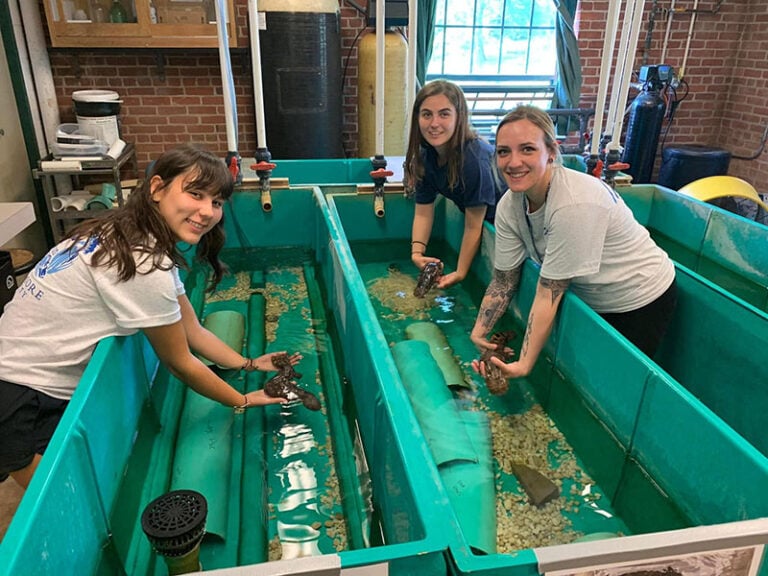




Thomas More University’s Biology Field Station was recently awarded two grants in recognition of its ongoing commitment to research and conservation along the Ohio River, including funding to support and protect the eastern hellbender, a rare and threatened species.
The eastern hellbender, North America’s largest salamander, is an indicator species whose presence indicates a healthy stream ecosystem. Unfortunately, their population has declined significantly throughout the species’ range.
As a result, the U.S. Fish and Wildlife Service recently announced a proposal to list the eastern hellbender as endangered under the Endangered Species Act. According to the Service, “Historically, eastern hellbenders have been documented in 626 populations. Recent data indicate only 371 of these populations (59%) remain. Among the remaining populations, only 45 (12%) are stable, 108 (29%) have an unknown recruitment status, and 218 (59%) are in decline.”
The Station was recently awarded a highly competitive $193,649 National Science Foundation grant through its Infrastructure Capacity for Biological Research Program, which “supports the implementation of, scaling of, or major improvements to research tools, products, and services that advance contemporary biology.”
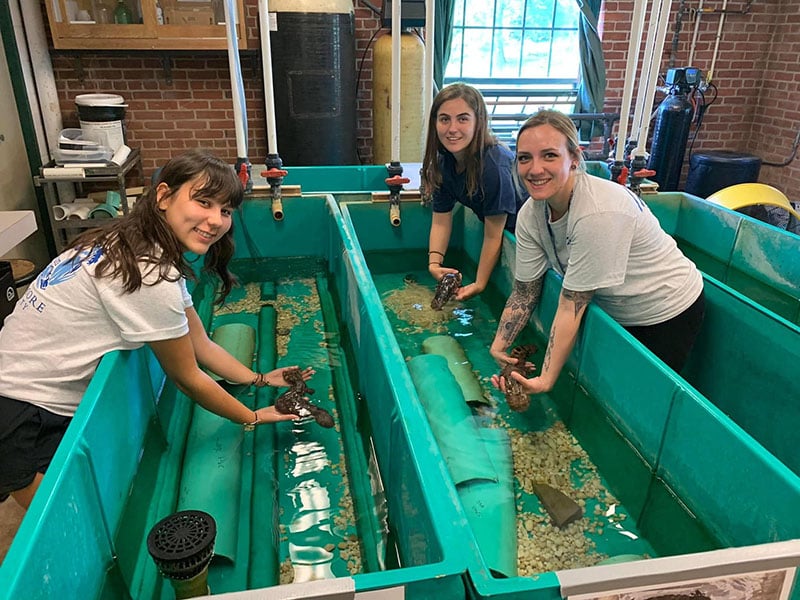
The NSF grant, coupled with another recent $7,500 grant from the National Wildlife Federation (NWF) and Mutual of Omaha’s Wild Kingdom, will support a major renovation of the Station’s aquaculture facilities and the establishment of a head-start program in partnership with Kentucky Fish and Wildlife.
“We are honored by this prestigious award and excited to increase our conservation work with eastern hellbenders,” said Chris Lorentz. Ph.D., Thomas More University Biology Field Station Director. “We’ve had adult hellbenders onsite since 2018, and they never fail to elicit positive reactions from young students to adults alike when they see this unique species up close. As a complement to the research, these outreach programs are critical to raising awareness about the unique biodiversity in our backyard and the conservation efforts to preserve species and ecosystems.”
Headstart programs collect eggs from the wild and rear them in captivity for several years before reintroducing them back to the wild, often increasing the chance of survival from 10% to 90%, thus having a significant positive impact on natural populations.
As the only active biology station along the Ohio river, the team aims to reverse this trend by bolstering natural populations of this imperiled species. Biology Field Station faculty, staff and students are excited to implement the NSF and NWF-funded projects and contribute to the conservation of eastern hellbenders.
The proposed renovations will upgrade an existing facility, increasing its capacity to hold up to 570 hellbenders at various life stages and enabling husbandry research to examine the optimal conditions and acceptable ranges in which hellbenders grow, thrive and survive.
The research findings will help produce best management practices and guidelines to be shared with the hellbender community of practice, including aquariums, zoos, governmental agencies and academic institutions.
“We have a long track record of partnerships and collaborations that advance our mutual interests in conservation and preservation of aquatic species,” added Lorentz. “Working with Kentucky Fish and Wildlife and others, including the Louisville Zoo, the Newport Aquarium, and Purdue University, will help meet the current needs to save this species from extinction.”
Beyond the science and research, the project will simultaneously enhance the Station’s K-12 STEM outreach programs. Hellbenders are a charismatic species that capture public attention and have widespread popular appeal, as evidenced by Kentucky’s recent adoption of the species as its state amphibian.
To learn more about the Thomas More University Biology Field Station, visit www.thomasmore.edu.
Thomas More University