














By Jennifer Elwell
University of Kentucky
White coveralls and tall boots are standard field gear for University of Kentucky research students as they drag white cloths and collect metal boxes at the Oran C. Little Research Center in Versailles.
These tools and tactics will provide better baseline data for tick species, their host animals and the impact on various land-use types in Kentucky through a research project primarily funded by the UK Student Sustainability Council.
The study will fill an information gap in the Commonwealth by focusing on the role of wild mice in tick life cycles, said Hannah Tiffin, Ph.D., the students’ research advisor and assistant UK Extension professor of veterinary entomology at the Martin-Gatton College of Agriculture, Food and Environment.
“A lot of our Northeastern and Mid-Atlantic states have that data already, but we’re still lacking a lot of that information,” Tiffin said. “We’re really trying to establish that baseline and see what ticks the mice are moving around because they’re really important in a lot of different ways for tick ecology.”
Tick surveillance and land use
Tiffin is a primary investigator on the SSC-funded project with co-investigator Matthew Springer, Ph.D., associate UK Extension professor of wildlife management in the Department of Forestry and Natural Resources, and Ashley Russo, a graduate research assistant in the Department of Entomology. Russo also received funding from the Promoting Excellence in Research for Kentucky program and the Karri Casner Environmental Sciences Fellowship to support her work and studies on the project.
Russo explained that one part of the research looks at tick species dispersal across different land-use types. They monitor four sites within Woodford County: the Oran C. Little Research Farm with mixed-use livestock pastures, the Buckley Wildlife Sanctuary, a private cattle farm and a private horse pasture.
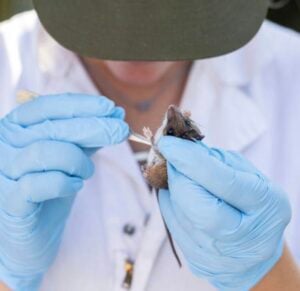
The research team uses different sampling methods to collect ticks at each location, including manually checking livestock, trapping and checking wild mice and artificial mouse nesting sites, and tick dragging, where ticks latch onto a white cloth dragged over pastures and vegetation.
The collected ticks are identified, then sent to a lab at Virginia Commonwealth University to determine whether they carry any disease-causing pathogens.
Testing mice and collection methods
Tiffin said trapping mice for tick surveillance matters for a few reasons.
“For one, they are just tick magnets,” Tiffin said. “They’re moving the ticks around in the environment, and there’s just a lot of mice. They’re generalist species, so you’re going to find them in a lot of places.”
Tiffin explained that mice move ticks from wilder areas into areas where they interact with people, animals and livestock.
“They also can harbor a lot of different pathogens,” Tiffin said. “The main one we think of when we’re thinking of mice is Lyme disease because they harbor Borrelia burgdorferi, which is the bacterium that causes Lyme disease. But they can harbor a whole bunch of other things and cause different diseases for humans and animals.”
Identifying ticks and the diseases they carry, according to Tiffin, requires a lot of time and specialized expertise.
Russo and Tiffin have trained several undergraduate students in wildlife handling, tick removal and tissue collection, and the team works quickly to reduce stress on the mice they capture in traditional metal Sherman traps. The team checks the traps in the morning and makes a second trip to each research location in the evening to bait and reset.
Multidisciplinary research and learning
Jason Killian, an environmental science major who transferred to UK to get more research experience, helps trap and process the mice Russo collects. He also manages 40 trail cameras across the four research sites to record additional wildlife and how they may impact mice and tick populations.
Erika Yurga, a preveterinary medicine junior, is a vector-borne disease intern for Tiffin’s Biting Insect and Tick Ecology (BITE) Lab, a position supported by the SSC grant. Her primary role for this research project is dragging the field locations and identifying the tick species found on the drags and mice.
The student team also includes BITE Lab student researcher Lily Tynan, who recently earned a bachelor’s degree in equine science and management, and wildlife ecology intern Carmen Tate, also supported by the SSC grant, who studies theatre and preveterinary medicine at UK.
“Through this experience, I have gained valuable skills and knowledge that have contributed to my personal and professional growth,” Tate said. “Working with a diverse range of animals and wildlife has allowed me to further explore and develop my interests as a preveterinary student at the University of Kentucky.”
For more information on tick disease and prevention, visit the BITE Lab website .