












By Jennifer Jahn
NKyTribune staff writer
For Christie Emerson’s daughters, the Kentucky Safe Teen Driving Challenge started with a Facebook post, a little parental encouragement and the possibility of winning some cash.
What it became was a lesson in how small choices behind the wheel can make a difference.
Emerson told her daughters about the statewide competition after seeing information about it online. Both were already conscientious drivers, but the prospect of earning a cash prize gave them another reason to take their good habits seriously.
“They were both motivated by the cash prize,” Emerson said.

The Kentucky Safe Teen Driving Challenge, administered by the Kentucky Transportation Cabinet’s Office of Highway Safety, is designed to encourage teens to make responsible decisions while driving. The 2026 challenge was open to Kentucky drivers ages 15 to 19 and used the DriveWell Go app, powered by Cambridge Mobile Telematics, to monitor driving behaviors.
The 2026 competition awarded $10,000 in total prizes, with $3,000 going to first place, followed by $2,500, $2,000, $1,500 and $1,000.
For the Emerson family, the competition became personal.
Emerson’s older daughter, Emily, participated when she was already licensed and driving independently. Her younger daughter, Haylee, had held her permit for only about three months when the competition began.
During the challenge, participants use the DriveWell Go app to track their driving. The app analyzes behaviors including speeding, hard braking, hard acceleration, harsh cornering, and phone distraction. The app provides feedback and an overall driving score.
For Emerson, that feedback offered something especially valuable as a parent: a glimpse into how her daughters drove when she wasn’t in the vehicle.
“One of the things I really liked about watching my daughters’ participation in the program was that in the case of my older daughter, Emily, who already had her license at the time of the contest, she was out on her own driving solo,” Emerson said.
When Emily returned home, the family could review the feedback from the app together.
“I knew that she was driving safely even when I wasn’t with her,” Emerson said.
For Haylee, the experience provided an opportunity to develop her skills as a newer driver.
Emerson watched her daughter improve some of the habits that can come with inexperience, including making smoother stops and navigating turns more fluidly.
“Over the course of the three months Haylee really showed growth and experience,” Emerson said.
The app’s scoring system is designed to make those behaviors visible.
The most important lesson for the Emerson sisters was not about the app at all. What they learned through the challenge, their mother said, was that being a safe driver also means maintaining good habits even when other drivers are not.
That can be particularly challenging for young drivers who are still gaining confidence. Emerson said other motorists sometimes honk when her daughters take their time at a traffic light or stop sign.
Her advice has been simple: ignore the impatient drivers and follow what they have been taught.
The family’s experience with the challenge has also extended beyond the competition itself.
After Emily won first place in 2025, Emerson spoke with a representative from Cambridge Mobile Telematics, the company behind the technology used by the challenge. The conversation prompted Emerson to wonder whether similar technology could be used by insurance companies to reward safe driving.
Eventually, the family found an insurance company that uses the technology to offer discounts based on driving habits. They signed up and earned the highest discount available through the program.
Emily once again had the family’s highest driving score.

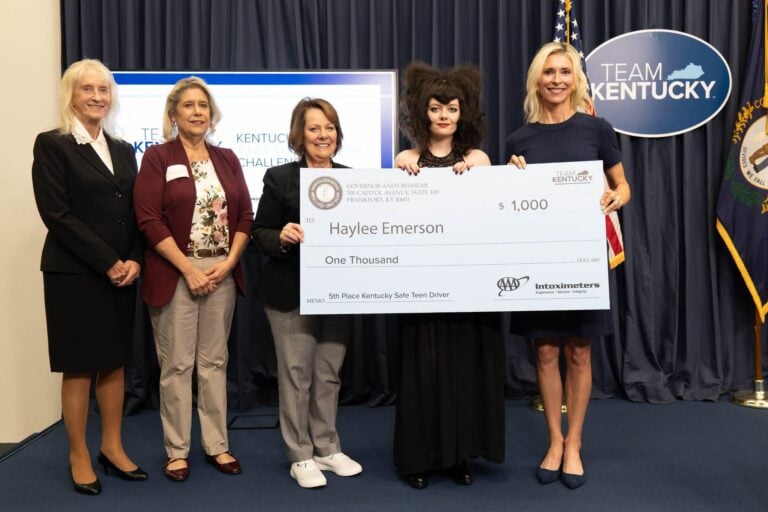
This year, Haylee added another accomplishment to the family’s safe-driving story. She finished fifth in the Kentucky Safe Teen Driving Challenge and received a $1,000 prize. The Kentucky Office of Highway Safety recognized her and four other top drivers at a September 2026 ceremony.
For Emerson, the competition demonstrates one way parents and communities can encourage teenagers to take driving seriously during a formative stage of their lives.
“I think the Kentucky Safe Teen Driving Challenge is a great way to motivate teens,” she said.
The financial incentive certainly caught her daughters’ attention, but Emerson believes the greater reward is helping young drivers develop habits that can stay with them long after the competition ends.
“What teen wouldn’t want to be rewarded thousands of dollars for doing what they should be doing behind the wheel anyway?” she said.
The Kentucky Safe Teen Driving Challenge uses competition and technology to make safe driving measurable, but the goal is ultimately much bigger than a leaderboard. The Office of Highway Safety says the program is intended to help teens build safer driving habits and reduce roadway injuries and fatalities.
For the Emerson family, it has also provided an opportunity for two sisters to grow in confidence behind the wheel while giving their parents another reason to talk about the importance of making good decisions on the road.