
















In December 2019, I watched a governor from my own party use one of the broadest powers in Kentucky government after voters had already rejected his bid for another term.
Former Gov. Matt Bevin issued more than 600 pardons and commutations during his final weeks in office. I was a Republican senator then, as I am now. His party label did not make those decisions easier to defend. It made it more important for Republicans to say plainly that some of them were wrong.
Many of the people who received clemency may have presented legitimate cases for mercy. That does not excuse the decisions that stunned Kentuckians and inflicted new pain on victims’ families.
Micah Schoettle, who had been convicted of raping a 9-year-old relative, was pardoned after serving 19 months of a 23-year sentence.
Patrick Baker had been convicted in state court of reckless homicide and other charges connected to the killing of Donald Mills. Bevin pardoned him. A federal jury later convicted Baker of murder in the same killing, and a federal judge sentenced him to 42 years in prison.
Those cases were not political abstractions. They involved victims, families, police investigations, prosecutors, judges and juries. One person set all of that aside after the election was over and just before leaving office.
That experience led me to file my first constitutional amendment on this issue in 2020. I have continued the effort ever since, not because I wanted to keep relitigating the Bevin administration but because his actions exposed a structural weakness that will remain until Kentuckians correct it.
This year, the General Assembly finally sent Senate Bill 10 to the voters. The Senate initially approved it 36-0. The House passed it 82-12, and the Senate concurred 36-1. Members of both parties agreed that the people of Kentucky should decide.
The Kentucky Constitution recognizes that government power ultimately belongs to the people. That principle must mean more than allowing voters to choose names on a ballot. It also means elected officials should remain answerable for how they use the authority entrusted to them.
A pardon or commutation is unlike most other executive decisions. A governor can use it to set aside a criminal conviction or alter a sentence reached through our justice system. That power serves a legitimate purpose, particularly when correcting an injustice. It is also an immense concentration of authority in one person.
Under our current Constitution, a governor can reserve that authority until voters are already casting ballots or until the election is over. An outgoing governor can then leave office without ever facing the voters’ judgment for those decisions.
That is the weakness this amendment addresses.
A yes vote would prohibit a governor from granting pardons or commuting sentences beginning 60 days before a gubernatorial election and continuing through the inauguration for that term. The governor would retain that authority during the rest of the four-year term.
The amendment does not abolish clemency. It does not allow legislators to decide individual cases. It does not prevent a governor from correcting an injustice or granting mercy when circumstances warrant it.
It establishes one boundary: Do not wait until electoral accountability has effectively disappeared.
Critics correctly describe clemency as a safety valve in an imperfect justice system. That is why I did not propose eliminating the power.
Hard cases will always deserve careful review. So do the hard facts of what happened in Kentucky in 2019. A legitimate concern about preserving clemency cannot justify ignoring documented abuses of that same power.
Others argue that Kentucky should simply elect governors with good judgment. We should. But constitutional government cannot depend entirely on the character of the person who happens to hold office. Our Constitution contains limits because every generation must prepare for officials who exercise poor judgment, place personal interests above public duty or abuse powers their predecessors handled responsibly.
This amendment is not a punishment for Matt Bevin. Constitutions look forward, not backward. His actions provide the clearest Kentucky example of why this safeguard is necessary, but the rule will apply equally to every future Republican and Democratic governor.
I have pursued this reform for seven years because I believe mercy and accountability can coexist. A governor should retain the power to correct an injustice. A governor should not be able to reserve that power for the moment when the people have lost their final opportunity to respond.
On Nov. 3, I am asking Kentuckians to vote yes. We can preserve executive clemency while ensuring no governor receives a consequence-free exit from office.
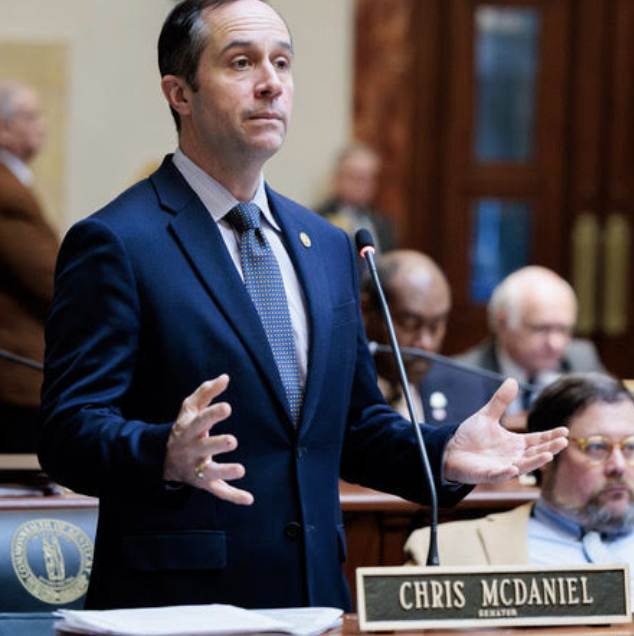
Chris McDaniel is State Senator for Kentucky’s 23rd District and an advocate for the only Constitutional Amendment on the November ballot.