















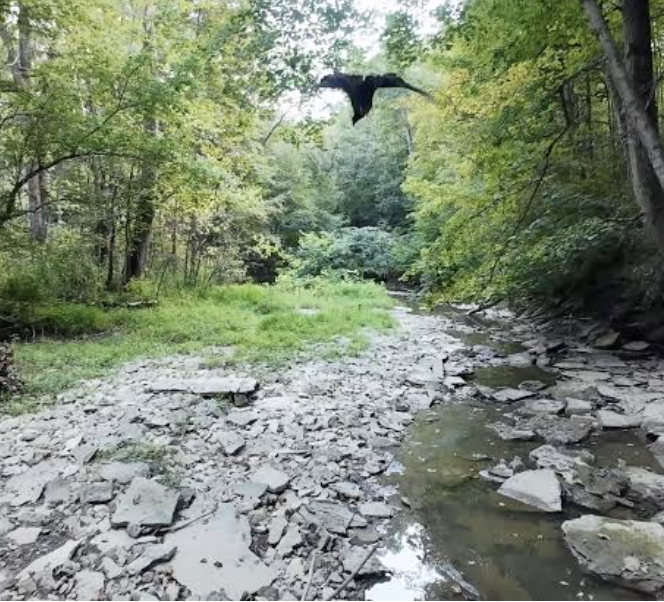
A thriving riparian ecosystem. A lush old-growth forest. A future Boone County nature preserve.
All of this stands to be destroyed if Northern Kentucky Sanitation District #1 (SD1) is allowed to proceed with its chosen route for Phase 4 of the Central Boone County Conveyance Project — a project required by the federal government to address sewer overflows, but one that residents now fear is being used to cater to large developers.
Gayle Pille — the naturalist and wildlife photographer at the center of the controversy — has spent the past 35 years doing what she loves most: caring for the natural world. Besides providing a haven for the wildlife that call her 45 acres home, she has spent countless hours and personal resources restoring her land, even planting over 1,000 native trees.
Her desire has always been, and still is, to donate her property to Cardinal Land Conservancy so that it can be enjoyed by generations of future Northern Kentuckians.
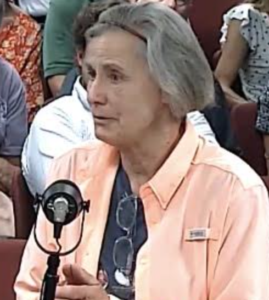
Then, five years ago, she received a letter from SD1 that threatened to ruin her dreams and her preserve. SD1 said it needed to acquire easements through her property for its sewer project. Its chosen route — Route B.2 — would cross back and forth along Woolper Creek, which winds its way for one mile through her land and directly behind her home.
Wanting to protect the creek and the forests surrounding it, Gayle told SD1 no.
What followed was a five-year court battle that resulted in SD1 being given the authority to use eminent domain to condemn portions of Gayle’s property. Not because the route it chose for the sewer— Route B.2— was determined to be the best, but because the court determined SD1 had the legal authority to take the land, regardless of whether a better alternative existed.
And better alternatives do exist. As a matter of fact, SD1’s own Hazen Report identified two feasible alternatives that had significant advantages. One in particular — Route B.3 — appeared to be the clear choice.
While Route B.2 was shown to require 31 creek crossings, affect 18 property owners, and have the highest risk of cost overruns, Route B.3 required only 13 crossings, affected just 3 property owners, and carried a significantly lower risk of cost overruns. SD1’s own tree analysis showed a whopping $1.59 million in replacement value for trees that would be lost on Gayle’s property alone, while Route B.3 went mostly through open land. Both routes were comparable in cost.
Woolper Creek was identified in earlier watershed studies conducted by the Boone County Conservation District, Boone County Fiscal Court, and SD1 as an environmentally important area in need of protection. Yet now SD1—in coordination with Boone County Fiscal Court — was fighting to wreak havoc along its banks. And not just on Gayle’s property, but along approximately five miles of the Woolper Creek corridor.
The damage was expected to be so extensive that the authors of the Hazen Report recommended eliminating Route B.2 from further consideration. A May 12, 2017 email documenting discussions between SD1 and Boone County even stated:
“Per our discussion and based on all available information at this time, a consensus was reached that Alternative B.3 is the best alternative for both SD1 and Boone County.”
Yet four years later, Route B.2 had been chosen and Route B.3 was buried, leaving myself and many other residents to ask, “Why B.2?”
Unfortunately, those at SD1 have failed to adequately answer that question. In response to our emails, they have claimed B.2 is better because it is a gravity sewer, reduces the need for pump stations, and serves future growth. Yet they have failed to provide any specific studies or additional analyses that led to the choice of B.2 over B.3, and often overlook the fact that Route B.3 is also a gravity sewer and Route B.2 also requires a pump station. What’s more, SD1 Chief Engineer Lydia Watkins testified in court that the only property Route B.2 opens up for development that Route B.3 does not is Gayle Pille’s property.
So we continued asking, “Why B.2?”
While trying to answer that question, we discovered that hundreds of acres of undeveloped Arlinghaus Builders property lie along Route B.2, not too far north of Gayle’s nature preserve. Public records show that Arlinghaus granted SD1 easements on its property at no charge. While other property owners were trying to get a fair price for their property, Arlinghaus was willing to give its easements away, leaving us to wonder whether Route B.2 was chosen for developer convenience.
If Watkins’ testimony is true, and the Arlinghaus property can be developed with Route B.3, then was Route B.2 chosen to make it easier and less expensive for Arlinghaus to build its next subdivision?
Bob Schroder, Vice President of Arlinghaus Builders, served on SD1’s Board of Directors for approximately 12 years, from 2009 to December 2021, including serving as Board President during the period when Route B.2 was being advanced. Jill Bezold, a manager at Arlinghaus, now serves on the SD1 Board.
A large and growing community movement has taken shape, rallying to support Gayle, Woolper Creek, and private property rights. Seeking answers, we have requested numerous public records from SD1 but, so far, SD1 has been slow in releasing those records.
Wanting to hear directly from SD1’s Board, we requested that SD1 put this issue on its October 20th meeting agenda — a request SD1 denied. We asked that planning of the route be paused until further discussions could take place—a request SD1 denied. We asked to be told what was necessary for the route to be changed — a request SD1 denied.
We have also spoken numerous times before the Boone County Fiscal Court, but have received little to no support. Judge/Executive Gary Moore has repeatedly denied involvement in the sewer project, yet documents tell a different story. Besides the 2017 email mentioned above, SD1’s own planning records show that Boone County officials met with SD1 to discuss sewer routes and growth priorities. And the Kentucky Court of Appeals acknowledged that the sewer plan was developed in conjunction with the Boone County Fiscal Court. So why are our elected leaders now distancing themselves from a project they helped shape?
But even more disturbing was an email from SD1 Executive Director Adam Chaney to Boone County Administrator Matthew Webster, sent shortly after we first presented our concerns to the Boone County Fiscal Court. Chaney wrote, “We are not trying to give them any oxygen whatsoever with any kind of response.”
He accused our advocacy group of attempting to “bait members into getting involved” and added,
“I would caution Chet or anyone else not to take the bait.”
We are appalled that SD1’s Executive Director would characterize concerned residents asking legitimate questions as people who should be ignored—and that he would actively discourage our elected representatives from getting involved. These are our elected leaders, not SD1’s.
They should be listening to their constituents, not taking instructions from the very agency we
are questioning.
As of now, SD1 seems to have doubled down on its decision to use the most environmentally damaging route. The route that requires the greatest sacrifice from property owners. The route that threatens to destroy Gayle’s beautiful gift to Northern Kentucky. And the route that could possibly set a dangerous precedent.
After all, if private property can be taken for developer convenience, where does it end?
It’s Gayle’s property today, but whose tomorrow?
And that is why we are no longer simply asking, “Why B.2?” We are demanding, “Stop B.2!”
Jennifer Watts lives down the road from Gayle Pille and has joined hundreds of other nearby residents to ensure that Gayle’s altruistic dream becomes reality for generations to come.