




By Paul A. Tenkotte, PhD
Editor, Our Rich History
The United States presidential election of 1960 marked a turning point in American politics. The Democratic New Deal coalition was aging and showing increasing signs of strain, particularly in the formerly Solid South. At the same time, the Cold War between the United States and Soviet Union was intensifying, while the crusade for Black civil rights was moving to center stage in American political life. President Dwight D. Eisenhower’s vice president, Richard M. Nixon (1913–1994), emerged as the Republican nominee and campaigned as an experienced successor to the popular incumbent.
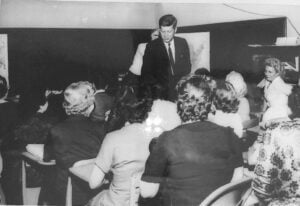
The Democrats nominated U.S. Senator John F. Kennedy (1917–1963) of Massachusetts, who, at just 43 years old, embodied the energy, optimism, and generational change that would become central themes of his campaign.
However, Kennedy faced a significant political obstacle: he was a Roman Catholic, and no Catholic had ever been elected president of the United States.
Anticipation surrounding Kennedy’s visit to Covington was steadily building. On October 5, the “Kentucky Post” underscored the historic significance of his forthcoming appearance:
“Older residents observed that, aside from a brief public appearance of Adlai Stevenson on the Covington City Hall steps in 1956, Sen. Kennedy will be the first presidential nominee to make a major campaign speech in Covington since William Jennings Bryan about the turn of the century.” (“Stage Set for Visit of Senator Kennedy,”; “Kentucky Post,_; October 5, 1960, p. 2).
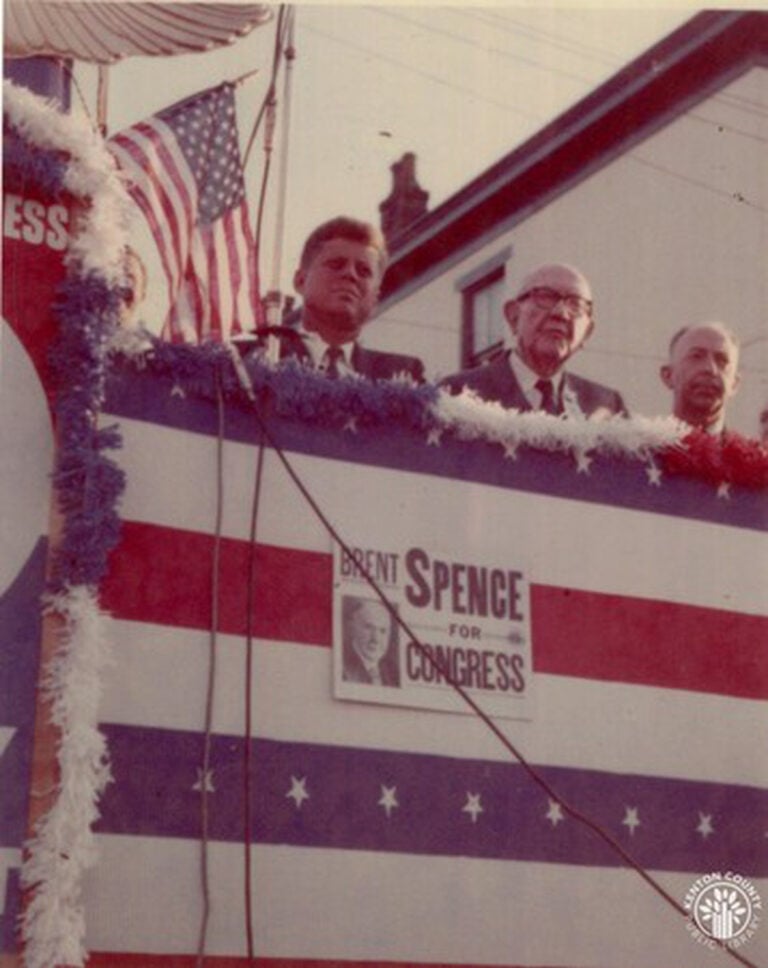
On Thursday, October 6, 1960, Kennedy brought his presidential campaign to Covington. The previous day, he had campaigned in Louisville, where more than 100,000 people reportedly gathered along the route of his motorcade. That evening, Kennedy flew toCincinnati, landing at Lunken Airport before spending the night at the Netherland Hilton Hotel in downtown Cincinnati.
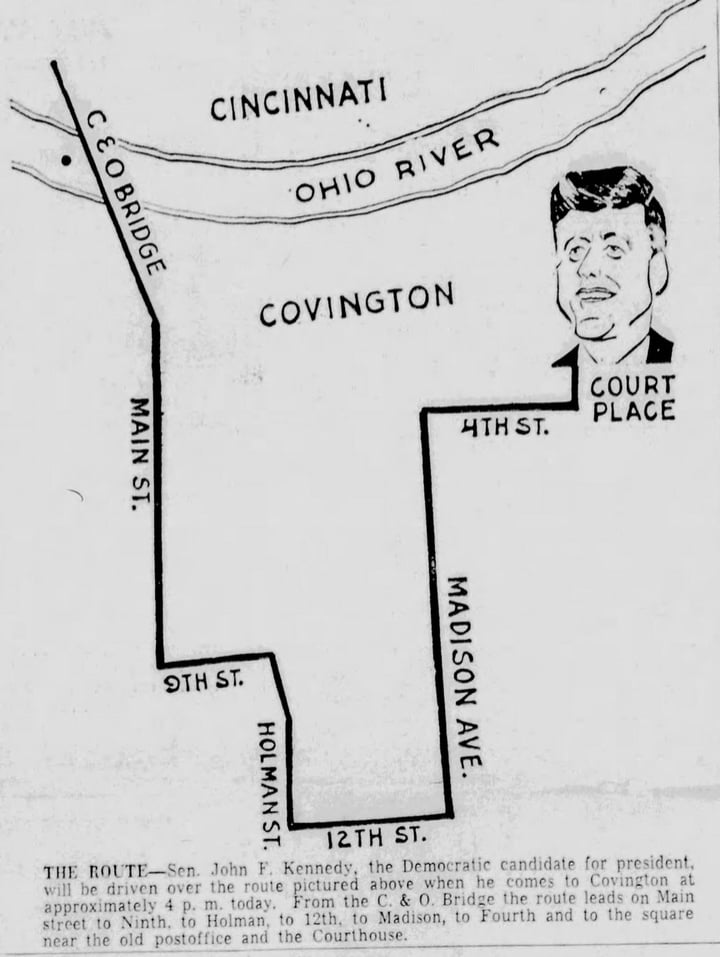
Plans originally called for Kennedy to cross the Ohio River via the C&O Highway Bridge at approximately 4 p.m. His itinerary changed, however, when he accepted an invitation to meet with three Gold Star Mothers, women who had lost children in service to the United States Armed Forces, in Newport, Kentucky. Kennedy then met with women of the Parent Teachers Association of Cote Brilliante School in Newport before crossing the Licking River into Covington. There, his motorcade joined a parade route at Fourth and Main Streets and proceeded along Ninth Street, Holman Street, and Madison Avenue before arriving at Park and Court Streets (“Kennedy Emphasizes Local Area in Talk,” “Kentucky Post,” October 7, 1960, p.1).
Thousands of Covington residents lined the streets along Kennedy’s motorcade route.
As the procession passed through the heart of downtown, the “Kentucky Post” described an unusual sight in Covington,” as “confetti flowed from building windows to the candidate’s party as the cars passed Sixth street and Madison avenue” (“Kentucky Post,” October 7, 1960, p. 5).
An estimated 13,000 people gathered to hear Kennedy’s speech in Covington.
Emphasizing the region’s potential importance in the presidential contest, Kennedy declared that the election “may be determined in Kentucky and Ohio.” He criticized the Republican administration for failing to address unemployment in Kentucky and the persistently low incomes of the state’s farmers. Kennedy also turned to industrial concerns, particularly relevant to neighboring Newport and its steel industry, warning that the nation’s steel plants were operating at only half their capacity (“Kentucky Post,” October 7, 1960, p. 1).
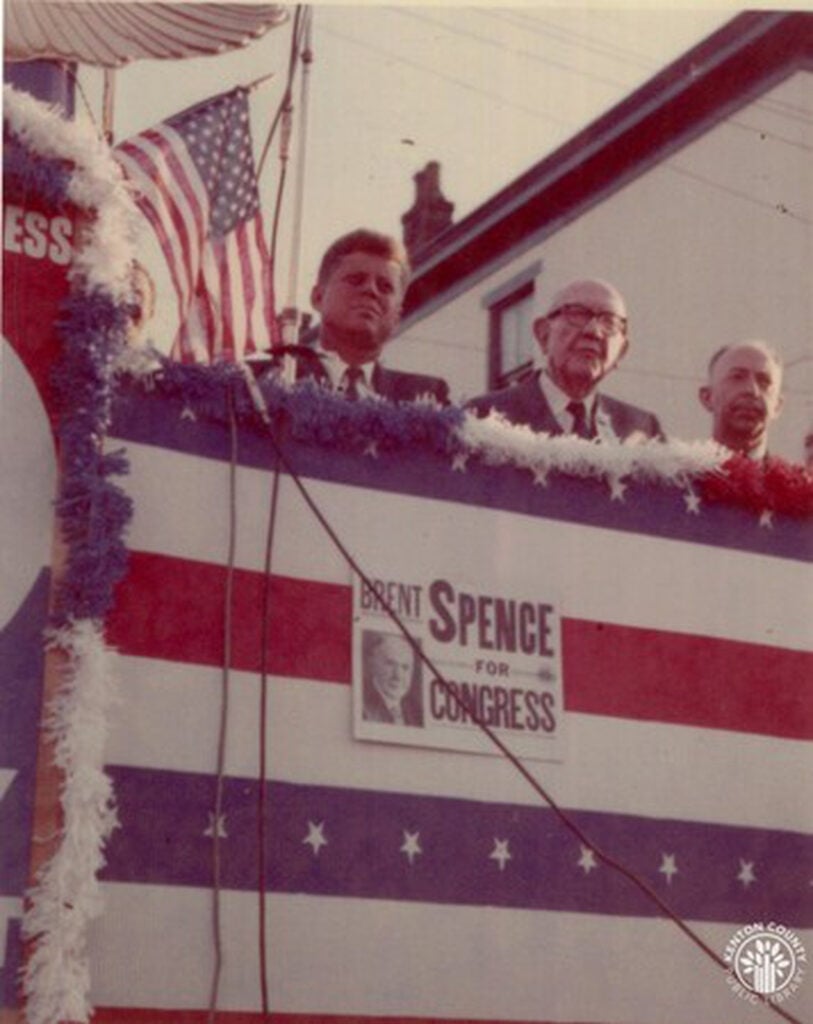
Kennedy also used his Covington appearance to bolster the campaigns of fellow Democrats Brent Spence (1874–1967) and Keen Johnson (1896–1970). Spence, a staunch New Deal Democrat, represented Northern Kentucky in the U.S. House of Representatives from 1931 to 1963. Johnson, a former governor of Kentucky, was seeking election to the U.S. Senate, which he subsequently lost to incumbent John Sherman Cooper (1901–1991). Kennedy’s speech was well received from the crowd. According to the “The Kentucky Post,” the audience “houted approval” when he said he could “see the rising sun. We are looking intothe beginning of a bright new day” (“Kennedy Emphasizes Local Area in Talk,” “Kentucky Post,” October 7, 1960, p. 1).
Following his speech in Covington, Kennedy crossed back into Cincinnati, where he delivered an address at Government Square and hosted a $100-per-plate fundraiser. By evening, he was back in Kentucky, continuing his campaign with stops in Lexington, Bowling Green, and Paducah. He concluded the trip by returning to Washington, D.C., on Saturday evening.
Kennedy’s visit to the Cincinnati and Northern Kentucky area may have persuaded some voters to support the Democratic ticket, but it was not enough to sway the majority. In Cincinnati’s Hamilton County, Nixon emerged victorious, as he did across the state of Ohio. The results were much the same across the Ohio River in Northern Kentucky. Nixon carried Covington’s Kenton County, Newport’s Campbell County, and then-rural Boone County, while also winning Kentucky as a whole. The results were somewhat informative, particularly given Cincinnati and Northern Kentucky’s status as Roman Catholic strongholds.
Nevertheless, Kennedy made history, becoming the first Roman Catholic to win the presidency. More than three decades after Al Smith’s defeat had demonstrated the formidable obstacles confronting a Catholic presidential candidate, Kennedy succeeded in overcoming them. His victory did not erase the nation’s long history of anti-Catholicism, but it weakened one of the remaining religious barriers to full participation in American political life. In that sense, the election of 1960 represented something larger than Kennedy himself—it reflected the gradual expansion of the American electorate’s conception of who could legitimately speak for, and ultimately lead, the nation.
Paul A. Tenkotte, PhD is Editor of the “Our Rich History” weekly series and Professor of History at Northern Kentucky University (NKU). To browse more than ten years of past columns, click here. Tenkotte also serves as Director of the ORVILLE Project (Ohio River Valley Innovation Library and Learning Engagement). For more information see https://orvillelearning.org/. He can be contacted at tenkottep@nku.edu.