





By Michael O’Bryant
Special to NKyTribune
Bartholomew Cavagna (1799–1889) arrived in Cincinnati without a ledger, but with the grit of a shipwrecked sailor and a promise made on a New Orleans dock. Born in Genoa, Italy, on Christmas Day in 1799, Cavagna spent his youth navigating the perils of the sea. After surviving a shipwreck in the Gulf of Mexico that washed him ashore in Cuba, he worked maritime routes until he saved enough capital to buy a small vessel transporting fruit from Havana to Louisiana.
In 1828, while unloading his cargo in New Orleans, a chance conversation with a Cincinnati commission merchant changed his trajectory. Impressed by the young man’s formidable work ethic, the merchant told him that if he ever made it upriver to Cincinnati, he would have a job waiting for him.
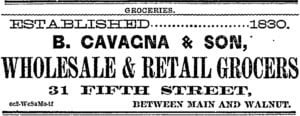
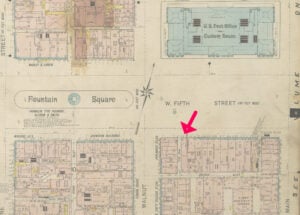
Cavagna arrived in Cincinnati in the late 1820’s. In 1830, he opened a modest grocery and dairy store on Fifth Street. The enterprise thrived, allowing him to purchase a larger building directly across the street next to the famous William Tell Coffeehouse, where he established both his permanent storefront and his home.
Public dining options in Cincinnati were scarce when Cavagna opened his doors. There were some elite “American Plan” hotels which had grand, communal dining halls featuring massive, multi-course meals served at strict, designated times. There were also select restaurants like the William Tell, the Broadway Exchange, and the St. Charles. For the ordinary worker, however, there were few alternatives to carrying a lunch from home or trekking back to their residence for lunch. Recognizing that local groceries frequently sold drinks to their customers, Cavagna saw an opportunity to supplement his income without the overhead of a formal dining room.
Behind an unassuming barricade of grain bags and stacked boxes, he engineered an ingenious culinary institution that bridged Victorian-era respectability with urban convenience.
Using a sturdy plank resting atop two barrels, he served an 1800s version of fast food consisting of coffee, sandwiches, cheese, crackers, cakes, and oyster stews. For just ten to twenty cents, patrons enjoyed their meals on genuine china, a civilized touch that contrasted pleasantly with the restaurant’s rustic setting.
This hidden backroom also offered something invaluable to Cincinnati’s elite: absolute discretion. Judges, lawyers, bankers, and insurance merchants whose prominent social standing —o r perhaps membership in a teetotaling religion — made entering a public saloon scandalous could slip into Cavagna’s place undetected. A daily ritual quickly took root.
Respectable men entered carrying empty market baskets under the guise of ordinary grocery shopping, slipping behind the barrier to refresh themselves with high-quality liquor and warm food. Sitting on No. 1 mackerel boxes and using barrels as tables, they discussed the news of the day before purchasing a few actual goods and departing with their dignity intact. If was said Cavagna’s back room attracted more famous Cincinnatians than any resort in the city, including Alphonso Taft, father of future President William Howard Taft (“Monkey John’s, “Cincinnati Commercial Tribune,” June 30, 1878, p. 1).
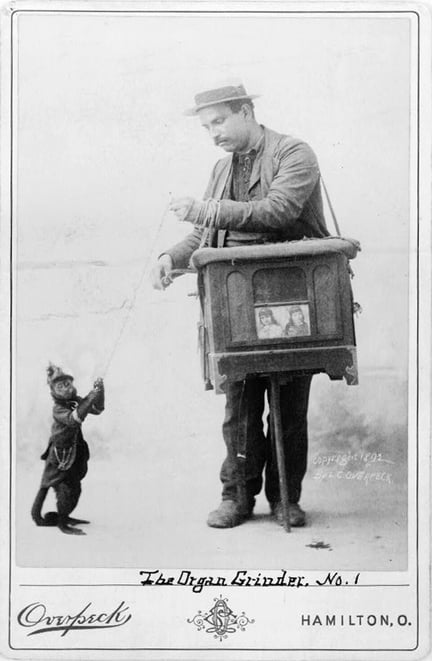
Working alongside his son John, who joined as a partner in 1867, Cavagna expanded the enterprise into one of the city’s largest groceries. He achieved immense financial success despite a total aversion to formal bookkeeping, opening a bank account only at his son’s insistence.
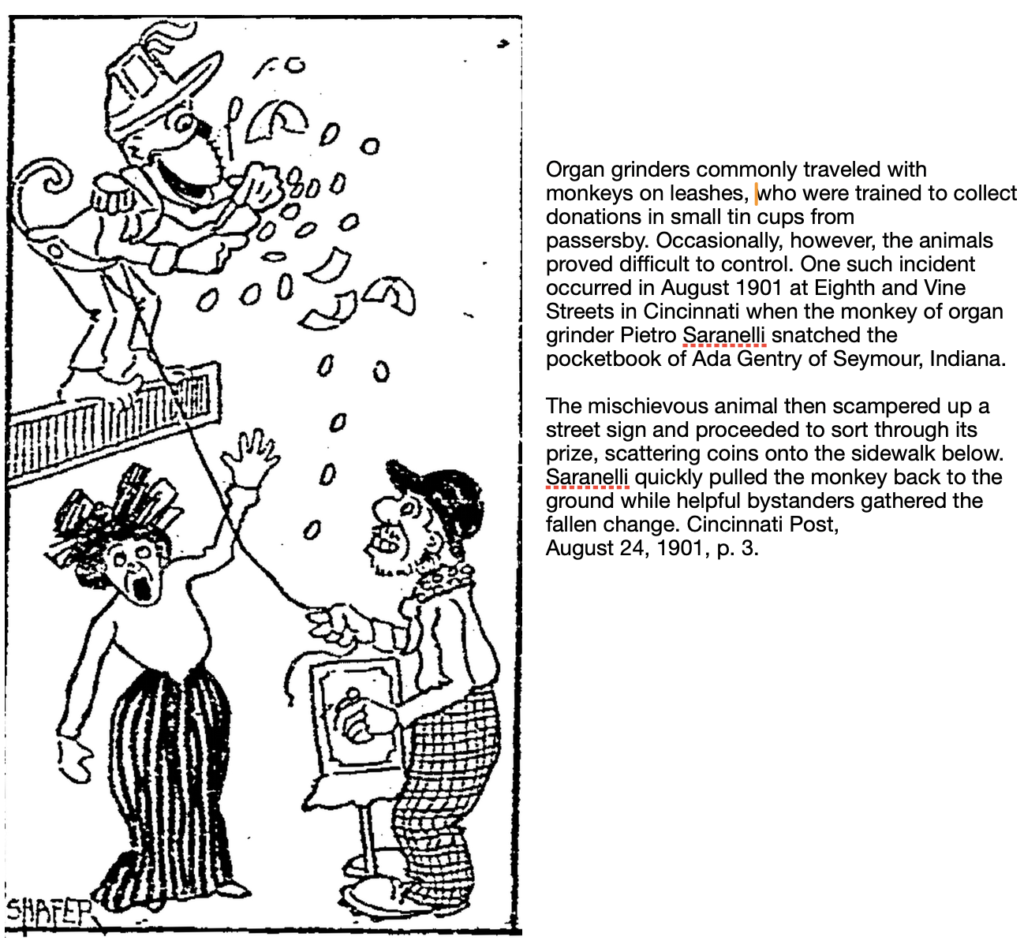
The vibrant social dynamic of Cavagna & Sons ultimately birthed a moniker that eclipsed Cavagna’s real name. As the business grew, the shop became a central gathering and lodging place for Italian immigrants, many of whom were street organ grinders—accompanied by monkeys — during the summer months. Through close association with these patrons, Bartholomew Cavagna became affectionately known to locals as”Monkey John.”
Though the physical building eventually grew shabby with age, it stood long enough to become a true Cincinnati landmark. Long after the sign above the door read Cavagna & Sons and the organ grinders had vanished from the streets, locals continued to call it Monkey John’s — a testament to an immigrant entrepreneur whose legacy outlived both his storefront and his name.
Michael O’Bryant was born in Dayton, Kentucky but grew up in Mason, Ohio, when it was still a farming community and the first day of rabbit hunting season was an unofficial local holiday. Earning his undergraduate degree in Education from the University of Cincinnati, he taught at Mason Public Schools, where he was asked to inaugurate their junior high football program. He later moved to the high school level, teaching English and Social Studies.
O’Bryant took temporary leave to attend Morehead State University where he served as an assistant track coach and earned his MA. Returning to Mason, he taught and served as an administrative assistant and Social Studies Curriculum Leader. For more than twenty years, he has worked in publishing, including Orange Frazer Press in Wilmington, Ohio, as well as the textbook company Cengage Publishing.
Paul A. Tenkotte, PhD is Editor of the “Our Rich History” weekly series and Professor of History at Northern Kentucky University (NKU). To browse more than ten years of past columns, click here. Tenkotte also serves as Director of the ORVILLE Project (Ohio River Valley Innovation Library and Learning Engagement). For more information see https://orvillelearning.org/. He can be contacted at tenkottep@nku.edu.