












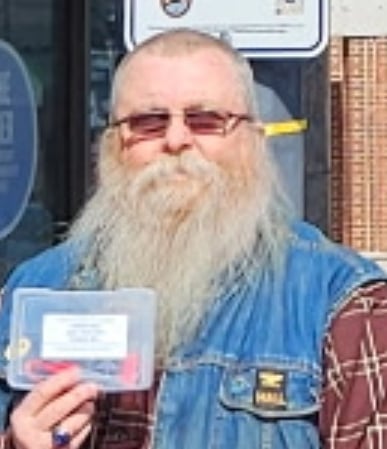
By John Schlipp
Special to NKyTribune
Soon after moving from Miamisburg, Ohio, to Northern Kentucky 30 years ago, I asked why Beggars Night was not being held on October 30th. The puzzled looks I received made me feel as though I had arrived from another planet. Around Dayton, Ohio, everyone knew that October 30th was Beggars Night — the evening dedicated to trick-or-treating — while Halloween on the 31st was typically reserved for parties and other celebrations. In Northern Kentucky, however, trick-or-treating generally took place on October 31st, while the mischievous night before was called “Cabbage Night.” However, Beggars Night and Cabbage Night were two completely different events.
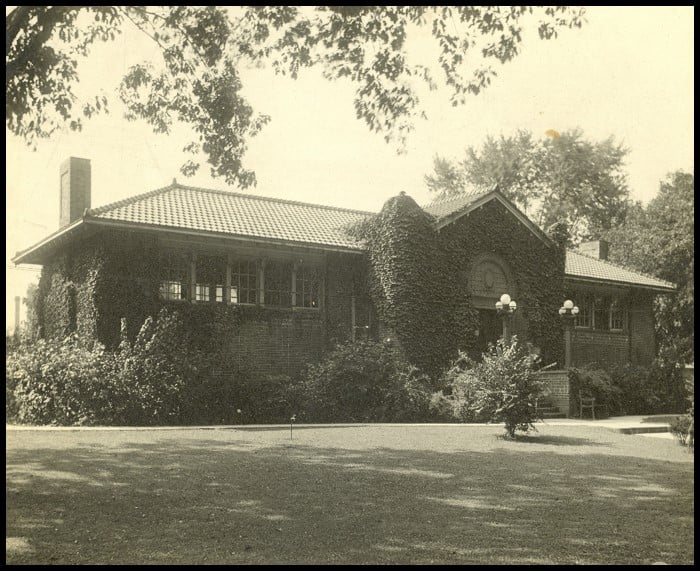
Years later, I became familiar with the many ghost stories associated with Covington’s historic Licking-Riverside neighborhood, including tales surrounding the Carneal-Gano-Southgate House. Those local legends brought back memories of my teenage years and my first job as a part-time library shelver in the historic Carnegie Library overlooking Library Park in Miamisburg, Ohio. There, amid the creaking floors, shadowed stacks, and rich local history, I encountered ghost stories of my own.
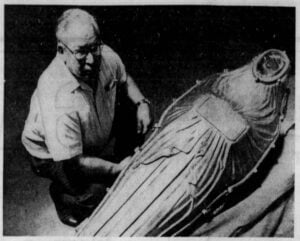
in Miamisburg’s Library Park. (Provided)
That beautiful Miamisburg park (renamed Veterans Memorial Park in 2020) offers mature trees, and sprawling sidewalks for people to stroll. It often hosted community events such as the Miamisburg Starving Artists Outdoor Arts & Crafts Fall Festival. The Carnegie building has served as the Miamisburg History Center and more recently transitioned to a site honoring veterans and first responders after the public library has moved twice to nearby facilities that are more accommodating for contemporary library patrons.
What a surprise it was to learn that the ground beneath my first library workplace in the park held stories considerably older, and more eccentric than any teenager could have imagined. Both library patrons and coworkers spoke of two pieces of local folklore that fascinated me:
• the legendary woman spirit in white, and
• the mysterious mummy whose coffin had quite literally been left behind when the cemetery moved.
For my boomer generation in Miamisburg, Halloween stories did not always begin with costumes. They might start with ghosts, goblins, graves, and a mysterious coffin that refused to leave Library Park.
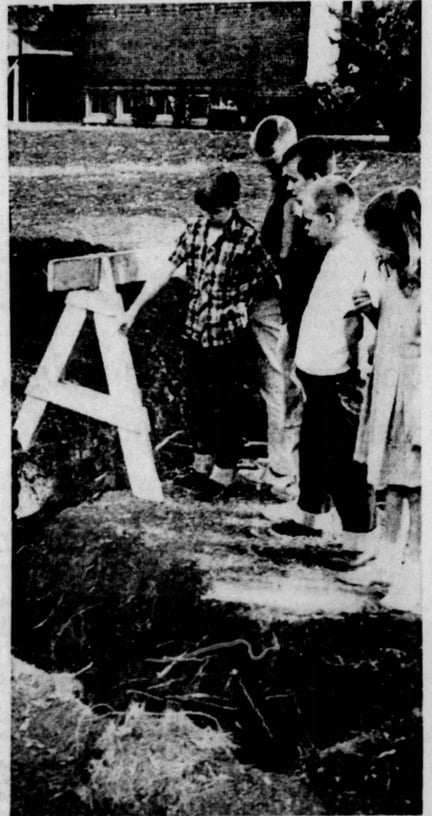
The Old Cemetery
Before it was Library Park, the site had been Miamisburg’s Village Cemetery. Among multiple earlier burial grounds it was eventually succeeded by Hillgrove Union Cemetery, established in 1863 on the rolling hills along East Central Avenue. One of Miamisburg’s founders, Dr. John Treon, was the first buyer of a plot in Hillgrove and has a prominent resting place on the grounds. The movement of burials from the earlier cemetery to Hillgrove provides an important historical backdrop to the ghost stories that came to surround the former graveyard.
The Carnegie library that later gave the park its familiar identity was built in 1910. But long before our generation knew the place as Library Park, Miamisburg residents knew the old cemetery for something altogether more unsettling: a ghost story that was making headlines by the spring of 1884.
Contemporary newspaper accounts from March 1884 reported an apparition described as a woman in white appearing in the cemetery, while crowds gathered in hopes of witnessing the mysterious figure for themselves.
Miamisburg’s woman in white spirit became something of a nineteenth-century media sensation, appearing in newspapers far beyond Ohio, from Kansas to Maryland. One particularly breathless account of the March 27, 1884, Frederick, Maryland “Daily News” carried the headline “REAL LIVE GHOST: A Graveyard Apparition that is Scaring a Western Town.” The newspaper claimed that “a thousand people” surrounded the Miamisburg graveyard nightly and reported that Mayor Marshall, the revenue collector, and other prominent citizens claimed to have seen the apparition. The mysterious figure “appeared to be a woman in white,” and on one extraordinary night, the paper reported, several hundred people armed with clubs and guns attempted to confront the specter.
The March 27, 1884, Maysville, Kentucky “Evening Bulletin” reported that the ghost “again made its appearance” in the old graveyard by the Short Line Depot. More significantly, the newspaper claimed the excitement was so considerable that residents were beginning to exhume bodies and that “the remains of three of the Nusz family were removed yesterday.”
The Kinsley, Kansas “Mercury” of April 5, 1884, reported that Miamisburg “claims an actual ghost” haunting the old graveyard near the railroad depot. According to the newspaper, Jacob Groby had struck the apparition with a club, while Henry Schomaker fired several shots at it, all “without avail.”
The “Mercury” then adopted a surprisingly compassionate tone, arguing that ghosts deserved to be treated “with kindness and respect,” including Miamisburg’s spectral visitor.
Whether the lady ghost actually existed is perhaps less important than the fact that generations of people believed she might. Those buried there were moved to the newer Hillgrove site. The park transformed into a community hub. Eventually a library arose nearby. But apparently, someone else had been overlooked.
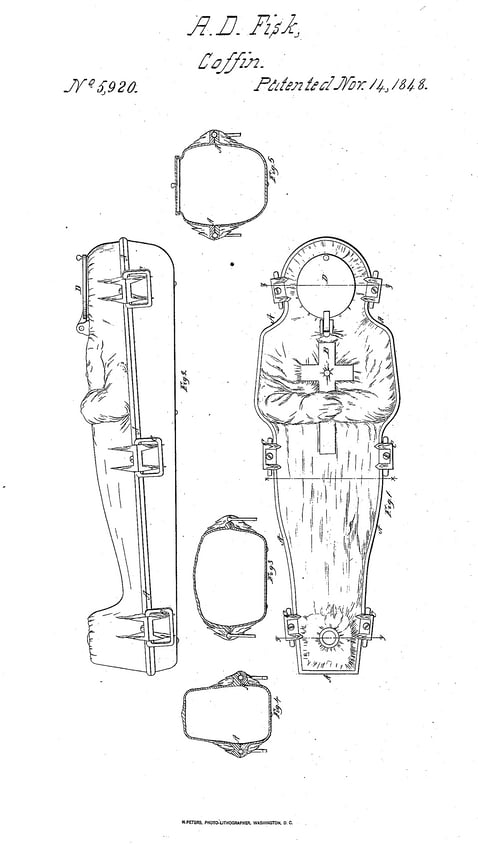
Patent Public Search database)
Eight decades later in 1964 …
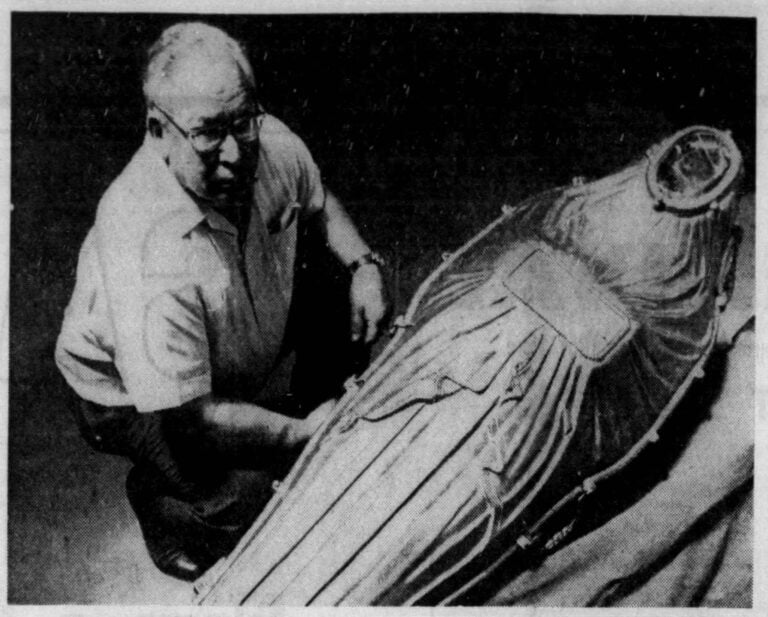
During a fountain restoration at Miamisburg’s Library Park, an unexpected link to the city’s past was discovered: a century-old cast-iron coffin containing remarkably preserved human remains. On October 17, 1964, the Dayton “Journal Herald” reported that a ditch digger working near Central Avenue had uncovered a cast-iron casket believed to be more than a century old. Mortician Richard Brough described the man’s body as “virtually mummified.” The remnants of an old-fashioned formal wing collar could still be seen. The mysterious burial was apparently overlooked when graves from the earlier cemetery were moved. This disinterred grave became a local curiosity that resurfaced as Library Park underwent improvements.
According to a June 21, 1965, Dayton “Daily News” report, the unidentified man was reburied to rest at the newly established Highland Memorial Cemetery (west of Miamisburg across the Great Miami River). The unidentified man soon became known as “Mr. X” and in later local lore as the “Coffin Dodger,” as reported in a Miamisburg’s Haunted History story by the Dayton “Daily News” on July 27, 2018. His unusual cast-iron burial case, described by the “Daily News” in 1965 as a “mummy shaped coffin,” added another layer of mystery to the Library Park’s unexpected visitor from the past. Whoever
Whoever he was, a man forgotten when a cemetery was moved had briefly become one of Miamisburg’s most intriguing residents more than a century after his death.
This exotic Egyptian looking cast-iron coffin displayed the following patent attribution mark:
A.D. FISK
NEW YORK
48
Nov
Patent
The casket patent attribution marking is verified in the USPTO Patent Public Search database as a U.S. Utility Patent 5920 “Improvement in Coffins.” It was granted to inventor Almond D. Fisk of New York, NY on November 14, 1848. The patent document describes the invention “as an Air-Tight Coffin of Cast or Raised metal … [with] a round plate of glass, cemented air-tight, over the face of the deceased.”
A recent conversation with school classmates on the Miamisburg Historical Society’s Facebook page revealed that our memories don’t always agree — and perhaps that is the best part of the story.
Some remembered walking past Library Park at night “to take a chance at seeing ghouls,” while others recalled haunted farm fields along Benner Road, ghost stories about an old historic home on Linden Avenue, and, of course, tales surrounding Miamisburg's Baum Opera House. As children, we found the boundaries between history, rumor, and imagination wonderfully blurred. The stories changed in the telling, but the thrill of believing that something might be out there remained remarkably consistent.
In daylight, the city park returned to ordinary life—a familiar gathering place with a history of its own. Once known as Library Park, today’s Veterans Memorial Park at 426 East Central Avenue has served generations of Miamisburg residents. A 1965 Dayton “Daily News” article celebrated the restoration of its historic fountain and a major community beautification effort. Today, the fountain and veterans memorials remain, while discussion of a possible “Central Park” identity offers another way to connect the park’s longstanding community role with its prominent location along East Central Avenue.
Whatever name it carries, the park remains part of Miamisburg’s shared memory: a place of civic pride, everyday encounters, and, for some of us, a little childhood mystery. The ghouls may never have appeared, but the stories — and the pleasure of remembering them together — have stayed with us.
I first encountered the intersection of history, memory and mystery as a teenager working at the Carnegie Library around Miamisburg’s Library Park. Years later as a degreed librarian, working at the Kenton County Public Library in Covington, I find echoes of those stories in my own historic neighborhood: Covington’s Licking Riverside which has its own tales of tragedy, scandal and the supernatural. Kenton County Public Library’s Local History and Genealogy staff has a proven track record of engaging the public through popular tours such as “Scandals & Mayhem”.
Good local history asks us to distinguish documented events from the legends that generations pass along. Perhaps that is the real attraction of ghost stories: they remind us that every familiar street, park and neighborhood has earlier lives beneath the one we know today. Click here to see upcoming Halloween events this year at KCPL.
John Schlipp is a Small Business and Career Navigator Librarian at Kenton County Public Library, specializing in business resources and intellectual property awareness. Contact John at
john.schlipp@kentonlibrary.org.
Paul A. Tenkotte, PhD is Editor of the “Our Rich History” weekly series and Professor of History at Northern Kentucky University (NKU). To browse past columns, click here.. Tenkotte also serves as Director of the ORVILLE Project (Ohio River Valley Innovation Library and Learning Engagement). For more information see https://orvillelearning.org/. He can be contacted at tenkottep@nku.edu.