
















By Steve Oldfield
NKyTribune staff writer
The USA Eagles men’s and women’s national rugby teams played games known as “friendlies” this past weekend in Nashville. The event was much larger than a day of rugby. It’s part of an overall strategy to build the game and create interest and excitement for when the World Cup comes to North America in 2031.
Music City is one of 27 cities that have applied to host a match. Cincinnati is also being considered for a share of the world’s third largest sporting event in terms of viewership and economic impact, behind FIFA World Cup Soccer and the Olympics.

“We are very excited about the potential of hosting a Rugby World Cup match in Cincy,” said Julie Kirkpatrick, president and CEO of MeetNKY. “That would be huge for the entire region.”
Kirkpatrick says that the economic benefit could be similar to Major League Baseball’s All-Star Game in 2015, which increased the region’s overall revenue by 15-percent from the previous year.
“The game created tremendous visitor demand in the region and brought close to 100,000 visitors,” she said.
While Greater Cincinnati and Nashville are competing with much larger cities on the coasts like New York, Boston, Los Angeles and San Francisco, some smaller cities have a definite place on the Rugby World Cup program.
“Mid-sized cities like Nashville and Cincinnati will be such a valuable addition to the World Cup should they be selected to host,” said Mick Hogan, managing director at MMG Sports Limited, and a consultant for World Rugby Annual Events. “The tournament needs a broad geographical spread of cities across the U.S. and mid-sized markets can mean that sports like rugby stand out more than in larger cities.”

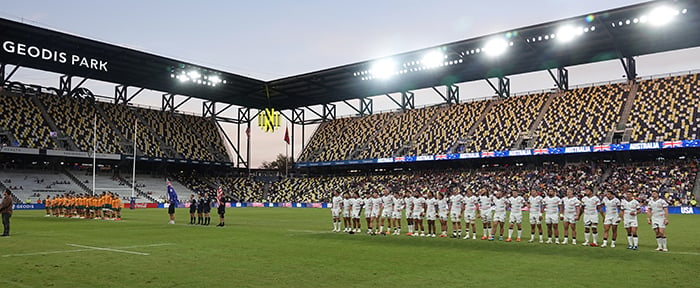
Nashville and Cincinnati also hold their own when it comes to a key consideration: having a large enough stadium with a grass field (known as a pitch in rugby). The cities sport two of the largest Major League Soccer stadiums in the country. Nashville’s Geodis Park has a capacity of just a little over 30,100 while FC-Cincinnati’s TQL Stadium can hold about 26,000 spectators.
Nashville’s venue, which has many similarities to TQL Stadium, scored high marks from the teams this weekend.
“The stadium is absolutely first class,” Hogan said. “The facilities for the fans, the players, broadcasters, sponsors and our staff are incredible.“
Geodis Park hosted a double-header. The men’s Eagles lost to Australia, 61-12. The women’s Eagles won their fifth straight game, defeating Italy 54-24.
“I love Nashville and this win means everything,” player Cass Bargell told fans after the game. “I’m just so proud of the way we’re growing and evolving every week.” That’s the goal behind staging international games across the country as well: growing the sport and building anticipation and excitement for the World Cup.
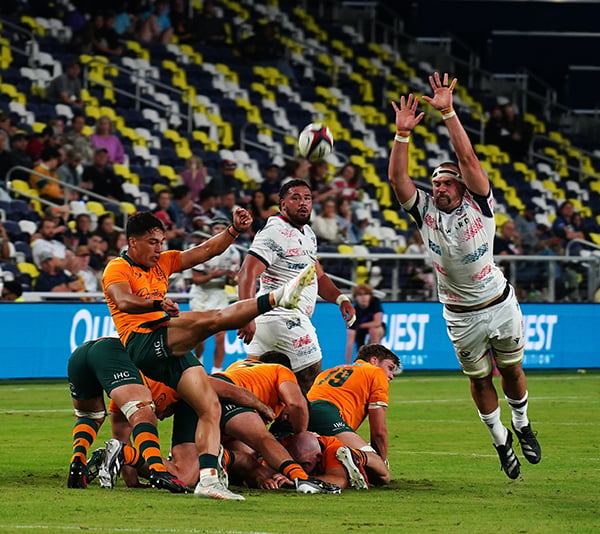
“Matches like this one are vital to the long-term planning for Rugby World Cup,” Hogan said. “They offer existing and new fans in the region the chance to experience international rugby.”
Nashville and Cincinnati are expected to soon find out if they will make the the final round of consideration to host the ultimate international rugby games: World Cup matches five years from now. An announcement about cities selected to move to the Candidate Phase is anticipated by the end of the year according to the World Rugby organization.
“Landing the Rugby World Cup in Cincinnati has a measurable impact, propelling us on a bigger stage,” Kirkpatrick said. “It will bring in new international travelers and support continued development at our region’s CVG International Airport. That will get our entire business and resident community excited to host.”