












By Howard Whiteman
Murray State University
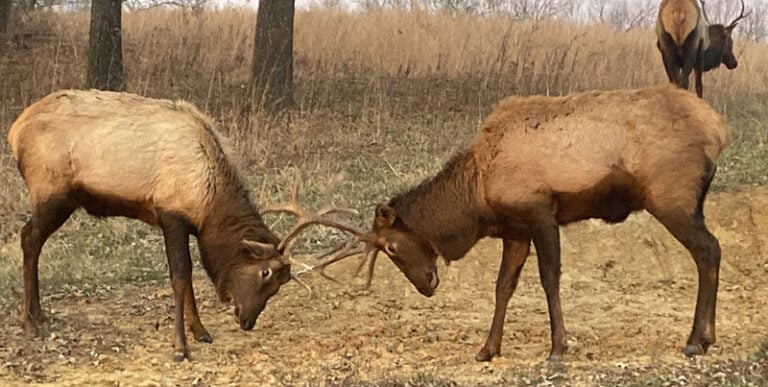
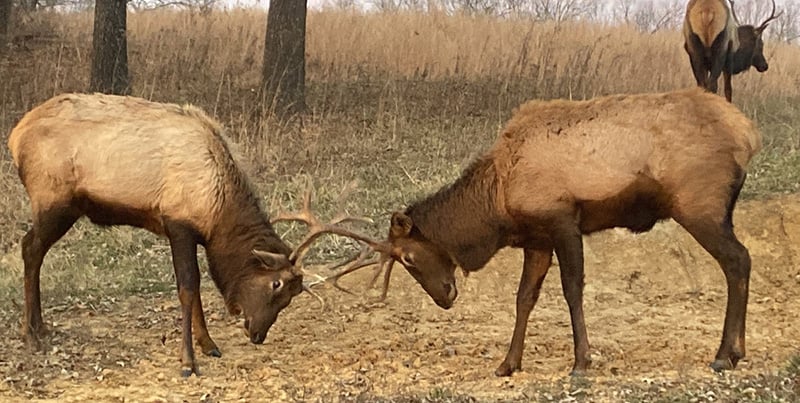
The two young bull elk were sparring right in front of us, only inches away. Back and forth they went across the road, as several other bulls looked on. They finally broke off from each other, and one bull circled us, rubbing his antler against the back of my car. That aging vehicle is tough as nails—you really can’t see the mark, although I wish you could. It would have been nice to have a free souvenir from the Elk and Bison Prairie. Given my proximity to the battle between two quarter-ton animals, though, I was happy to be safe within any vehicle.
As we continued our circle through the Prairie, we saw more elk, as well as the abundant bison, some wild turkeys, and a variety of songbirds. One of the main goals of the Elk and Bison Prairie is to promote native prairie plants, and there were plenty to see. Although there are times when the elk are hiding, we saw plenty that day, and the epic battle was a particularly good show.
The Elk and Bison Prairie (EBP) is an important place for visitors to the Land Between the Lakes (LBL) National Recreation Area to learn about the historic prairie and the animals that inhabited it. LBL, as you may know, is in western Kentucky and Tennessee, an area that most of us don’t think about as prairie country; we think about Kansas, Iowa, or Nebraska, but not Kentucky and Tennessee. Yet millions of acres of prairie once inhabited this region, including the Pennyroyal Plain, a 3.7 million-acre continuous expanse of tallgrass prairie that crossed both states, Kentucky’s Big Barrens region, and the Tennessee Grasslands, as well as scattered islands of prairie in other parts of the states. Less than 1% of those ecosystems are intact today, in part because of fire suppression and conversion to agriculture by European settlers. The 700-acre EBP is one of the few areas that have been restored into native prairie, both for educational purposes and to inspire future restorations.
We also don’t think about elk and bison being native to the area, but they were. LBL’s Trace—or more specifically, the Woodlands Trace National Scenic Byway, which is the main road going north and south through this peninsula of the Tennessee and Cumberland Rivers, is a “buffalo trace”, a historic migration path created by bison and used by the Native Americans that hunted them. There are several traces throughout Kentucky and Tennessee, one of which sits near the Buffalo Trace distillery, for those of you that are bourbon fans. Bison were extirpated from the eastern U.S. in the early 1800s. Similarly, elk are native to most of the eastern U.S., although the eastern elk subspecies was driven to extinction over a century ago. Yet like bison, we can find evidence of their historic presence throughout the east, with names like Elk County, Elkton, Elk Wallow, and Elk Creek.
To help preserve that history, the EBP was established in 1996 with the help of a variety of partners, including the Tennessee Valley Authority (TVA), who managed LBL at the time (it is a U.S. Forest Service (USFS) property now); the Friends of LBL, a non-profit organization that supports LBL; the Kentucky Department of Fish and Wildlife Resources; the Tennessee Wildlife Resources Agency, the Rocky Mountain Elk Foundation, a non-profit focused on elk conservation, and Parks Canada (the elk originally came from Canada).
Beyond the importance of EBP’s native prairie, another benefit of the EBP is its critical role in the restoration of wild elk in the eastern U.S. If you have seen elk in Great Smokey Mountains National Park, you have likely seen some of the descendants from the EBP. Other LBL elk were shipped to the North Cumberland Wildlife Management Area, just north of Knoxville, and most recently were used to establish a new population in West Virginia. Along with separate elk reintroduction efforts in Kentucky and Pennsylvania, the EBP has helped restore elk back into their native habitat, to the point that they are now managed for hunting in some states.
The importance of the EBP for eastern elk restoration is even greater today than when it started because of the spread of chronic wasting disease (CWD). This disease attacks elk and deer, and before it emerged it was easier to move elk from western states or even Canada to eastern ones. Now, with CWD spreading throughout the U.S., it is much more difficult. As a disease-free herd, the EBP plays an even more important role in efforts to reintroduce elk back into the wild.
Although this conservation success story was started with the help of many, it has been maintained by the strong partnership between TVA or USFS and the Friends of Land Between the Lakes. Two TVA biologists, Marcus Cope and Steve Bloemer, were co-project leaders on the initial establishment and management of EBP. Scott Ray managed the EBP during the transition from TVA to USFS, and most recently, Curtis Fowler has been the USFS EBP manager. All four of these wildlife biologists have done an amazing job over the years maintaining the EBP, and keeping the prairie, bison, and elk healthy, as well as ensuring the success of every elk restoration. They have been aided by the Bugle Corps, a group of Friends volunteers that monitors activities on the EBP every day and conducts outreach with the visitors that drive through the prairie, as well as helping with roundups and medical checks. The EBP’s conservation accomplishments are a direct result of the hard work of these and other TVA, USFS, and Friends staff and volunteers.
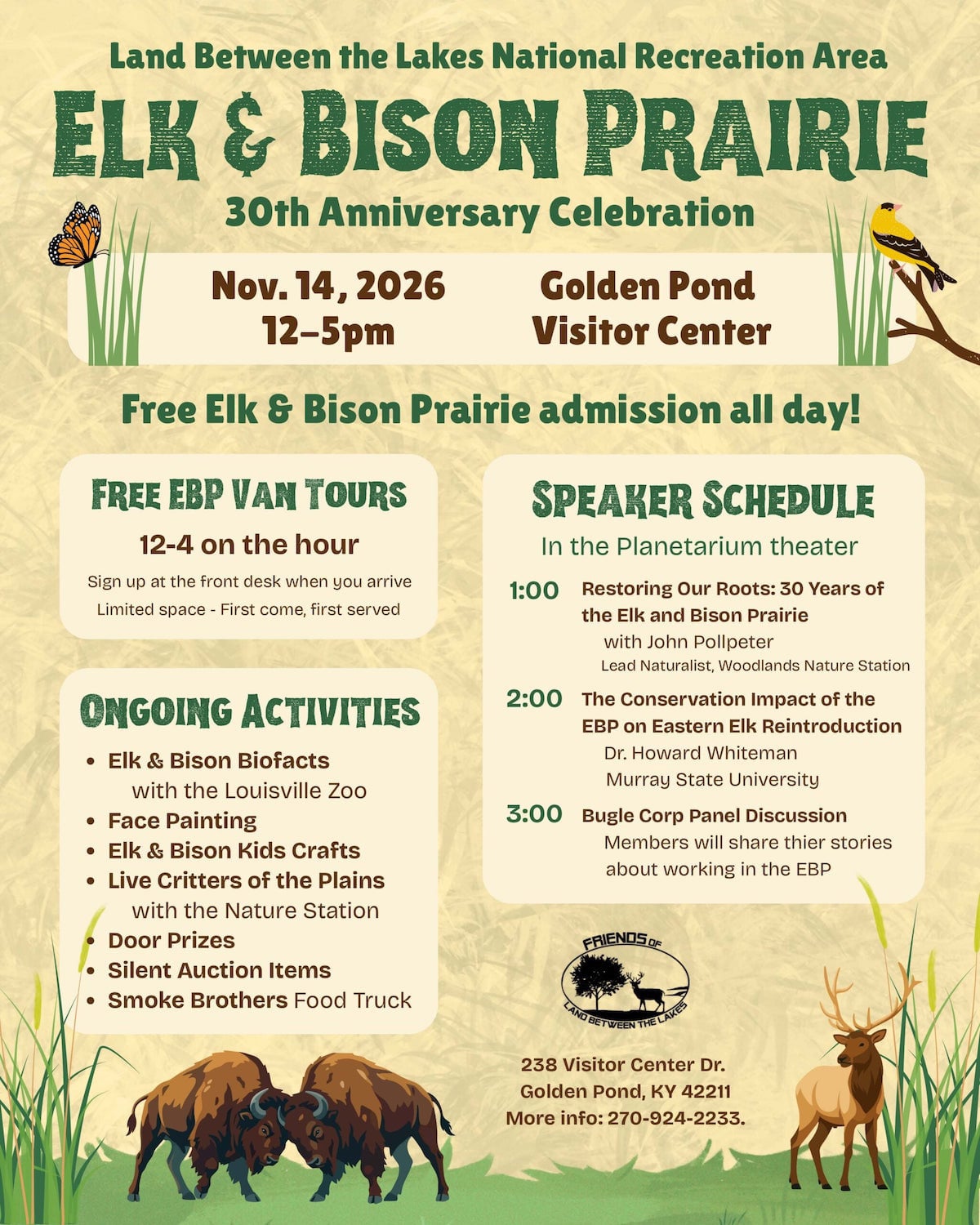
It is high time to commemorate this success story, as the EBP turns 30 years old this year. The Friends of LBL and the USFS are holding a 30th anniversary celebration from 12-5 on Saturday, November 14, at the Golden Pond Visitor Center. There will be free EBP admission all day, and free van tours of the prairie from 12-4 on a first come, first served basis. Ongoing activities include biofacts with the Louisville Zoo, face painting and crafts for kids, live prairie animals from the LBL Woodlands Nature Station, door prizes, a silent auction, and a Smoke Brothers food truck. At 1 p.m., John Pollpeter, lead naturalist at the Woodlands Nature Station, will be presenting “Restoring Our Roots: 30 Years of the Elk and Bison Prairie”. At 2 p.m., yours truly will be presenting “The Conservation Impact of EBP on Eastern Elk Restoration”. Finally, at 3:00 there will be a Panel Discussion, as Bugle Corps members will share their favorite EBP stories. All are welcome and invited to the celebration!
With all of the issues surrounding the environment in recent years, we don’t get enough opportunities to celebrate success stories. Here is a great opportunity, right in our own backyard, to celebrate a conservation icon. Let’s all take advantage of it, and use the positive energy to springboard future conservation efforts, for the prairie, elk, bison, and other living things, into the next 30 years. I sincerely hope to see you there, and if you are lucky, you will see two bulls sparring just like I did.
Dr. Howard Whiteman is the Commonwealth Endowed Chair of Environmental Studies and professor of Wildlife and Conservation Biology at Murray State University.