



















By Howard Whiteman
Murray State University
The voices call to me all day long, and sometimes long into the night. When I spend time
in the woods I cannot help but hear voices. Not the ones associated with the frayed ends
of sanity, though I imagine those are coming soon enough, but rather the voices of nature
that surround us.
It’s November, which is when I spend an inordinate amount of time in a tree stand while
hunting whitetail deer. Climbing up a tree in the pre-dawn stillness, I get myself situated for the morning voices. It often starts with a brown thrasher, the rooster of the woods that sometimes begins calling before the actual rooster that crows on a nearby farm.
Next, it’s the turkeys waking up—softly at first, with purrs and soft yelps, which
eventually may lead into a cavalcade of sound as they reassess their status and try to get
their day, and flock, in order. Occasionally, even a gobble or two comes off the roost,
rare for November or any other month not part of the spring breeding season.
Soon enough it is raucous crows, sometimes so loud they are the only voice I hear. But
many other birds join the fray as the day warms up. Chickadees, titmice, cardinals,
nuthatches, wrens and numerous warblers flit across the canopy, at eye level for me,
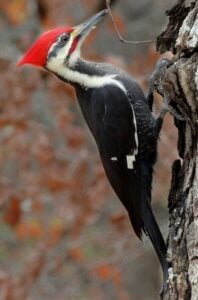
searching for insects, berries, or seeds. One of the loudest are the woodpeckers, who
voice their opinions both with calls and head banging. Pileated woodpeckers, the size of
crows, have one of the loudest voices in the forest, and are the heaviest of headbangers.
On occasion, a red-shouldered hawk passes silently through the forest, releasing scolding
voices from all of the squirrels that it did not make a meal of, and sometimes screaming
its own distinctive call in dismissive fashion. Then there are the owls—barred, great-
horned, and screech in my woods—that call more often than you would think during the
day, often single lonely hoots rather than their normal voice. Speaking of odd daytime
voices, I often hear male chorus frogs producing their distinct breeding calls, months
before a female is going to care, because there’s always a chance, right?
Above, it is the high-flying geese—Canada and snow, that honk their distinctive calls.
Sometimes a flock of mallards or teal will buzz over the treetops, looking for their next
landing spot with voices made both with bills and wings. The prehistoric call of a great
blue heron is so distinctive I don’t even have to look up. More rarely, flocks of sandhill
cranes make their voices heard, as they hone in on the local stopping point for their
annual migration.
Then there are the deer, the focus of my early-morning sits. Deer snorts, either at me,
other hunters, or other deer, wake me up from dozing. Occasionally I hear a deer sneeze,
and if I’m lucky the distracted tending grunts of a buck following a doe, a voice like no
other and music to my ears.
I almost always hear deer before I see them, but a lot of times it is not their vocalizations that warn me of their approach. There is nothing better than crunchy dry leaves to allow me to hear the voices of their feet, which are very distinctive and stark compared to the padding gait of a coyote. Of course, they are not the only species moving through the leaves and there are a lot of deer mimics. The squirrels that made it through the hawk gauntlet often convince me that they are deer with their busy scurrying on the forest floor, while using their real voice to scold me, their compatriots, that pesky hawk, or sometimes seemingly the sky itself. Similarly, the non-native climate migrants called armadillos are even more adept at deer mimicry than squirrels and really don’t seem to care how much noise they make, grunting as the search for insects and other morsels in the leaf duff.
As the day warms and the wind picks up, the trees creak their voice in response. The
wind itself has its own voice, while helping the trees find theirs, the volume of their
woody voice a great indicator of wind speed.
As people awaken, I hear sounds of humanity, the machinery of modern life, the car
engines, honks, slamming of doors, even an airplane or helicopter. All of it can drown out
the other voices, but there are pockets of nature between the occasional passing car or
truck. And of course, the sounds of humans include the local dogs, a busy rooster, and a
small herd of cows. But mostly I focus on the voices of the woods.
As evening comes, most voices become quiet, while others begin anew. The thrasher is
back, calling at last light just as he did at first, while the owls pick up, sometimes in
dramatic fashion if there is a territorial dispute. On warmer nights the insects begin
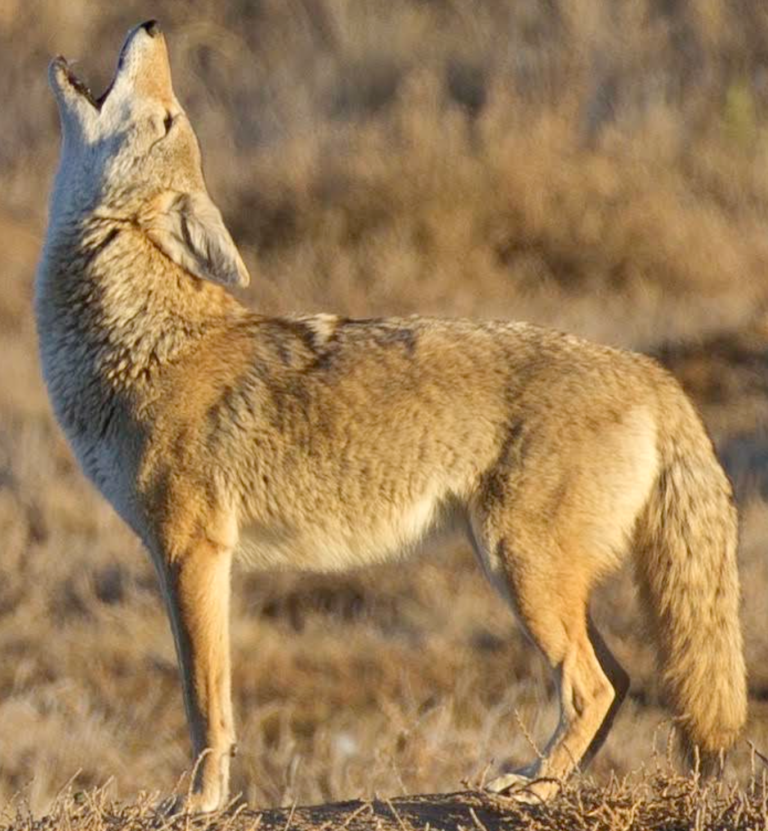
buzzing, thinking that perhaps winter is already over. The howls of coyotes are one of
my favorite evening voices, the call of the wild in the east for our generation, never to
replace the wolves that once ruled the eastern forest, as much as they may try. When the
coyotes howl, it is clear that the nighttime hunters have clocked in, and it is time for me to clock out.
The voices of nature remind us that, like in human communities, there are always a
diverse array of opinions. Like humans, those opinions are not universally shared in
nature, and there are conflicts, mistimed and mixed messages, and plenty of
miscommunication.
But what is also clear from nature is that none of these species ever stop talking, making
their voices heard, or listening. Neither should we.
Communication, whether in wildlife or humans, requires a sender and a receiver. If the
potential receiver isn’t tuned in, the message may get unnoticed, or, like a deer-
mimicking squirrel, we might receive faulty information. That may mean that the
volume has to increase, the message has to change, or that we have to repeat the message
over and over. It also means that some of us might have to listen more closely to all of
the voices coming our way.
The voices of nature don’t make any of our problems disappear. But they do provide
some relief during a time when the world sometimes seems to be standing on its head.
Maybe hearing voices will help you as it has helped me.
The voices I hear also provide inspiration. They remind me how important it is for
humans to hear and understand nature’s voice, so that we can appreciate and conserve it
for future generations.
For some people, a good book or immersion in music or an epic film provides similar
relief and inspiration. But to me, there is something special about the sounds of the forest on a crisp November morning, and the voices that are telling me so much and nothing at all, simultaneously.
Dr. Howard Whiteman is the Commonwealth Endowed Chair of Environmental Studies and professor in the Department of Biological Sciences at Murray State University.