

















Our representative democracy rests on a fundamental principle: We, the people, have a right to participate in decisions that affect us.
Since 2023, the League of Women Voters of Kentucky has published annual reports describing how Kentucky’s General Assembly weakens that principle by using fast-track maneuvers and undemocratic tactics that limit transparency and public participation.
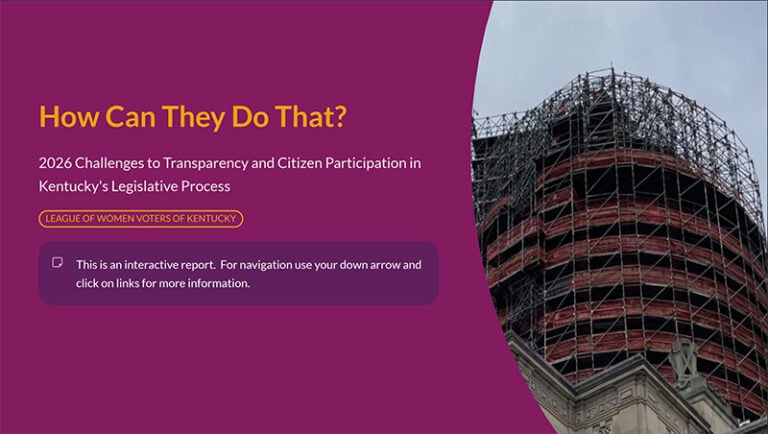
Has the legislative process improved since our first report? The answer is yes and no. In our latest report, How Can They Do That? 2026 Challenges to Transparency and Citizen Participation in Kentucky’s Legislative Process, our analysis shows improvement in two of the processes we monitor, and little or no change in other processes. We also note increased use of piggyback bills, reported for the first time this year. The report can be found at
lwvky.org/how-can-they-do-that.

Improvements occurred in these areas:
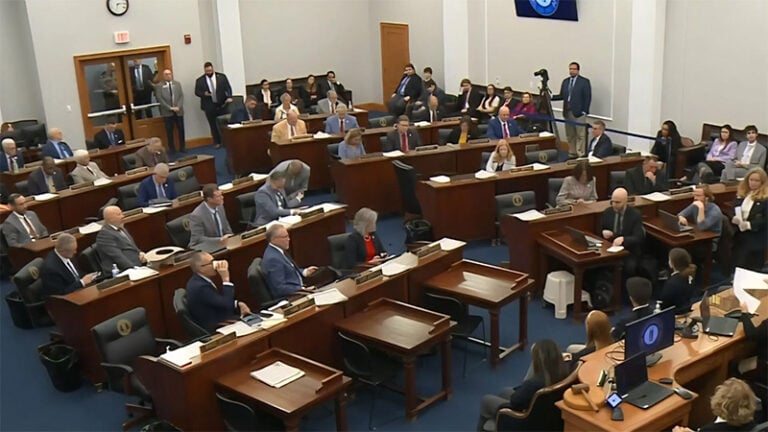
● Use of scheduled committee meeting times: Our past reports have shown that legislative committees often canceled scheduled meetings and then held “surprise” meetings on short notice, making it hard for the public to observe and participate. This situation improved in 2026, when committees held 90% of meetings at scheduled times, compared to 79% in 2024. The number of “surprise” meetings declined from 47 in 2024 to 28 in 2026.
● Journal of Proceedings: In the past, publication of the Constitutionally-mandated journals of legislative proceedings have lagged by as many as five years. Currently, however, published journals are complete through 2025.
Unfortunately, we saw little improvement in other processes that we have been monitoring.
Both the Senate and the House used fast-track maneuvers like early bill readings and last-minute committee substitutes to pass about 20 percent of all bills that became law in 2026, compared to one percent in 1998.
The legislature has also increased its use of shell bills and piggyback bills to dramatically alter the content of bills late in the session and rush them through the process too quickly for the public to understand and give input. In 2026, 145 shell bills were filed, compared to only 15 in 2010. Piggyback bills, which are prohibited by House and Senate Rules, had been declining for the past 10 years, but the number jumped back up to nearly 30 in 2026, reversing years of progress.
Going forward, we ask that the legislature ensure public participation by:
● Continuing to improve its use of scheduled committee meeting times to transact business, and publishing records of legislative actions promptly–including minutes of committee meetings (which are not consistently available during 60-day sessions).
● Limiting the use of fast-track maneuvers to emergency situations.
● Filing genuine bills rather than adding substantive content at the last minute through shell bills and piggyback bills.
● Bringing back a webpage for legislators to prefile bills before each session, giving the public time to give input that might improve bills before they are filed.
The League of Women Voters of Kentucky supports informed and active citizen participation in government. But citizens can only participate if they are given time and opportunities to do so.
We urge the General Assembly to take a hard look at the processes we describe in our report, and work toward expanding Kentuckian’s voices in the lawmaking process. Our interactive report can be found on our website at lwvky.org/how-can-they-do-that.
Jennifer A. Jackson, M.D., is president of the League of Women Voters of Kentucky, a nonpartisan political organization that encourages informed and active participation of citizens in government. She can be reached at info@lwvky.com.