













By Steve Flairty
NKyTribune columnist
I’ve never participated but have always admired marching bands. There’s the soaring sounds of patriotism, contemporary pop music, and a mix of other ear pleasers that grab me. The brass sounds, especially. I’m also amazed watching a whole throng — usually young people — marching in such an organized, impressive way across a field in front of thousands.
There’s something good and American about it.
And I like the stories, many of which I heard from my longtime friend and college roommate at EKU, Jim Palm. This hard-working, talented guy was a music major, a marching band member in high school and college, and later served as a respected marching band director.
I remember my roomie dragging through our dormitory room door about 6:30 on weeknights. I had been out of class for a couple hours and chilling. He’d taken his daily classes, then headed to the field to practice with the EKU band. Before he retired for the night, he’d do homework in his bed. It was brutal for him and his cohorts, and I felt a bit guilty about it.
But Jim always had stories to tell.
He talked about a fellow marcher in high school whose pants fell down on the field as the crowd watched. It wasn’t terribly uncommon, he said, for a band member to pass out while standing at attention. He experienced the havoc of someone marching the wrong way and the problems it caused. He told me about the marcher during his freshman year at EKU who did flaming baton tricks but caught the dry grass on fire. On one of their patriotic shows, the director had cannons brought in for sound effects. Trouble was that the booms were so loud and so much smoke was created that it almost ruined the program. These are a sampling.
Recently, I’ve gathered marching band stories from other Kentuckians, too.
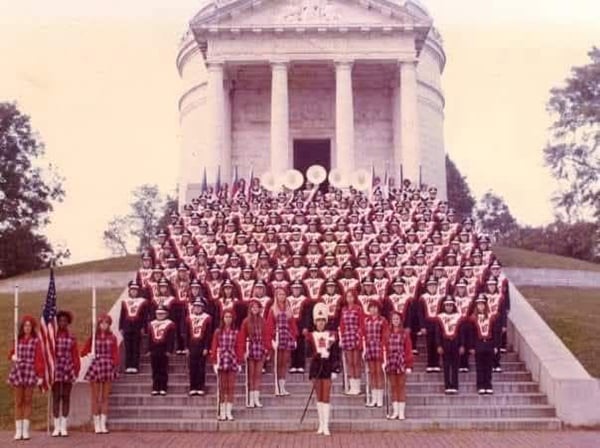
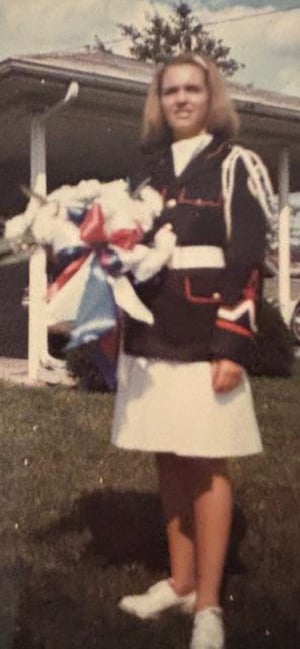
Bettie Ockermann, of Lexington, recalls her marching band days at Henry Clay High School from 1957 to 1960. “My parents made monthly payments for a clarinet, the only way they could afford the 150-dollar instrument,” said Bettie. Under the capable direction of Richard Borchardt, she noted, they marched in downtown Lexington in all kinds of weather, with Bettie saying she looked like a “soaked cat” when it rained. “We practiced each weekday morning at Woodland Park at 8:00 am which was our first hour class, then walked to school on Main Street to finish our school day.”
A Versailles woman, Mary Sue Mitchell, talked about her hot band camp days and uncomfortable uniforms, but still had “lots of fun,” especially on the bus trips. She had difficulty memorizing her music, and being a flute player, she “had to wear a music holder around my neck.”
Mary Sue looks back with a smile about her native Lynch, Kentucky, band days when they were invited to march in a parade in Virginia. At the time, they had no uniforms to wear. The improvising band’s director suggested that they dress as hobos, and “as we marched along the streets playing our instruments,” she noted, “people threw change (money) at us.”
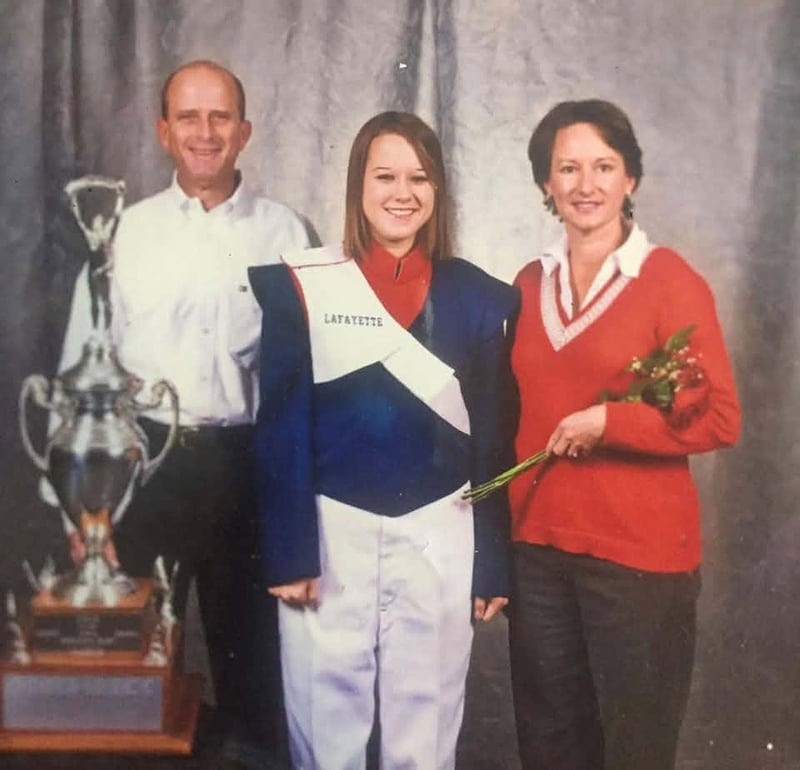
My wife, Suzanne, reminded me that her senior year highlight was being selected by band members for the coveted Lafayette High “Band Sponsor” position. “I marched between the two drum majors in front of the band,” she explained. “I carried a bouquet of flowers and smiled representing the spirit of the Lafayette Band, which they called ‘The Pride of the Bluegrass.’”
Though she loved her marching band experience while a teenager in Irvine, Ann Burns, now of Richmond, could never complete an entire band camp as part of Estill County’s marching band. “I was very light-skinned, so I would get burnt to a crisp, would get sun poisoning, and I’d have to go home,” she explained. She played the trombone, unusual for a girl. The reason? Two older brothers played trombones in the band but quit to play football instead. “We had two trombones at the house and my dad said he wouldn’t buy another instrument and if I wanted to play in the band, the trombone or the trombone would be my choice,” she said, grinning. “It was good because I could leave one at school and one at home and wouldn’t have to carry it back and forth to practice.”
Another member of that Estill County band at the time, Gina Arvin, remembered clearly what happened in their first ever competitive marching show for the school. It was a disaster. “We had no idea what we were doing.” Another member of the band, Melody Taylor, said that “there’s no word to describe how bad it was.”
The newbie band director (my former roommate, Jim Palm) would get frustrated during practices and throw his clipboard to the ground. “He’d blow that whistle, and he had a clipboard . . . and there that clipboard would go,” Gina said, laughing.
Another of that group, Dennis Hall, said during band time, “you’d get all the emotions. It was tough.” He joined the military five days after high school and soon put his marching experience to good use. Because of his rigid training under Jim Palm, Dennis said, “I made it through basic training ‘in a breeze’ (and) I became the guide who carried the flag for the squadron, and we won awards with our marching.”
After those early trying times, Burns, Arvin, Taylor, and Hall noted that the band got better, and they gave much praise to Palm. From that challenging start, the Estill County Marching Band today is well-established and regularly does well in competitions. All four of the above attended a recent special recognition day for Palm given in Irvine.
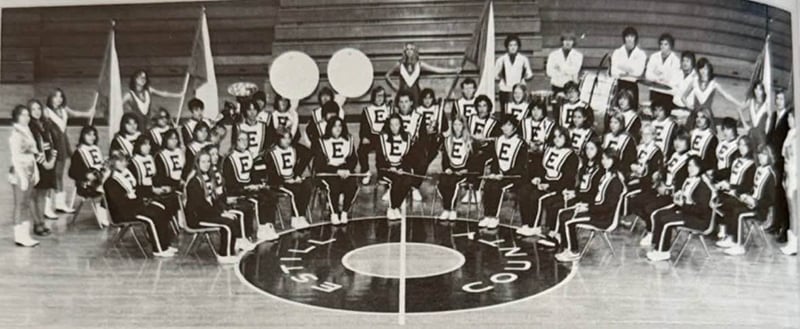
For some, the sounds of a marching bands stick lifelong. A Winchester native, Jason Eades, recalled that In soccer practice for the George Rogers Clark High School, in Winchester, the marching band practiced next to them. “Until this day, I can still hear the ticktock’ in my mind,” he said.
While growing up in California in the late 1970s, current Wilmore resident Jill Snyder had to deal with the results of a financial crunch on schools that affected her band experience. “Proposition 13 passed in California before my freshman year, and I never got to participate in marching band. So those of us who have been taking band lessons all those years had to go ‘zero,’ (and going) before school started for no credit to do band.”
Another Lafayette High School story came from a former fourth grade student of mine. “I am tragically uncoordinated,” said Melissa Rogers. “I remember having to work really hard to learn the drills.”
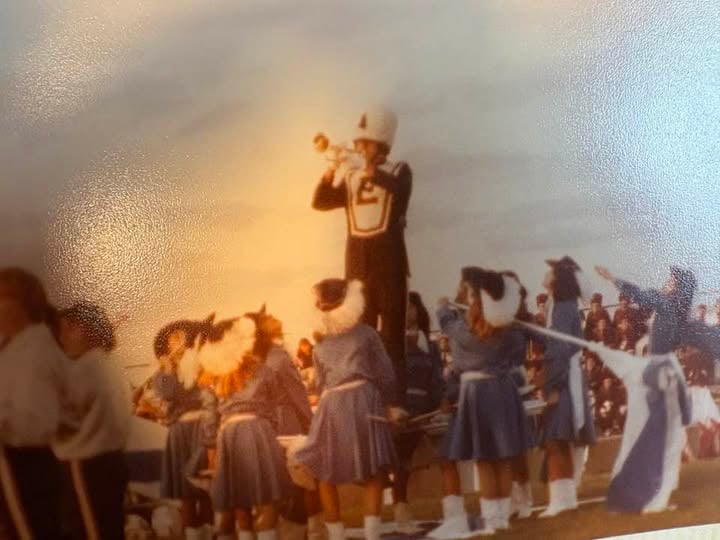
She wore basketball goggles on the field to keep herself from looking at the ground while marching.
On one occasion, Melissa nervously agreed to play “Moonlight Sonata” as a piano keyboard solo for the second movement of the band show, a gig that she knew some thought another person deserved. “That’s just one of the things I’ve had to let go,” she said. “On a positive note, I got to march off the field so I could play the solo and that was a relief.”
Wendy Wilhoit’s marching and concert experience in the Warren Central High School Band, in Vicksburg, Mississippi, has had a lasting effect on her. She didn’t consider herself very good as a bassoon player and explained that she “sat in my chair and usually pretended to play as not to make a mockery of myself.” Wendy, who lives in Central Kentucky now, was also in the color guard and received a “cute” uniform and says that her band times were “a piece of my life that still blesses me to the core.”
Like me, Judy White, a Campbell County High School classmate of mine, wasn’t in the band. But having children who did made her proud. “We moved to Ft. Mitchell in 1994. My husband did his homework before moving there and found they had a very strong under the direction of Brian “Bosco” Brown,” said Judy. “My daughter started at Beechwood as a sophomore alto sax, and my youngest son 7th grade drumline, who both went on to be field commanders. My mom heart was full when I saw how welcoming these ‘bandies’ were at their first summer band practice. What an inclusive group band members are. Lifelong friends were made and fun times were had.”
Steve Flairty is a teacher, public speaker and an author of seven books: a biography of Kentucky Afield host Tim Farmer and six in the Kentucky’s Everyday Heroes series, including a kids’ version. Steve’s “Kentucky’s Everyday Heroes #5,” was released in 2019. Steve is a senior correspondent for Kentucky Monthly, a weekly NKyTribune columnist, and a former member of the Kentucky Humanities Council Speakers Bureau. Contact him at sflairty2001@yahoo.com or visit his Facebook page, “Kentucky in Common: Word Sketches in Tribute.”