















This season of college football has delivered plenty of upsets. And, apparently, no upset is complete until several thousand people decide the safest place to celebrate is directly on top of the players, coaches and officials in the middle of the football field.
Through the first weekend of November, at least 11 FBS games that received national attention ended with fans storming the field. It started in Week 1, when Michigan fans rushed the field after a 13-12 Hail Mary win over Western Michigan, despite Michigan entering the game as a 27.5-point favorite. From there the flood gates were opened wide.
Nobody puts a price tag on field storming quite like the SEC. Since 2025, the conference has imposed a flat $500,000 fine for each violation, with the money going directly to the visiting school. That replaced the old escalating system of $100,000, $250,000 and $500,000.
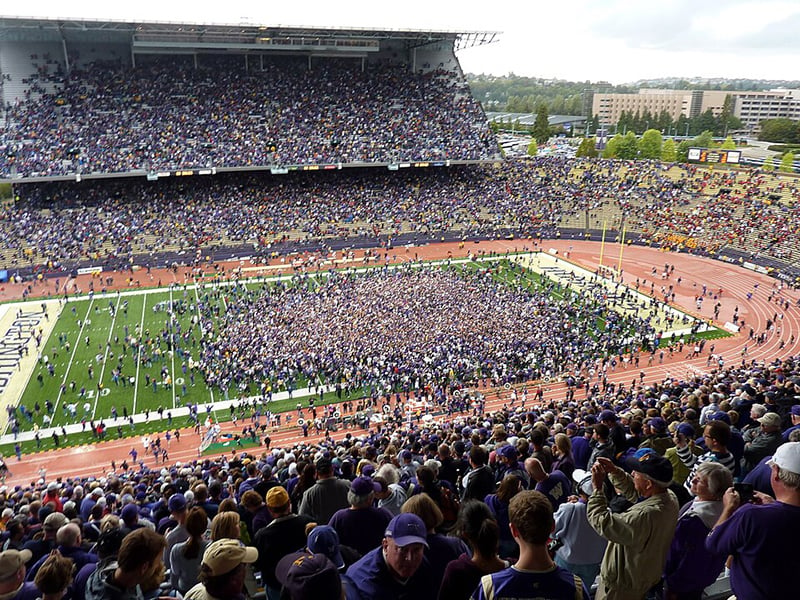
As I sat in my superstitious cocoon on my family room couch on October 10, regretting not going to the Kentucky vs LSU game at Kroger’s field, I watched several of my friends & neighbors post pictures and videos of themselves storming the field. As a result, Kentucky became the first school fined this season after its overtime win and every fan that I have talked to were there said it was worth every minute
Tennessee followed a week later after beating Alabama 26-10. Then South Carolina joined the club after a walk-off 48-yard field goal on Oct. 24. The recipient of South Carolina’s $500,000 fine? Tennessee. Nothing says sportsmanship quite like beating somebody and then mailing them half a million dollars. Three weekends. Three field storms. $1.5 million in fines.
There is some wiggle room. The SEC commissioner can reduce a fine to $100,000 if a school demonstrates it made a legitimate effort to prevent the rush. Schools can also avoid the penalty by allowing the visiting team and officials to get safely off the field before fans are allowed on. In other words, sometimes five extra minutes of patience can save $500,000.
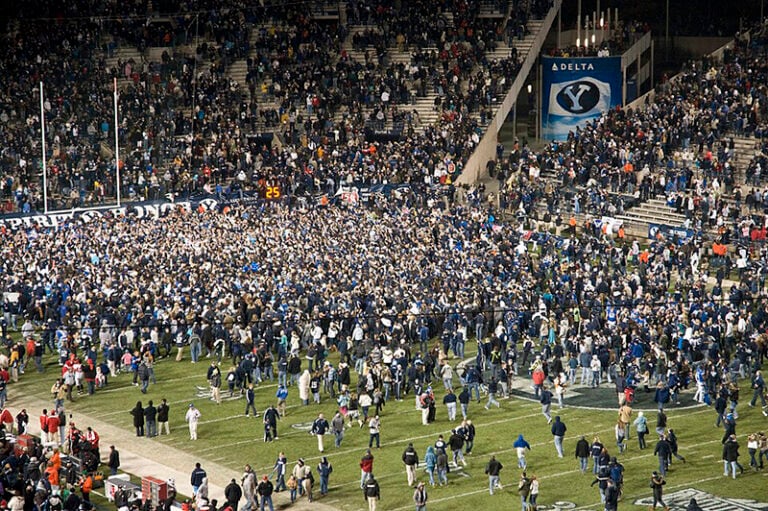
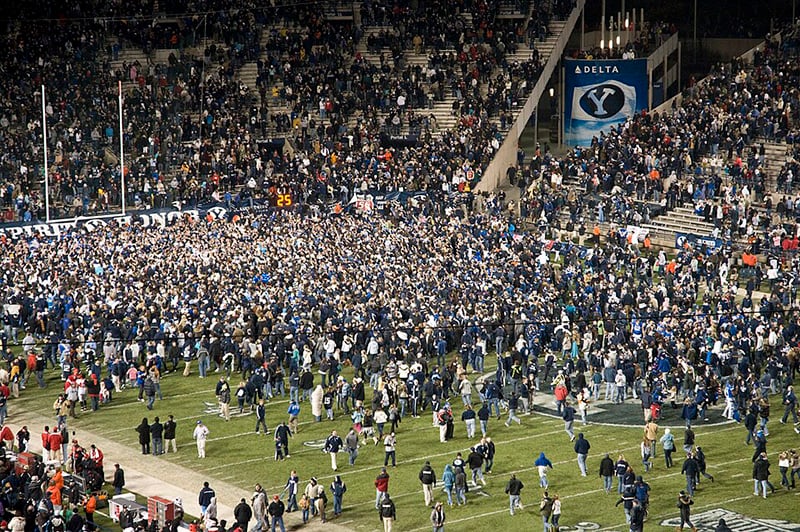
Other conferences take a softer approach. The Big 12 reviews incidents individually and has waived fines when schools demonstrate the visiting team had a safe path off the field. That approach was tested in Provo on Oct. 17, when BYU beat No. 2 Notre Dame and much of the 65,179-person crowd ended up on the turf. Utah fans followed suit after beating BYU.
The Oct. 23-24 weekend brought four more field rushes at Appalachian State, Minnesota, UCF and Cincinnati. A week later, USC fans flooded the Coliseum following a 30-18 win over No. 2 Ohio State.
With my experience in the insurance industry, I know that the fines make headlines, but the injuries make claims and that is where the fun ends.
As I watched the final play live on TV, something in the end zone caught my eye. Doing my best Leonardo DiCaprio-as-Rick Dalton impression from “Once Upon a Time in Hollywood,” I started pointing and whistling at the TV as a fan trying to climb over the railing to storm the field lost his footing and fell at least 10 feet from the stands, landing flat on his face. I turned to my wife and asked if she had seen it too. She had. The clip eventually surfaced on social media the next day. I never learned whether he hurt anything more than his pride, but I did hear there were a handful of injuries that night.
There are several documented incidents where fans were hurt far worse than a twisted ankle. Once thousands of people spill into an area occupied by emotional athletes, coaches, officials, television crews and security personnel, crowd control quickly becomes more of a suggestion than a plan.
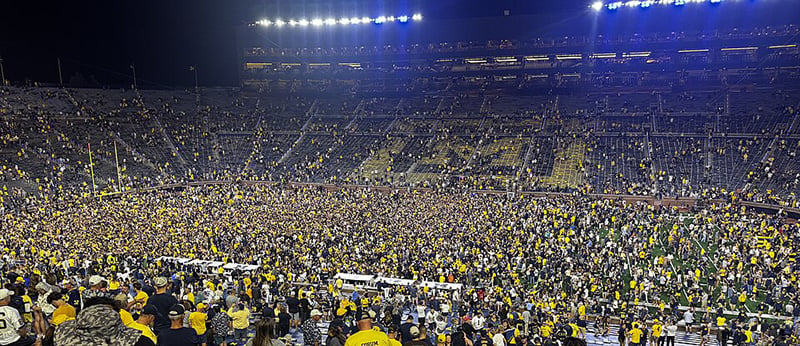
Researchers affiliated with the National Center for Spectator Sports Safety and Security have documented more than 90 college field and court incursions since 2022.
Apparently, “Please remain off the field” is becoming college football’s version of “Some assembly required.”
The crowd itself isn’t always the biggest dangers, sometimes it’s the goalpost.
A goalpost can weigh anywhere from 450 to 1,800 pounds, which makes pulling one down considerably less charming than it looks on television.
In October 2005, 20-year-old University of Minnesota-Morris student and basketball player Richard Rose was killed when fans tore down a goalpost following a double-overtime homecoming victory. The coroner determined he died from head trauma caused by the falling post.
In 2001, a 21-year-old Ball State student was left paraplegic after a goalpost fell onto his back. The university had encouraged the celebration through a scoreboard message, and the student eventually received a $300,000 settlement, the maximum allowed under Indiana law against the school.
Then there was Wisconsin in 1993. Students rushed the field after a victory over Michigan and were crushed against fences. Seventy-three people were injured, six critically, and 11 lawsuits followed. That’s the uncomfortable progression risk managers and safety consultants know too well: Celebration → incident → injury → attorney.
Field storming isn’t the only college tradition capable of producing an insurance claim.
Consider the live animals. Oklahoma’s Sooner Schooner has tipped over twice. Texas Tech ended the Masked Rider’s touchdown gallop after a horse struck a game official. Texas’s roughly 1,600-pound steer Bevo broke through his barriers at the 2019 Sugar Bowl and headed toward Georgia mascot Uga, scraping a photographer in the process.
Colorado’s Ralphie can reach about 25 mph, and a handler had to dive out of the way on Oct. 31 this year.
And who could forget Georgia’s Uga V, who famously lunged at an Auburn receiver in 1996, proving that even a bulldog can turn into a liability exposure? So the risk-management lesson: Whether your game-day tradition has horns, hooves or just a bad attitude, the question “What could go wrong?” should be answered in writing, well before kickoff.
Because live animals apparently weren’t enough, college football also gives us parachutists, rappellers and cannons.
In January 2026, a parachutist at the Armed Forces Bowl snagged the goalpost netting and fell about 30 feet. In April, winds pushed a skydiver into the Lane Stadium scoreboard during Virginia Tech’s spring game, requiring a crane to get him down.
At a UTSA-Navy game, an airman rappelling from the stadium roof lost control, fell to the turf and later died.
All these incidents eventually lead to the same question, “Who pays?”
Depending on the circumstances, exposure may fall on the university, a student organization, private animal owner, hired performance team, individual administrator, contractor or even the fans themselves. Public universities can also operate under statutory liability caps, potentially pushing injured parties to look for other defendants and other available insurance policies.
For anyone hosting, sponsoring or insuring game-day events, the takeaway isn’t that traditions need to disappear. It’s that traditions need to be planned like exposures, not treated like surprises. Review general liability and special-event coverage. Look closely at animal liability, aviation and performer exposures. Require certificates of insurance and meaningful hold-harmless agreements from contractors. And don’t overlook something as simple as crowd timing.
A delayed field-access plan that gives visiting players and officials enough time to leave safely can potentially prevent injuries, confrontations and, in the SEC, a $500,000 fine.
College football doesn’t need fewer traditions. It just needs to make sure the celebration doesn’t become the most expensive play of the game.
Be safe my friends.