













The riverboat captain is a storyteller. Captain Don Sanders shares the stories of his long association with the river — from discovery to a way of love and life. This a part of a long and continuing story.
By Capt. Don Sanders
Special to NKyTribune
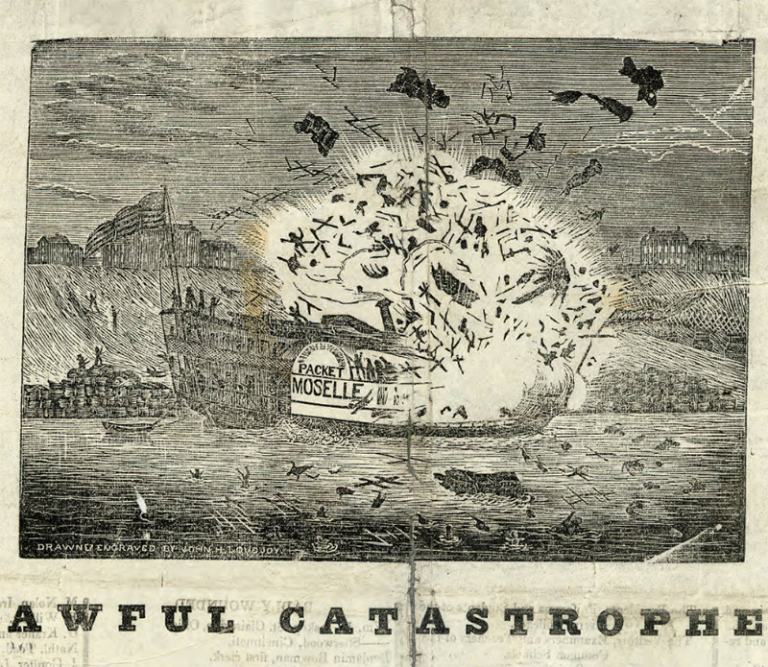
Only recently, I posted a group of sketches from April 25, 1838 showing the fully loaded Steamer MOSELLE exploding just 30 feet offshore in front of the Cincinnati Public Landing.
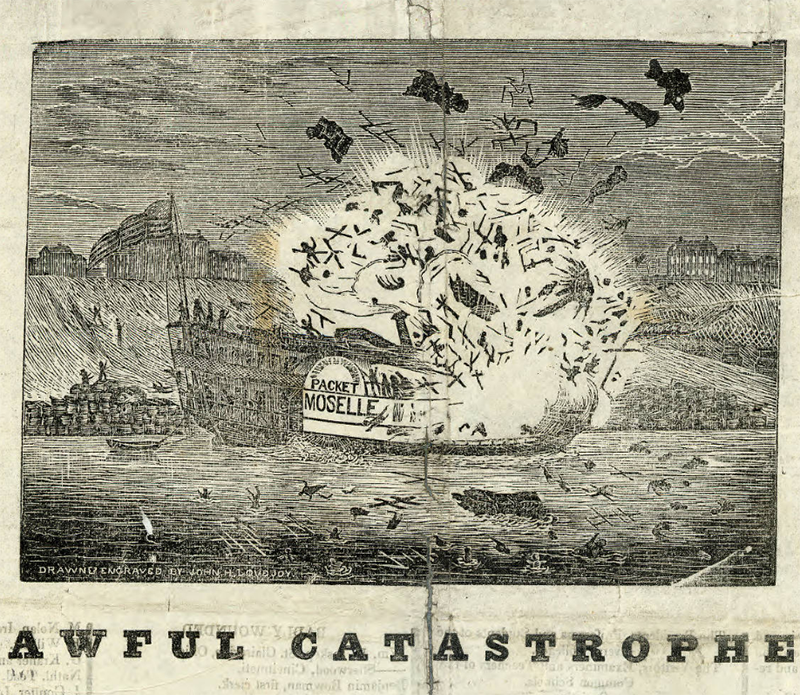
The steamer was crowded with friends and family members of the passengers who had just boarded the steamboat, which was racing breakneck past them after picking up a family a couple of miles upriver when — KABOOM — the world suddenly ended or forever changed for 81 people killed, 55 missing, and 13 more badly mauled. For a modern perspective, imagine being at an airport where family members or friends just boarded a flight, and you’ve stuck around to watch the plane take off when — KABOOM! Kinda brings it all home, doesn’t it?
Nearly a century and a quarter later, Captain John Beatty, the premier Cincinnati river salvage expert, found the bell from the Steamer MOSELLE while hardhat diving in the Ohio River near where the ill-fated steamer let loose all four fully pressurized boilers and went KABOOM. For years, Cap’n Beatty carried the green patina-colored bell engraved with the name MOSELLE, mounted on an open trailer with brass steam whistles from other boats, and exhibited them at various river gatherings.
While scrounging for engravings portraying the disaster that happened a year before the invention of photography was publicly announced, and a full decade before the historic Fontayne & Porter Daguerreotype of Cincinnati captured the Public Landing, I found a photo of the MOSELLE bell mounted on Captain Beatty’s trailer. Curious about the bell’s whereabouts, I called Shantyboat Mike Fletcher, who would know if anyone did. After a long chat, we concluded that, after Cap’n John Beatty’s death, the bell and much of his other river plunder went under the auctioneer’s gavel, into private hands, and disappeared.
What interested me most was that Mike emphasized seeing the name MOSELLE engraved on the face of the bronze bell. If so, then that bell would see better service displayed in the downtown lobby of the Cincinnati Public Library than it likely has, tucked away in someone’s garage with last week’s dirty laundry piled up around such a treasure.
For years now, I’ve been attempting with little success to regenerate interest in building and rowing small wooden boats such as skiffs, yawls, and jonboats on the Western Rivers. Although I began rowing wood, squared-ended craft as a boy, aluminum and fiberglass soon replaced the traditional materials used to build watercraft on the Mississippi and its tributaries. The art of building such river-related arks began dying with the passing of the older generations, although the eastern coast of the country has kept its traditions alive.
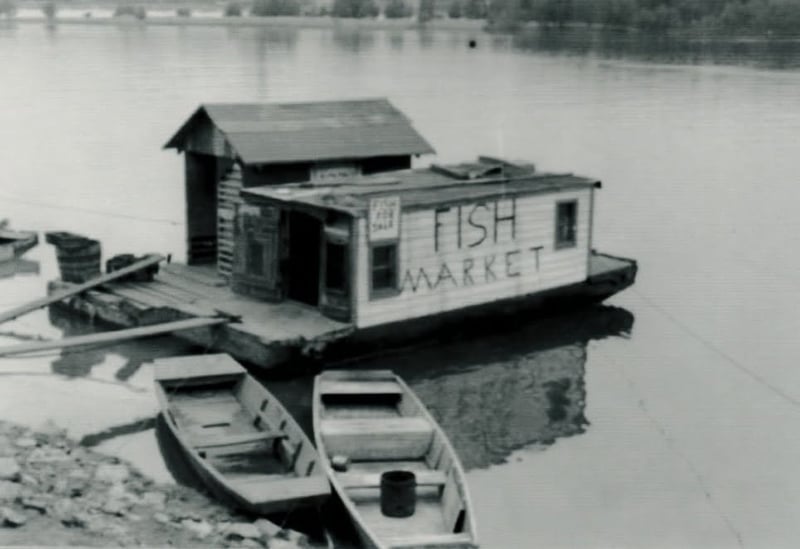
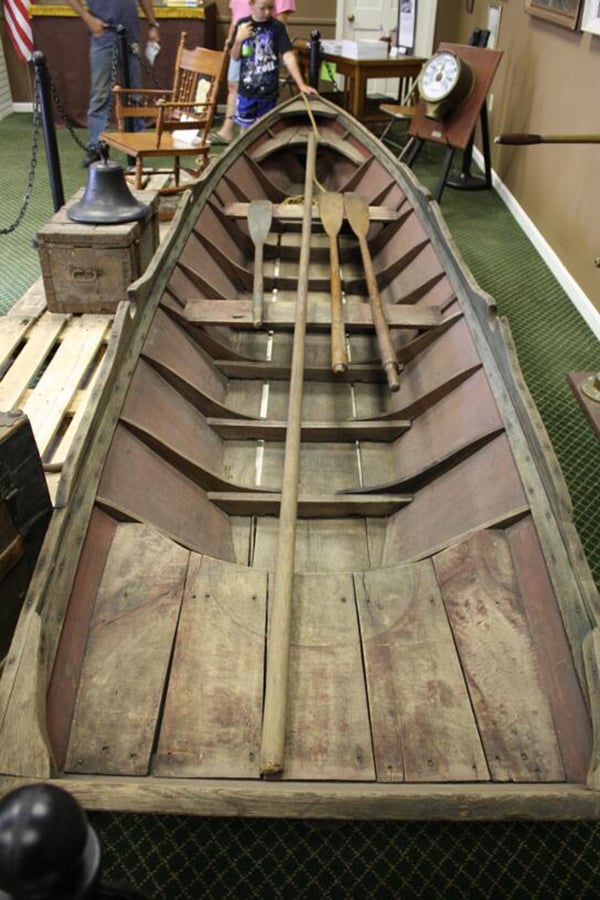
After my last failed attempt to find a builder for a duplicate modeled after an exceptional wooden vessel, built in the 1880s, known as the “Thompson Skiff,” housed at the Ohio River Museum at Campus Martius, in Marietta, Ohio, I figured that was one unachieved item forever remaining on my Bucket List. That is, until I posted a rather plain photo of a 1900 floating shanty with “FISH MARKET” scrawled on the cabin, with two finely built wooden jon boats floating nearby.
I couldn’t resist commenting: “How I’d love to have one of those wooden jon boats. They’re impossible to find anymore.”
My two sentences set off an animated conversation with several interesting comments. However, no one indicated where such a gem might still be found until a fellow named Trapper Haskins spoke up, and his words gave an old dream new possibility.
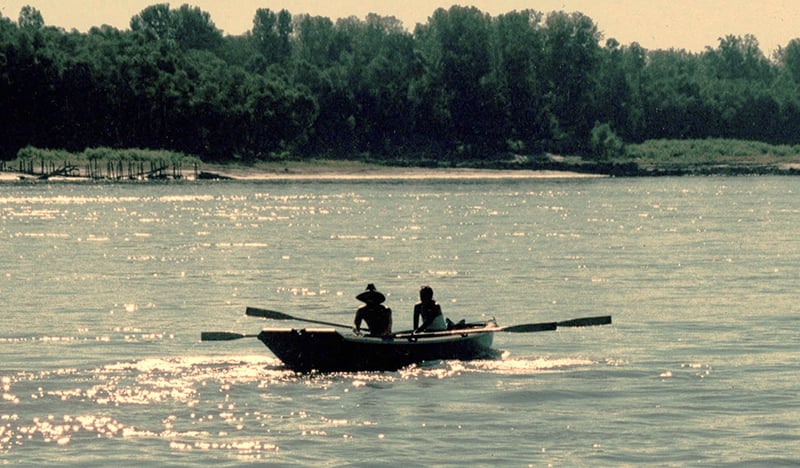
“Don, I’d be happy to take on your jon boat project. I studied wooden boatbuilding as an apprentice in Maine when I was younger. I spent the next several years working in the boatyards there. I am originally from Memphis, so I decided to build a Mississippi Yawl for myself (similar to these jon boats but without the square bow). Anyhow, I’m now in Middle Tennessee where I run a custom woodworking business. I would love to discuss building a boat for you!”
I could only reply, “Check your message box.”
What I know about Trapper is that he has a proven track record of building a traditional wooden Mississippi River boat similar to the Thompson Skiff. In fact, he said he has a set of drawings for the Thompson, which Jim Stephens of the Campus Martius Museum gave him when Mr. Stephens visited the Maine workshop where Trapper was building his own skiff in 2001. Mr. Stephens built a couple of boats modeled on the original 1880s white oak boat, found stored under a porch for use if the river flooded and the boat could be easily accessed.
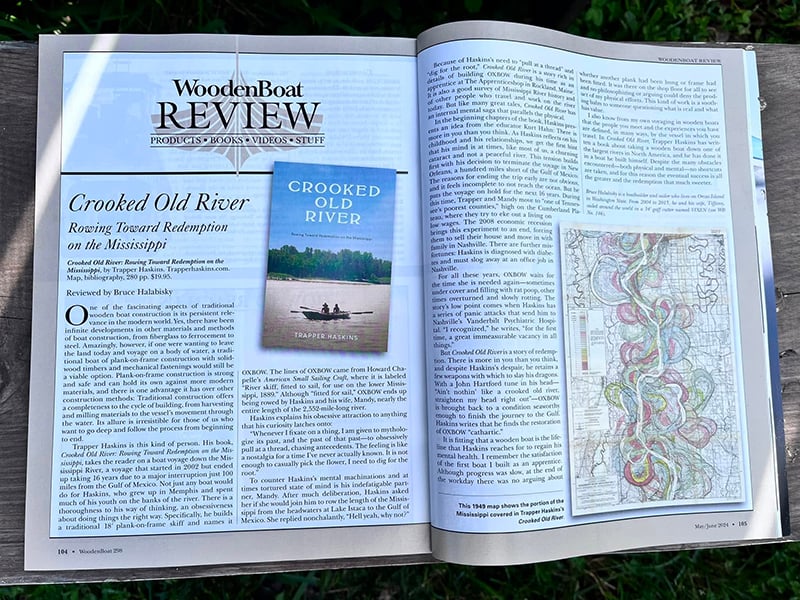
Notably, when Trapper Haskins finished his traditional skiff, he christened it OXBOX; he and his wife rowed the boat down the MISSISSIPPI River toward New Orleans over several years. From these adventures, he wrote the book, “CROOKED OLD RIVER,” which received a cherished review in WoodenBoat Magazine.
Let’s say I’m delighted and grateful to have found an experienced wooden boatbuilder, and hopefully something positive like a new boat will come out of this. Better yet, I hope a seed germinates among some youngsters interested in resurrecting the fine art of traditional boatbuilding in the type and style Western River artisans built for nearly 200 years.
Or, as Cap’n E. E. Wagner so often said, “Let’s wait and see what happens.”
If all that wasn’t surprising enough, my long-time Tennessee River friend, Captain Sam Evans Strickland, recently sent a message beginning:
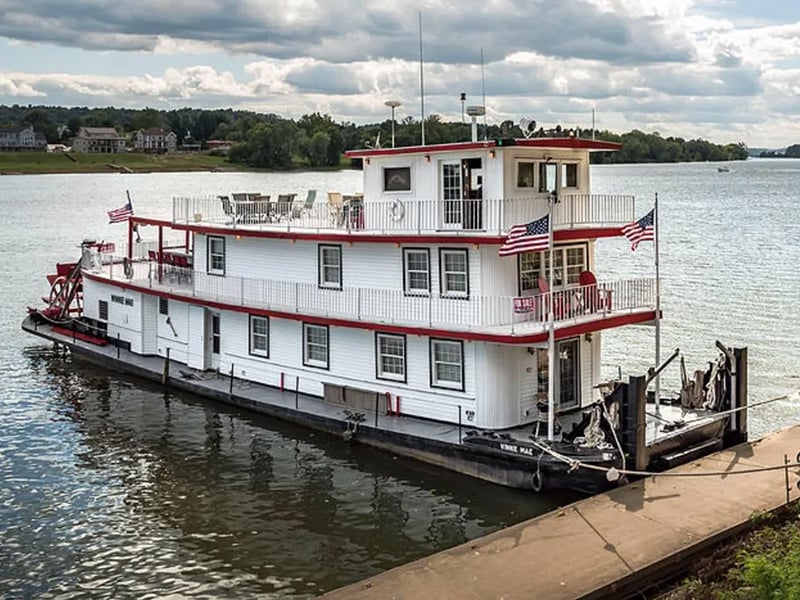
“Good morning, Don. I am ready to make someone a great deal on the WINNIE MAE. The time has come, after having her for over 10 years, to find her a good home. If you have anybody in mind, please let me know.”
The stern paddlewheeler WINNIE MAE, 118 x 22.5, was built in 1936 for the Monongahela & Ohio Dredging Company and was one of the first paddlewheelers powered by diesel (instead of steam). Her original engine was a Fairbanks-Morse Model 36, 300 HP, 6 Cylinder Marine Diesel. Rebuilt into a luxury live-a-board by Capt. Jamie Donahue in May 2005.
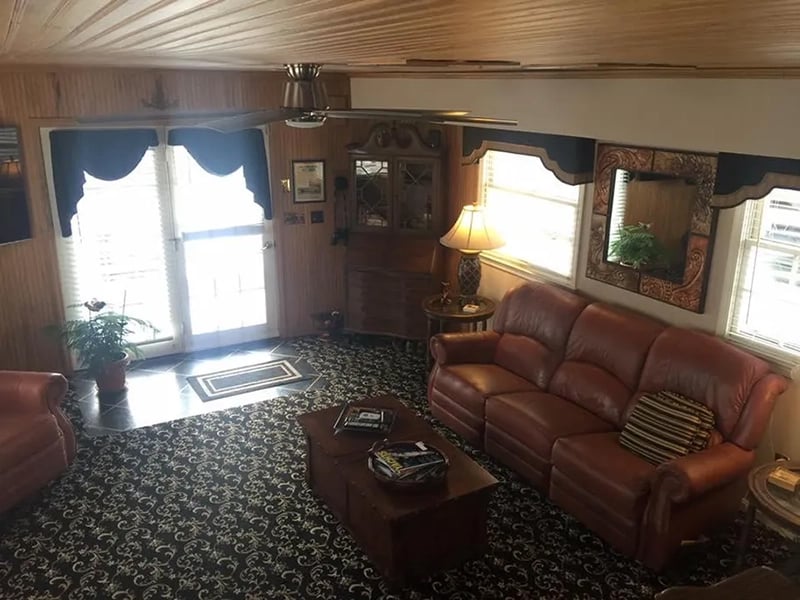
Captain Sam continued, “I have it listed on Captains Choice of Pickwick website. It has a lot of pictures in the whole description. It’s at $950,000. My concern now is that it goes to a good home and that the buyer can afford to keep it in good shape. I just replaced all the buckets, and I am currently having the water pump rebuilt. The engine and generator are in excellent shape; everything about the boat is great except it probably needs a new roof membrane. It has an old rubber commercial roof that needs replacing. Other than that, she’s in excellent shape and beautiful inside. I’m very negotiable on price as long as the buyer will take care of it.
There you go, a boat for all tastes. If anyone’s interested in the WINNIE MAE, let me know or contact Captain Sam, and be sure to tell him you read about his amazing sternwheel boat right here so he’ll know. In the meantime, I’ll be dreaming about a certain much smaller boat — if you know what I mean.

Captain Don Sanders is a river man. He has been a riverboat captain with the Delta Queen Steamboat Company and with Rising Star Casino. He learned to fly an airplane before he learned to drive a “machine” and became a captain in the USAF. He is an adventurer, a historian, and a storyteller. Now, he is a columnist for the NKyTribune and will share his stories of growing up in Covington and his stories of the river. Hang on for the ride — the river never looked so good.
Click here to read all of Capt. Don Sanders’ stories of The River.
Purchase Captain Don Sanders’ The River book
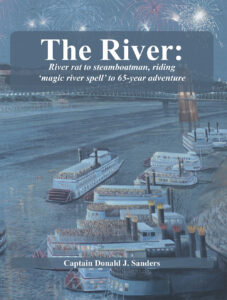
Capt. Don Sanders The River: River Rat to steamboatman, riding ‘magic river spell’ to 65-year adventure is now available for $29.95 plus handling and applicable taxes. This beautiful, hardback, published by the Northern Kentucky Tribune, is 264-pages of riveting storytelling, replete with hundreds of pictures from Capt. Don’s collection — and reflects his meticulous journaling, unmatched storytelling, and his appreciation for detail. This historically significant book is perfect for the collections of every devotee of the river.
You may purchase your book by mail from the Northern Kentucky Tribune — or you may find the book for sale at all Roebling Books locations and at the Behringer Crawford Museum and the St. Elizabeth Healthcare gift shops.
Click here to order your Captain Don Sanders’ ‘The River’ now.