














The riverboat captain is a storyteller. Captain Don Sanders shares the stories of his long association with the river — from discovery to a way of love and life. This a part of a long and continuing story.
By Capt. Don Sanders
Special to NKyTribune
“I’m going to walk right down to that river and keep on going.”
Or so someone overheard a woman telling her companion. Was she earnest, or was she seeking a sympathetic response from her ostensibly unfazed associate? Although the river has been a personal, inviting source of pleasure and escapes from the hubbub ashore, its dark surfaces and murky depths also beckon others with more baleful impulses
.
River folks realize that the watery world they’ve chosen to inhabit can become the source of their demise in an ill-fated instant. Most, myself included, remain unfazed by the extinction potential in the alien environment beneath their feet. It’s not that the possibility of calamity is callously ignored; rather, the river’s allure outweighs the risks. Life goes on unless unexpected circumstances intervene.
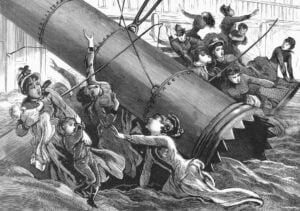
Historically, floods, droughts, ice, storms, heat, cold, and other hazards have all shaped the human relationship to the fluvial environment. Still, the introduction of the steamboat in 1811 increased the Grim Reaper’s tally of dangers in engaging with the waterways of the Mississippi River and its tributaries.
From the 1816 explosion aboard Captain Henry Miller Shreve’s palatial Steamer WASHINGTON at Marietta, Ohio, which killed 13, to the end of 1853, when the federal government established the Steamboat Inspection Service, a forerunner of the U.S. Coast Guard, an estimated 7,000 people died in steamboat disasters. The worst maritime catastrophe in U. S. history remains the explosion of the sidewheeler SULTANA loaded with repatriated Union POWs recently released from the infamous Confederate prison camps of Cabaha, near Selma, Alabama, and Andersonville in southwest Georgia.
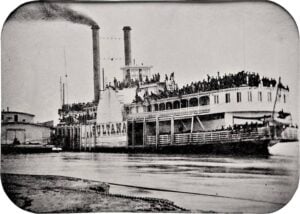
Around 2 a.m. on April 27, 1865, the overloaded SULTANA was straining upbound on the Lower Mississippi River, several miles above Memphis near a chain of small islands known as “Paddy’s Hens and Chickens,” when the vessel’s faulty boilers suddenly gave way. Although the exact number of victims remains unknown, the U. S. Customs Service set the official tally of the lost at 1,547 souls. By comparison, the sinking of the ocean liner TITANIC, 47 years later in international waters off the coast of Newfoundland, Canada, claimed 1,517 crew members and passengers.
I grew up in a city bordered on two sides by rivers, the Ohio to the north and the Licking to the east. With a policeman for a father, I heard numerous stories involving the unfortunate circumstances of various victims of foul play when they and the river interacted with disastrous results.
Human bodies, called “floaters,” periodically washed up on the town’s shores, and the police were usually the first on the scene to recover and investigate the grisly remains. My father, Lt. Col. Jess Sanders, Jr., usually the officer in charge of the gaggle of “coppers,” as Dad liked to call himself, and his men found themselves surrounding the bloated remains of a male person resting along the rocks upstream above the John A. Roebling Suspension Bridge. While they were waiting for what they referred to as the “meat wagon” to transport the bloated, blackened body to the coroner, one of the officers, apparently with nothing better to do to keep his mind occupied, pushed his boot down hard on the swollen, extended midsection of the dead man.
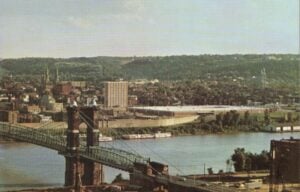
With a terrifying shriek, the policeman leaped back as an engorged eel, feeding on the innards of the deceased, shot out of the mouth of the decaying, foul cadaver.
As the snake-like fish flopped onto the riverbank, it writhed, squirmed, forced its way back into the water, and swam away angrily. Even today, the tale still gives me the “willies” as I imagine the grisly scene, as it was the day when my father excitedly recounted the event shortly after it happened on the rocky shore above the Suspension Bridge.
Roebling’s Suspension Bridge was the scene of another bizarre and perplexing tragedy involving unfortunate victims and the Ohio River. On a frigid, bitter winter night, a man and his wife were driving across the bridge into Kentucky from Cincinnati on the northern side of the river when they argued angrily. Near the middle of the historic structure, the husband shouted,
“Say another word… I’ll stop and jump off the bridge!”
When the wife continued, the man stopped the automobile, leaped out, and climbed down into the steel structure below the roadway. The terrified wife pleaded for her husband to climb back and get into the car. But the man, who was by then hanging below the metalwork above the angry waters far below, screamed that he could not pull himself up from where he was dangling. He pleaded for her to run for help at the police station inside the City Building, half a bridge length and a short distance away.
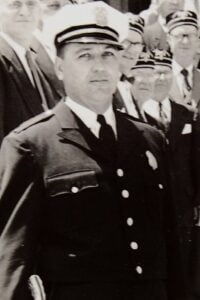
Inside the aging Richardsonian Romanesque Revival Courthouse and city offices, my father and several other “coppers” were suddenly shaken by the screams of the hysterical wife pleading for their assistance to save her husband, holding on for dear life beneath the roadway of the nearby bridge. Dad and all those who could be spared from the government building hurried to the man hanging beneath the steel structure, where his pleas for mercy already sounded weak. Soon, a rescue team from the city fire department joined the police officers, who so far had failed to assist the terrified and exhausted fellow.
While the rescuers anxiously strove to aid the man hanging above the freezing waters, the repentant couple cried and pleaded to the Creator and His Heavenly Host to spare the husband’s life. As my father and those assembled on the historic overpass spanning the broad river swollen by recent storms stood helplessly by, two terrifying screams rent the winter air. One, that of the man, until it suddenly ceased as his body slammed into the river beneath the span while his mate screeched on in terrified disbelief. Her terror-stricken shrieks were the only sounds heard in the encroaching gloom of the frigid night.
In the sixty-some years since I first recognized the riverway as my life pathway, I have personally saved at least seven fortunate souls from the jaws of death on the river. In turn, my own guardian angels have spared my life that many times.
Life and death on the watery byways can be but moments apart. In the overall scheme of living and dying, I’ve taken my chances on the river and have yet to regret those choices.
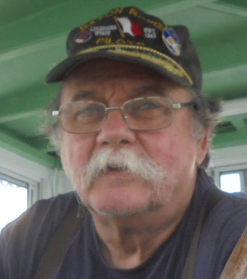
Captain Don Sanders is a river man. He has been a riverboat captain with the Delta Queen Steamboat Company and with Rising Star Casino. He learned to fly an airplane before he learned to drive a “machine” and became a captain in the USAF. He is an adventurer, a historian, and a storyteller. Now, he is a columnist for the NKyTribune and will share his stories of growing up in Covington and his stories of the river. Hang on for the ride — the river never looked so good.
Click here to read all of Capt. Don Sanders’ stories of The River.
Purchase Captain Don Sanders’ The River book
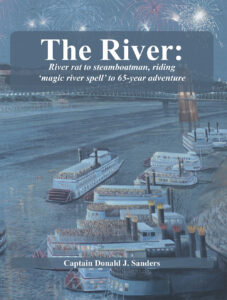
Capt. Don Sanders The River: River Rat to steamboatman, riding ‘magic river spell’ to 65-year adventure is now available for $29.95 plus handling and applicable taxes. This beautiful, hardback, published by the Northern Kentucky Tribune, is 264-pages of riveting storytelling, replete with hundreds of pictures from Capt. Don’s collection — and reflects his meticulous journaling, unmatched storytelling, and his appreciation for detail. This historically significant book is perfect for the collections of every devotee of the river.
You may purchase your book by mail from the Northern Kentucky Tribune — or you may find the book for sale at all Roebling Books locations and at the Behringer Crawford Museum and the St. Elizabeth Healthcare gift shops.
Click here to order your Captain Don Sanders’ ‘The River’ now.