



















By Lindsey Piercy
University of Kentucky
Every year for more than five decades, economists at the University of Kentucky have taken the pulse of the Commonwealth’s economy.
What began as an annual publication tracking economic trends has evolved into one of Kentucky’s most comprehensive resources for policymakers, business leaders and community organizations working to plan for the future.
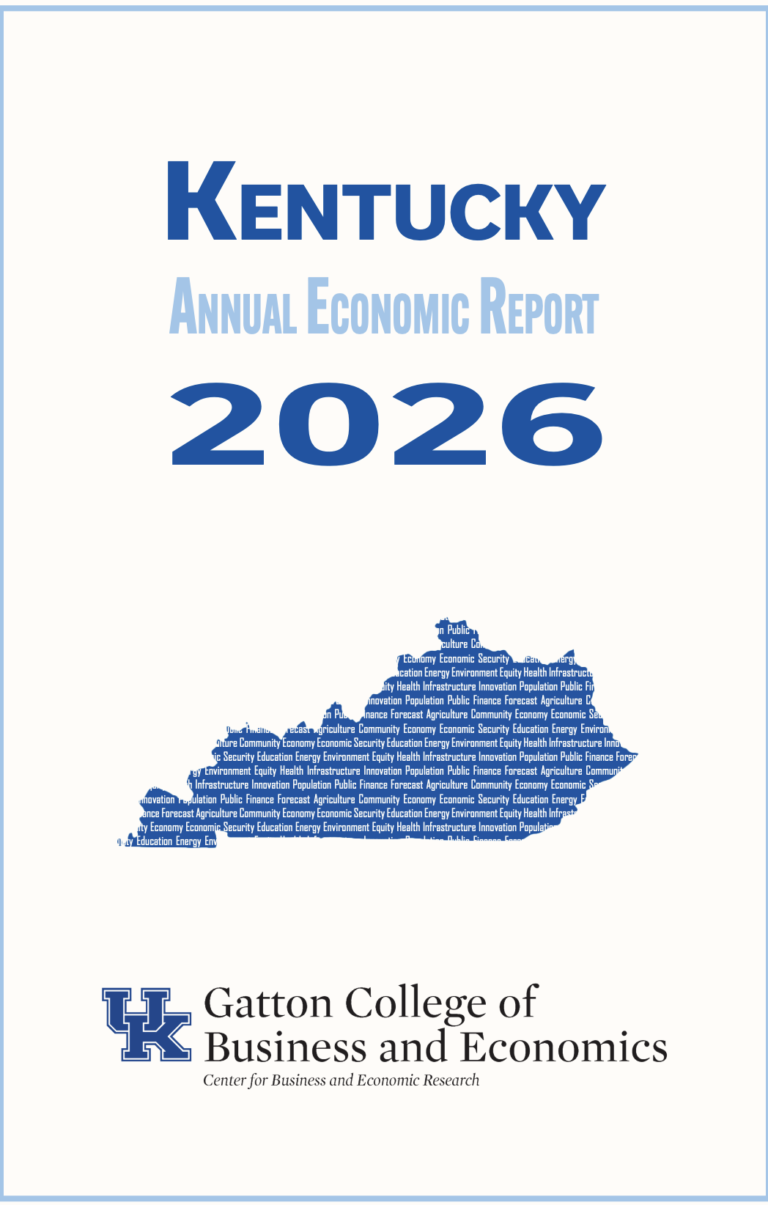
Produced by UK’s Center for Business and Economic Research (CBER) in the Gatton College of Business and Economics, the Kentucky Annual Economic Report traces its origins to 1972 — when the first report was released by the Kentucky Council of Economic Advisors.
“Developing sound public policy is difficult, and it becomes much harder without reliable data and the context needed to understand what those data mean,” said CBER Director Michael W. Clark, Ph.D. “The Kentucky Annual Economic Report helps policymakers, business and community leaders, and citizens understand the economic, workforce and demographic challenges facing the Commonwealth and make better-informed decisions.”
CBER assumed responsibility for publishing the report in 1984, and in 1986 the Kentucky General Assembly enacted KRS 164.738 — directing CBER to maintain state economic data and produce the annual report.
Over time, the publication has expanded far beyond traditional economic indicators. Beginning in 2013, Michael Childress, CBER research associate and managing editor of the Annual Economic Report, redesigned and broadened the report to place greater emphasis on the long-term forces shaping Kentucky’s economy and quality of life.
Today, the report examines 13 major topic areas — ranging from the economy, education and workforce to health, infrastructure, innovation, population, public finance and the strength of Kentucky’s communities. By combining data, research and analysis across these areas, the report provides a broad view of the state’s challenges, progress and opportunities.
What the 2026 report says about Kentucky
At more than 360 pages, the 2026 Kentucky Annual Economic Report highlights Kentucky’s economic strengths, while identifying persistent challenges that could affect the state’s long-term growth.
“The economic strengths include a diverse mix of industries, a central location, strong transportation networks, competitive energy costs and a growing manufacturing sector,” Clark said. “But the report also finds that building a more skilled and educated workforce will be key to the state’s future growth.”
Kentucky continues to trail the nation and many competitor states in educational attainment and labor force participation, with significant regional disparities and acute challenges in many rural and Appalachian communities.
The report also points to innovation, infrastructure and population trends as important to Kentucky’s economic future. The state continues to lag the nation in areas such as venture capital, patents and STEM jobs. Slow population growth and an aging population could also make it harder to grow the workforce.
Overall, the report identifies education, workforce participation, innovation and infrastructure as key areas that will determine Kentucky’s ability to build on its strengths and support continued economic growth.
A national model for long-term planning
The approach to building the comprehensive report recently received national recognition.
The Pew Charitable Trusts highlighted CBER’s report in “States Are Thinking Long Term to Prepare for Emerging Budget Risks,” an examination of how state governments are using information about demographic, climate and technological change to prepare for fiscal challenges.
“The CBER annual report stands out as an example of putting long-term trend data into the context of a state’s fiscal outlook,” said Caitlyn Wan Smith, officer with The Pew Charitable Trusts. “Incorporating this type of information into the budget process gives decision-makers the opportunity and insight to plan for challenges beyond the next fiscal year.”
A trusted resource for Kentucky leaders
For Kentucky policymakers, the report serves as a day-to-day reference.
“The Kentucky Annual Economic Report is one of those resources I keep within arm’s reach at my desk in Frankfort. It’s an encyclopedia of Kentucky’s economy — bringing together an extraordinary amount of information in one place,” said Sen. Chris McDaniel of Ryland Heights, chair of the Senate Appropriations & Revenue Committee. “Whether I’m looking at employment trends, household income, public finances or any number of other issues, the report helps me better understand where Kentucky stands and the factors shaping our future. It’s an invaluable reference for anyone responsible for making informed decisions on behalf of the Commonwealth.”
Organizations across education, business, innovation and public policy also rely on the report to understand how Kentucky is evolving and what those changes mean for its future.
“We look forward to the report every year as a barometer on how the state is doing — in areas of progress and in areas where we need to make progress,” said Brigitte Blom, president and CEO of the Prichard Committee for Academic Excellence. “The report helps us see where we are progressing as a state and where we need to collectively double down.”
“The report is a critical tool for Kentucky’s business community,” added Charles Aull, Ph.D., vice president of policy and research for the Kentucky Chamber of Commerce. “It helps organizations like the chamber to have all this information accessible in one place and to have it produced by trusted researchers.”
Kris Kimel, co-founder of Space Tango, founder of Humanity in Deep Space and partner with Kentucky Space Futures, said the report helps frame discussions about Kentucky’s long-term competitiveness.
“For many years, we have relied on CBER’s Kentucky Annual Economic Report, because it looks beyond today’s economy and examines the long-term forces that will shape Kentucky’s future competitiveness,” Kimel said. “Creating Kentucky’s future economy requires more than good intentions — it requires credible data, thoughtful analysis, a willingness to look beyond the next budget cycle and imaginative new ideas. The annual report helps frame the conversations Kentucky needs to be having if we hope to build a more competitive, innovation-driven economy.”
Putting the data to work
The report also has practical applications in state government.
Nick Grinstead, Ph.D., HMA planner/planning grants manager with the UK Hazard Mitigation Grants Program Office, has been using the report since 2013 to help Kentucky meet federal requirements for its FEMA-approved hazard mitigation plan.
Stephanie Robey, assistant director of administration at the Kentucky Division of Emergency Management, also uses the report when Kentucky seeks federal disaster assistance.
“When developing the governor’s request for a Presidential Major Disaster Declaration, I rely heavily on the Kentucky Annual Economic Report,” she said. “Much of the decision-making by FEMA and the White House is centered on socioeconomics. To have this wealth of data and analysis is crucial.”
The report is intended to serve a practical purpose: helping people make informed decisions about Kentucky’s future. Its findings can support everything from budgeting and fiscal planning to decisions involving education, business, innovation and emergency management.
Looking beyond the next budget cycle
The modern report blends CBER’s longstanding tradition of economic analysis with the broader public-policy perspective developed through that work.
“Economic development is ultimately about preparing for the future,” Childress said. “Many of the forces that will determine Kentucky’s long-term prosperity — including demographic change, educational attainment, entrepreneurship, technological innovation, infrastructure and workforce development — unfold over decades rather than election cycles. Our goal is to identify those trends early, present them objectively and provide research that helps Kentucky’s leaders anticipate opportunities and challenges before they become immediate problems.”
More than 50 years after its debut, the Kentucky Annual Economic Report remains rooted in its original purpose of helping Kentuckians understand their economy. Today, however, it offers something broader.
“This recognition affirms the important role university-based research can play in helping Kentucky prepare for the future,” Clark added. “For more than five decades, CBER has provided independent, data-driven analysis that helps policymakers, business leaders and communities understand not only where Kentucky’s economy is today, but where it is headed. That work reflects the University of Kentucky’s land-grant mission, and we’re honored that it has been recognized as a model for supporting long-term public policy planning.”
You can view the 2026 Kentucky Annual Economic Report on CBER’s website.