















By Paul A. Tenkotte, PhD
Special to NKyTribune
The headlines and news stories on New Year’s Day of 1926 — from New York City to Cincinnati/Northern Kentucky — made a single fact evident. The nation’s moral experiment in regulating the manufacture, sale, and transportation of alcoholic beverages was an abysmal failure. Nearly halfway through the era of Prohibition, the Eighteenth Amendment had clearly backfired. Average Americans defied the law, while mobsters rose to power and violence ballooned. Disrespect for the rule of law and distrust of the government were the unintended consequences.
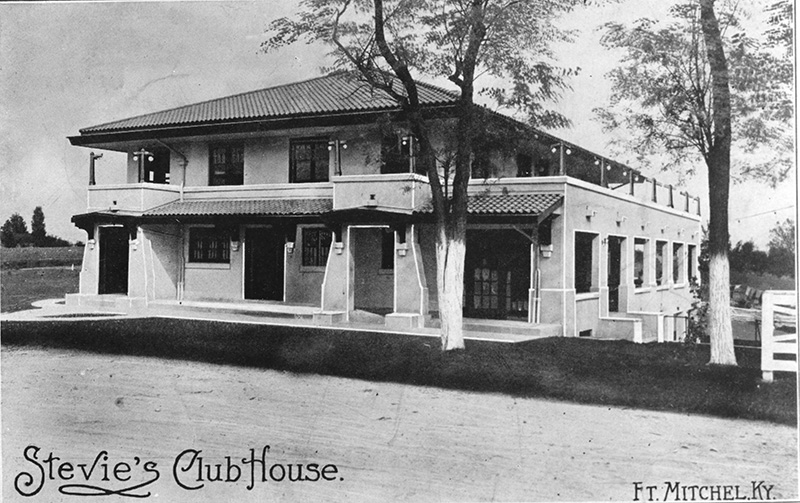
The “Kentucky Post” stated that “this was one of the wettest New Year’s since the advent of prohibition.” “Apparently undaunted by the annual threat that the law would take a stern course, Cincinnati revelers ‘carried their own’ to clubs, roadhouses and hotels. There was little attempt to conceal flasks.” Northern Kentuckians were joined by Cincinnatians who “flocked to Kentucky, patronizing La Vista, Lookout House, Clifton Garden and Stevie’s, Ft. Mitchell” (“Revelers Defy Dry Threat,” “Kentucky Post,” January 1, 1926, p. 9).
While home brew and bootlegged supplies of alcohol were readily available, Prohibition nevertheless adversely affected many immigrant groups, especially the Germans and Irish in Cincinnati/Northern Kentucky, whose breweries and distilleries closed and whose ethnic traditions floundered. The anti-immigrant stance of the Prohibitionists was not coincidental. The 1920s were virulently nativist. Two years earlier, the US Congress had approved the Immigration Act of 1924, also known as the Johnson-Reed Act. Fed by xenophobic and racist beliefs, this act severely restricted the number of annual immigrants permitted from Eastern and Southern Europe, who were regarded as racially inferior. It also upheld the virtual exclusion of Asians, already embodied in the Chinese Exclusion Act of 1882. Finally, it established the U.S. Border Patrol.
The 1920s were also marked by an American and European fascination with eugenics, a since-discredited, pseudo-scientific explanation of racism, arguing that genetics determined which races were superior and which were inferior. The eugenicists, however, went one step further, attempting to use forced sterilization, institutionalization of the so-called “unfit,” immigration restrictions, and other means to engineer a superior race of people. Hitler and the Nazis would bring the movement to its horrendous peak in the 1940s with the genocide of Jews, homosexuals, and Roma.
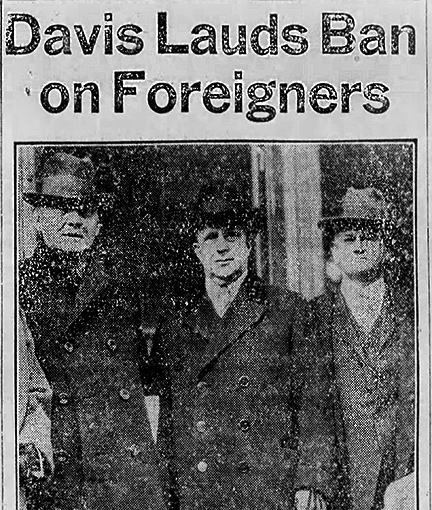
One of the most steadfast supporters of immigration restriction and eugenics was Welsh-born James J. Davis (1873–1947) of Pittsburgh, Pennsylvania, in the Ohio River watershed. He served as U.S. Secretary of Labor from 1921 through 1930, under Presidents Harding, Coolidge, and Hoover. In 1926 Davis visited Cincinnati for a Royal Order of Moose convention. He spoke at the Cincinnati Business Men’s Club on the topic of immigration, proclaiming that economic prosperity was a result of immigration restriction: “Knowing that they cannot enter the United States, European workmen have settled down to their pursuits in their own countries,” Davis asserted (“Davis Lauds Ban on Foreigners,” “Kentucky Post,” January 16, 1926, p. 5).
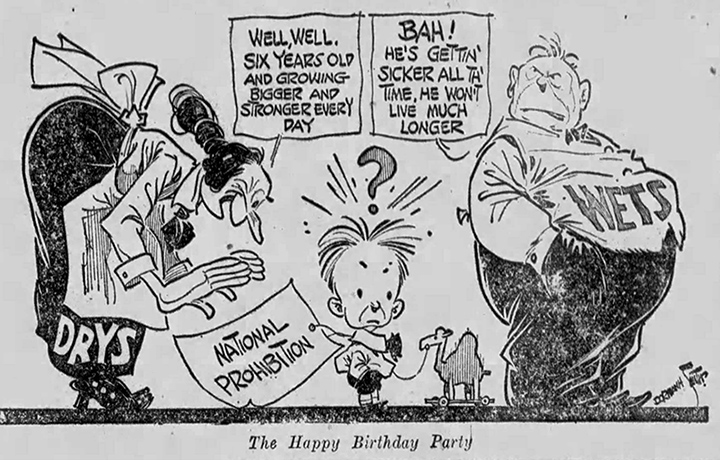
The same “Kentucky Post” edition of January 16, 1926 also carried a United Press article relating to the anniversary of the official beginning of Prohibition six years before, at one second after twelve midnight on January 17, 1920. The editorial cartoonist satirized the continuing debate between the “Drys” supporting Prohibition, and the “Wets” advocating for its repeal. On the government spreadsheet, the claims of economic success by Prohibition supporters seemed less evident. As the article noted, the federal government had appropriated $100 million to enforce Prohibition while losing $1.5 billion in revenues. “Despite the mammoth effort,” the reporters stated, “liquor is obtainable in practically every city in the nation at $1 to $15 a quart.” U.S. Senator Walter E. Edge (Republican) of New Jersey declared that “We need a tempered law that will lessen the present spirit of defiance and protest. I think that not even the most ardent friends of prohibition can claim it has bettered the morals of the nation” (“Draw Law Fight Center on Sixth Birthday,” “Kentucky Post,” January 16, 1926, p. 5).
Two days later, the “Cincinnati Enquirer” reported that Oswald Ryan, a “widely known Indiana writer and orator,” was scheduled to speak at the Wise Center on Reading Road in Cincinnati. According to the “Kentucky Post,” Ryan stated that “Foreign officials consider America a dumping ground for the worst of their citizenry.” The same reporter summarized Ryan as claiming that “if the steady flow of aliens had been allowed to continue, American ideals would have been destroyed and institutions ruined” (“Center to Hear Lecturer,” “Cincinnati Enquirer,” January 17, 1926, p. 2; “Offer ‘A Word to the Y’s,” “Kentucky Post,” January 18, 1926, p. 17).
Immigration restrictions of the 1920s were breaking up families. James H. Pateman, a British-born pastor at New Thought Temple in Cincinnati, had been allowed to come to the United States, along with his wife and three daughters, on a temporary six-month “special permit,” which was renewed for an additional six months. Meanwhile, as a clergyman, Rev. Pateman had apparently been granted permanent residency for himself. His wife and daughters, however, were required to leave the United States by March 20th or face deportation. While the family remained hopeful that their situation would be resolved on behalf of Mrs. Pateman and their two young daughters, it was complicated by the fact that their oldest daughter, Phyllis, had turned 18 years old. As an adult, she would not be able to return with her family to the United States, even if visitor status were renewed. Instead, Phyliss, her mother and two younger sisters left for Canada in February 1926.
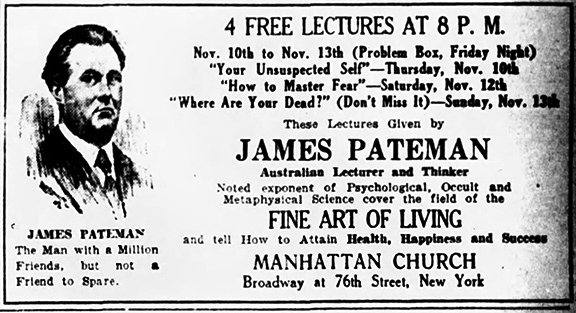
The editors of the “Post” were appalled by the Pateman case. “Our federal government has more important things to do than to drive out thinkers by reason of technicalities of law. The immigration laws were enacted, in part, to keep out foreign labor from competition with American labor. But, certainly, thought is not in such flourishing condition in America that it will suffer much from the competition of a European thinker. Indeed, a wise government would encourage the importation of foreign thinkers to replenish the domestic supply” (“Father in U.S. Can’t Bring Daughter,” “Kentucky Post,” January 21, 1926, p. 15; “Thinkers: Cincinnatus Column,” “Kentucky Post,” January 21, 1926, p. 5).
In February 1926, New Thought Temple appealed to President Coolidge in the Pateman case. By October of that year, however, the situation was still unresolved. Rev. Pateman, on “a leave of absence” from New Thought Temple, lectured nationwide, while his spouse and family remained in Canada. Returning to Cincinnati in late 1926, he established his own peripatetic Church of Truth, offering lectures at Cincinnati hotels and at the Odd Fellows Hall at Seventh and Elm Streets. His wife and daughters remained in Canada (“Appeal Is Sent to Coolidge,” “Kentucky Post,” February 10, 1926, p. 17; “Pastor Is Sued,” “Kentucky Post,” October 16, 1926, p. 13; “Church of Truth,” “Kentucky Post,” October 28, 1926, p. 6).
By late 1927 Rev. Pateman joined his family in Canada. He continued to lecture throughout the United States, including special engagements in New York and Massachusetts, where the local newspaper proclaimed that Pateman had been an international lecturer for 27 years, including “Australia, New Zealand, the Fiji Islands, England, Scotland, Canada and the United States.” They continued: “He was president of the New Thought center at Adelaide, Australia, and was until recently pastor of the Cincinnati temple, said to be the largest New Thought Temple in the world.” By 1930, Pateman was lecturing in London, England (“New Thought Healer to Talk on Faith at Unity Center Here,” “Springfield [MA] Daily Republican,” May 20, 1927, p. 20; advertisement for “The Practical Psychology Club of London,” “Marylebone and Paddington Mercury,” February 1, 1930, p. 4).
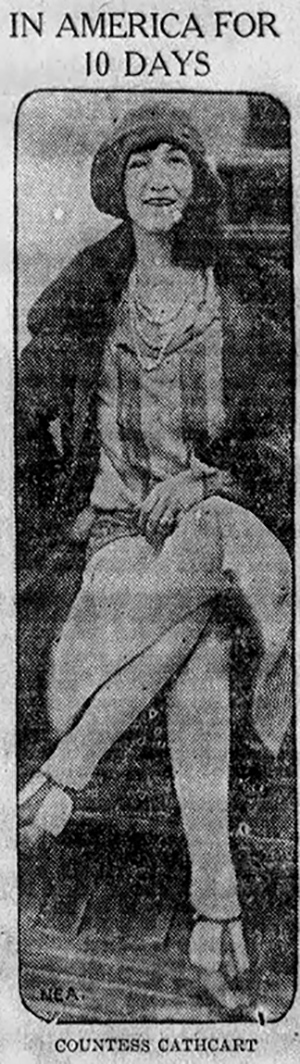
On February 9, 1926, a South African actress and writer named Vera Estelle Cathcart (Countess Cathcart, 1892–1993) arrived in New York City. She was visiting the United States to oversee the New York City production of a controversial play that she had written based upon her own life, entitled “Ashes.” There, immigration officials detained her, claiming that she had admitted to committing adultery in scandalous divorce proceedings abroad in 1921. According to U.S. immigration law, “moral turpitude” was considered cause for refusing entry. The key legal question became whether the United States could refuse admittance to a person who committed an act considered immoral but not illegal in the place where it occurred. On February 22nd, Countess Cathcart was allowed to enter the United States for a 10-day period on bond. Then, on March 5th, a federal court in Manhattan overturned the immigration officials and permitted the Countess of Cathcart permission to enter the United States as a “visiting alien” (“Countess Cathcart Is Halted in Harbor,” “New York Daily News,” February 10, 1926, p. 43; “Vera Can Stay,” “Kentucky Post,” March 5, 1926, p. 13).
The Cathcart case gained blowback internationally. The editorial staff of the “Cincinnati Post” concurred that the event “becomes sillier the closer you study it.” The editors reasoned that under such circumstances, “no foreigners at all” could enter the United States. “For instance, any Englishman, Frenchman, German or other foreigner who at any time in his life ever carried a bottle of brandy or wine or other intoxicant home, or even toted a hip-flask, should be barred. For tho [though] transporting liquor is not an offence in Europe it is a crime punishable by a term in the penitentiary in the United States.” “Absurd, isn’t it?” the editors asked. “Not that we give a darn if foreigners laugh at some of our laughable officials, but we do hate to see our country stripped of its dignity by such wooden-headed administrative nets as this” (“The Law,” “Kentucky Post,” February 22, 1926, p. 8).
New Year’s 1926 witnessed the deepening divisiveness of politics and culture in the United States, as prohibition and immigration became increasingly tense issues. However, truth be told, both Rev. Pateman and Countess Cathcart were unorthodox thinkers, unsettling to those convinced that foreigners were contributing to an undermining of American society. Sadly, moral and legal issues became conflated, as officials politicized federal policies to uphold their own moral and religious beliefs.
Paul A. Tenkotte, PhD is Editor of the “Our Rich History” weekly series and Professor of History at Northern Kentucky University (NKU). To browse more than ten years of past columns, click here. Tenkotte also serves as director of the ORVILLE Project (Ohio River Valley Innovation Library and Learning Engagement). For more information see orvillelearning.org/. He can be contacted at tenkottep@nku.edu.