













When Washington Post columnist Geoffrey Fowler requested his personal data from Starbucks, he expected a simple purchase log. Instead, he received an eight page dossier detailing every drink, every snack, and every tap in the Starbucks app. Even more surprising: the more loyal he became, the fewer deals he received.
Fowler’s experience isn’t a glitch. It’s insight into a growing practice known as surveillance pricing, a practice where companies collect and use your personal data to decide how much you, specifically, should pay for something.

Most people assume prices are set by supply, demand, and competition. In today’s digital world where ever increasing amounts of data are being collected about you, prices are increasingly set by algorithms trained on your behavior, your location, your device, and even your perceived financial stress. And the result is simple: you may be quietly paying more than others for the exact same thing.
This article breaks down what surveillance pricing is, why it matters, and what you can do to protect yourself from it.
What is surveillance pricing?
Surveillance pricing happens when companies collect detailed information about you such as your browsing habits, purchase history, ZIP code, device type, and much, much more. Your data is fed into sophisticated algorithms that determine the price or discounts you get based on your data. Companies rarely admit to surveillance pricing, even when data strongly suggests they use it.
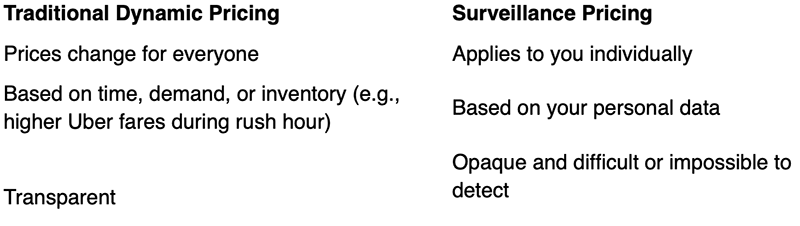
This goes far beyond the more familiar concept of dynamic pricing, think Uber’s surge rates or airline fare changes that apply to everyone. Surveillance pricing is individualized. It’s based on what a company thinks you are willing to pay based on what they can infer from the massive amounts of data they are rapaciously collecting about you from your purchases, your email, your searches, your apps and your so called “smart” devices, aka the Internet of Things devices.
Here’s a quick comparison:
A few real world examples:
1. Online shopping: Consumer Reports found prices on Instacart varied significantly for identical items at the same store. Volunteers saw differences up to 23%. Adding up to over $1,200 a year for a typical family. After public backlash, Instacart ended its AI driven pricing tests in December 2025, but it showed how apps tailor prices based on your data at chains like Kroger or Albertsons.
2. Travel and airlines: Airlines like Delta announced AI driven pricing models in 2025 that factor in browsing behavior, urgency, and location. If you’re searching repeatedly for a last minute flight, the system may interpret that as desperation and raise the fare. Delta faced scrutiny and clarified they use broader data, not pure individual targeting and no specified evidence has been found of surveillance pricing.
3. Retail and grocery apps: Major retailers use digital coupons and app based offers that differ from shopper to shopper. Two people standing in the same aisle may see different prices depending on their loyalty history, neighborhood, or past purchases.
4. Device based pricing: Studies have shown that some retailers historically charged more to shoppers using iPhones, assuming they had higher incomes. While many companies deny doing this today, regulators continue to investigate device based price differences.
5. Ride-sharing: Uber has been accused of using phone battery level as a pricing signal although the company denies it. This illustrates how easily personal data collected from your devices can be repurposed for many things you may not understand or appreciate, including pricing decisions.
Why surveillance pricing should concern you
Surveillance pricing isn’t just about paying a few dollars more. It reshapes the entire marketplace in ways that undermine privacy, fairness, and trust. Ever wonder why your friend pays less for the same flight? Surveillance pricing might be the answer.
1. It erodes your privacy.
Your clicks, searches, and app activity are fuel for pricing algorithms. Companies track:
• Items you hovered over
• Products you abandoned in your cart
• Your location and ZIP code
• Your device type
• Time of day and even weather patterns
Behind the scenes, data brokers package and sell additional information about you such as income estimates, health related searches, and family status to retailers looking to refine their pricing models. The FTC’s 2025 findings highlight how this incentivizes more spying.
2. It creates unfair, unequal pricing.
Surveillance pricing aims to charge each person the maximum they’re willing to pay. For example:
• A new parent searching for baby items might get higher prices than a neighbor without kids.
• A shopper in a low-income ZIP code could be charged more because the algorithm assumes they won’t comparison shop.
• A loyal customer may get fewer discounts because the system knows they’ll return anyway.
3. It destroys transparency.
When prices are personalized, comparison shopping becomes nearly impossible. You can’t know whether the price you see is the same one your friend sees or whether it’s inflated based on your data.
This secrecy gives large companies a powerful advantage over smaller competitors who can’t access the same data.
Limitations on surveillance pricing
• It may not be legal in every state.
• It’s not always technically accurate.
• It can backfire when consumers notice.
What you can do to protect yourself from surveillance pricing
The good news is that you are not powerless to protect yourself from surveillance pricing. Consumers have already pushed companies to reverse course, like Instacart, and you can take steps to limit how much your data fuels surveillance pricing.
1. Reduce the data companies can use
• Focus on privacy friendly products and platforms. You can see those I use here.
• Use a reputable Virtual Private Network (VPN) to mask your location.
• Clear browser cookies and shop in incognito mode.
• Reduce the number of apps you have on your devices.
• Limit the amount of data that apps can collect about you including location information.
• Use tracker blocking web browser extensions like uBlock Origin or Privacy Badger.
• Reduce or eliminate Internet of Things devices. The less you have, the better.
• Compare prices across devices or ask a friend to check the same item.
These steps don’t eliminate surveillance pricing, but the more you limit your digital footprint the more difficult it is to profile you. You can find more details on how to limit your digital footprint here.
2. Watch for signs of personalized pricing
You may be experiencing surveillance pricing if:
• Prices jump after repeated searches.
• Discounts disappear when you log in.
• You see different prices on different devices and/or different locations.
• Apps offer fewer deals as you use them more.
Document suspicious patterns with screenshots and report them to your state attorney general or the FTC.
3. Support stronger consumer protections
Momentum is building for new laws:
• New York’s Algorithmic Pricing Disclosure Act (effective November 2025) now requires companies to disclose when prices are set using personal data: “THIS PRICE WAS SET BY AN ALGORITHM USING YOUR PERSONAL DATA.”
• California, Colorado, and other states are investigating algorithmic pricing practices under privacy laws.
• The FTC has been studying how retailers use personal data in pricing since 2025 and continues to monitor for harm.
• If you live in Kentucky, learn how the Kentucky Consumer Data Protection Act (KCDPA) may help.
Join petitions from groups like Consumer Reports or EPIC. Your voice matters, consumer backlash has already forced changes. Especially in states like Kentucky which now have consumer data privacy laws.
The bottom line
Surveillance pricing isn’t a distant, theoretical threat. It’s already shaping the prices you see. It can mean paying more for groceries, losing discounts, or being charged extra simply because an algorithm thinks you’ll tolerate it based on your data.
But awareness is powerful. When consumers understand how their data is used, they can push back by protecting their privacy, demanding transparency, and supporting laws that keep pricing fair.
Your data shouldn’t determine your worth. And the more we shine a light on surveillance pricing, the harder it becomes for companies to quietly use your data against you. Use the tips above to get started protecting your privacy today.
Dave Hatter is an award-winning technology leader with over 30 years of software engineering and cybersecurity experience and is an employee owner and Cybersecurity Consultant at Intrust IT.