












Thirty years in safety and risk management industry have taught me that manholes are one of the deadliest confined spaces a worker can enter. What the public rarely hears is that the same hole in the ground is just as dangerous to the people walking, driving, and cycling above it — and most of them have no clue.
In a single week, two stories crossed my desk that caused me to pause, pick up the keyboard, and make this public service announcement to better inform you of this dangerous hazard in your neighborhoods and community streets.
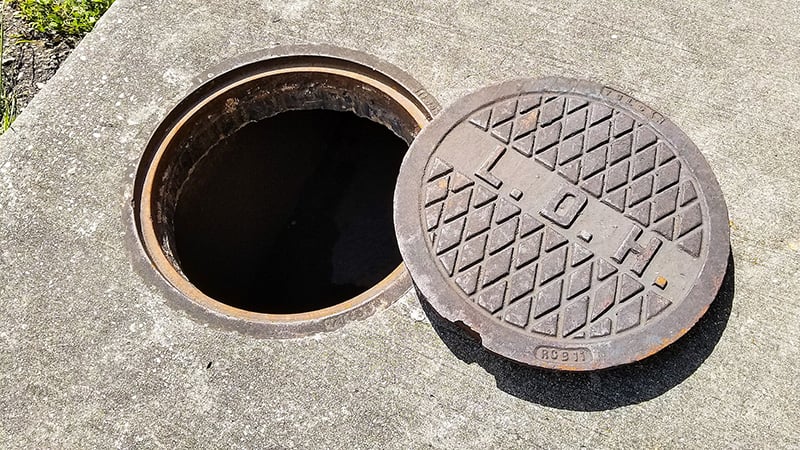
The first involved a construction client that had allegedly installed an improperly sized manhole cover. While that may sound like a minor mistake, the consequences were anything but minor. Later that same day, a driver struck the loose cover at speed, causing the vehicle to roll over, resulting in severe injuries.
The second incident came a day later via a news notification on my cellphone: Just before 11:20 p.m. in Midtown Manhattan, a woman stepped out of her SUV at West 52nd and Fifth Avenue and dropped ten feet into an uncovered manhole.
Unfortunately she never climbed out. Investigator later discovered nearby video footage showed a passing truck had dislodged the cover minutes earlier. Scalding steam from the shaft triggered cardiac arrest before help could arrive.
Many of us have crossed dozens of manholes daily without a second thought. Fixed in sidewalks, crosswalks, and roadways, these cast-iron covers look innocuous, harmless and safe. I can tell you with great certainty that they are not.
I asked an account manager who intakes claims within our public entity division just how frequent manhole claims are and she said that they probably receive a couple of dozen such claims a year, most of which are minor in nature.
However, nationwide very year hundreds of pedestrians, cyclists, and children are injured by slip trip and falls, plunges into, explosive ejections, crashes, and steam burns — the predictable outcome of deferred maintenance — and entirely preventable.
Manholes — also called utility holes and maintenance holes — provide access to underground utility systems like sewer, stormwater, telephone lines, gas lines and electrical networks.There are an estimated 25 million manholes in the US and that is just sanitary sewer manholes.
According to data from the National Trauma Data Bank (NTDB), roughly 20 to 49 people per year suffer severe trauma from falling into open or improperly secured manholes. There is no single official database tracking all pedestrian manhole falls worldwide. However, medical trauma studies estimate that between 20 and 50 people a year require emergency treatment for severe injuries caused by falling down open manholes or storm drains
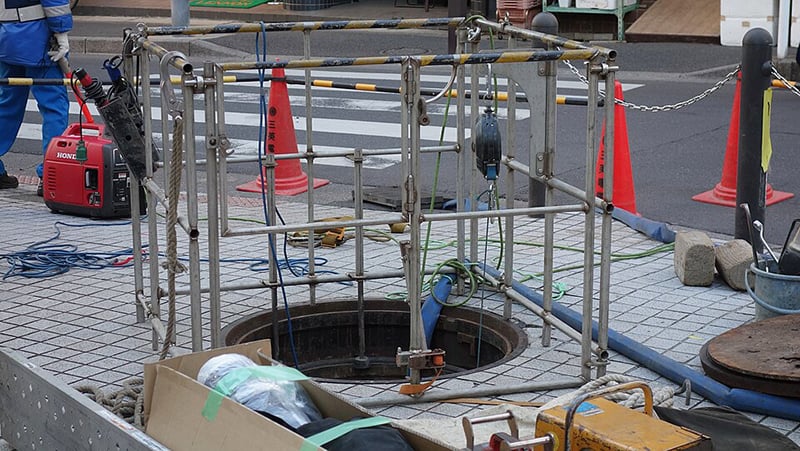
Such injuries follow noticeable and repeating patterns. Falls into open or unguarded shafts are the most severe — a maintenance crew that leaves an open manhole without barriers, even briefly, creates an invisible trap for the public. In the daylight, a pedestrian may see the hazard in time but after the sun falls they often do not.
Manhole cover failure and displacement will injure people when cast-iron lids are improperly reseated after maintenance work, corroded at their frames, or simply worn beyond safe tolerances. The fact is a manhole cover that rocks under foot pressure can flip without warning and can cause severe injuries.
For scooters and cyclists, such hazards are very real. Some manholes represent a chronic design failure as parallel-slotted grate covers that serve drainage functions are bicycle tire traps. A front wheel dropping into a slot at any speed locks instantly — the rider goes over the handlebars. In 2021 in San Franciso, a commuter cyclist hit one of these types of manholes and suffered traumatic brain injures broken collarbone and facial fractures.
Power wheelchair users navigating a cover that has settled below grade face tip-over forces that produce the same result as a car accident.
Explosive ejections are the most alarming hazard for bystanders — electrical arcing or gas ignition beneath a utility vault can launch a 300-pound cover into the air as a lethal projectile, with no visible warning to anyone on the sidewalk above.
In my industry manhole injuries carry serious financial consequences. Municipalities, utilities, and contractors face premises liability that routinely produces six-figure settlements and multi-million dollar judgments — especially when a reported defect went unaddressed.
“The common thread across every one of these incidents is not bad luck. It is the failure of a responsible party to maintain, inspect, secure, or adequately warn. These are not accidents. They are the foreseeable consequences of deferred maintenance and inadequate safety protocols.”
A lot of the country’s sewer and utility infrastructure is old — really old. Some of the frames and covers still in use have been there for 50 to 80 years, and over time they corrode, shift, and become unstable. On top of that, contractors sometimes make the problem worse by leaving manholes open, poorly marked, or not properly secured after work is done. When that happens, the people most likely to get hurt are often the most vulnerable — kids, older adults, wheelchair users, and anyone walking through the area at night.
In my opinion, that’s what makes this so frustrating. These aren’t freak accidents. Most of them are the result of neglect, rushed work, or someone deciding a basic safety precaution could wait.
When it comes to manhole hazards, responsibility depends on who is in control. Contractors are responsible for keeping active work areas safe. Utilities are responsible for the infrastructure they own. Municipalities are responsible for the streets, sidewalks, and other public areas people use every day. Each has a real duty here, and it’s not optional. The recommendations below aren’t idealistic best-case practices — they’re the basic steps that should already be happening
Construction contractor active work zone public safety obligations
 Keven Moore works in risk management services. He has a bachelor’s degree from the University of Kentucky, a master’s from Eastern Kentucky University and 25-plus years of experience in the safety and insurance profession. He is also an expert witness. He lives in Lexington with his family and works out of both Lexington and Northern Kentucky. Keven can be reached at kmoore@higusa.com
• Work Zone Guarding – Never leave an open manhole unguarded, ever.
• Lightening – Illuminate open manholes and barricades during all low-light hours. Reflective cones do not meet the standard.
• Pedestrian Detours – Provide a protective, accessible detour for every sidewalk closure. Directing pedestrians into traffic is not a detour. Every closure needs a marked, protected route accessible to wheelchairs, strollers, and visually impaired users.
• Cover Restoration – Document cover restoration with a written checklist and photos before leaving any site.
Public utility companies: Infrastructure design, condition and response duties
• Cover design – Replace parallel-slot grate covers on all bike and pedestrian routes. Parallel-slot covers cause cyclist ejections and wheelchair tip-overs citywide. A funded, time-bound replacement schedule is a minimum standard of care.
• Defect response – Treat public defect reports as same-day emergency safety events. Missing or open covers require same-day response; rocking or displaced covers, 48 hours. Every report must be timestamped and tracked to documented closure.
• Explosion prevention – Monitor underground gas and arc-fault risk in active vault corridors.
• Proactive replacement – Fund cover and frame replacement before failures injure someone. Corroded frames and cracked covers are predictable end-of-life failures. Risk-tiered inspection cycles must drive proactive replacement—reactive repair after an injury is indefensible.
Municipalities: Public right-of-way governance and accountability
• Permitting – Require right-of-way permits with enforceable public protection terms. No manhole in a public right-of-way should be opened without a permit that specifies traffic control, pedestrian detour, nighttime lighting, and cover restoration requirements—with financial penalties and work-stop authority for non-compliance.
• Defect tracking – Assign tracking numbers and response timelines to every public report. A report submitted to a 311 system that disappears without a tracking number is a documentation gap that becomes a liability gap. Published, enforceable response timelines create accountability and protect the municipality in litigation.
• ADA audit – Audit and remediate all covers on designated accessible routes. Remediate elevation discontinuities above one-half inch and parallel-slot designs on accessible routes—both a safety duty and federal requirement.
• Capital investment – Budget manhole replacement as a public safety capital priority. A single premises liability judgment for a preventable manhole injury routinely exceeds the cost of replacing dozens of covers. The financial case for proactive infrastructure investment is as clear as the moral one.
Manholes are among the most common urban infrastructure features and the most overlooked public safety hazards that is preventable. The gap between their unremarkable appearance and their lethal potential is what makes them dangerous. Each incident reflects a decision — or a failure to make one — by a contractor, utility, or municipality.
The public cannot see, anticipate, or fix these hazards. That obligation belongs to the organizations that own the infrastructure beneath our feet. The question is not whether they have the tools to prevent these injuries. They do. The question is whether they will use them.
Be safe my friends.