










By Dylan Mahorney
Special to NKyTribune
In the Antebellum Era, the Ohio River was not nearly as wide or deep as it is today. During particularly hot summers, the river could dry up so much that “boats were grounded and horse drawn wagons easily crossed the river …” On the other hand, cold winters would freeze the Ohio River completely. For commercial and traveling purposes, these events would be barriers. But for others, this was an opportunity. (Lois Wright Morton and Kenneth R. Olson, “Securing the Nation’s Infrastructure: The Ohio River,” “Journal of Soil and Water Conservation,” Vol. 74, no. 1, January 2019)
For enslaved African Americans, the Ohio River could serve as a gateway from the slave states of Kentucky and Virginia to the free states of Ohio, Indiana, Illinois, and Pennsylvania. This divide between free and slave states earned the region the title of “Borderland.” Here the Underground Railroad flourished as a secret and loosely organized series of networks where Whites and Free Blacks worked to help enslaved people escape to freedom. They did so despite the Fugitive Slave Act of 1850, which demanded that all freedom seekers be returned to their enslavers. An additional section of the act even stated that officials could force ordinary citizens to assist with captures.
Fugitive slave trials were also common in the region. One case of note was that of Margaret Garner and her family, highlighting how slaveholders and abolitionists shaped their legal strategies regarding fugitive slave cases. In many ways, the Garner case escalated the national debate over slavery, freedom, and federal power.
The Garner family of Boone County saw the Ohio River as their chance for freedom. Margaret Garner was born in Richmond in 1833. She spent most of her life enslaved on Maplewood Plantation in Boone County, owned by John Gaines. Gaines sold his plantation and enslaved people to his brother, Archibald Gaines, when John left the state to serve as governor of the Oregon Territory (Nikki Marie Taylor, “Driven toward Madness: The Fugitive Slave Margaret Garner and Tragedy on the Ohio.” Athens, Ohio: Ohio University Press, 2016, p. 37; “Fugitive Slave Case: Before U.S. Commissioner J.L. Pendory [sic]. Testimony for the Claimant,” “Cincinnati Daily Enquirer,” February 10, 1856, p. 3).

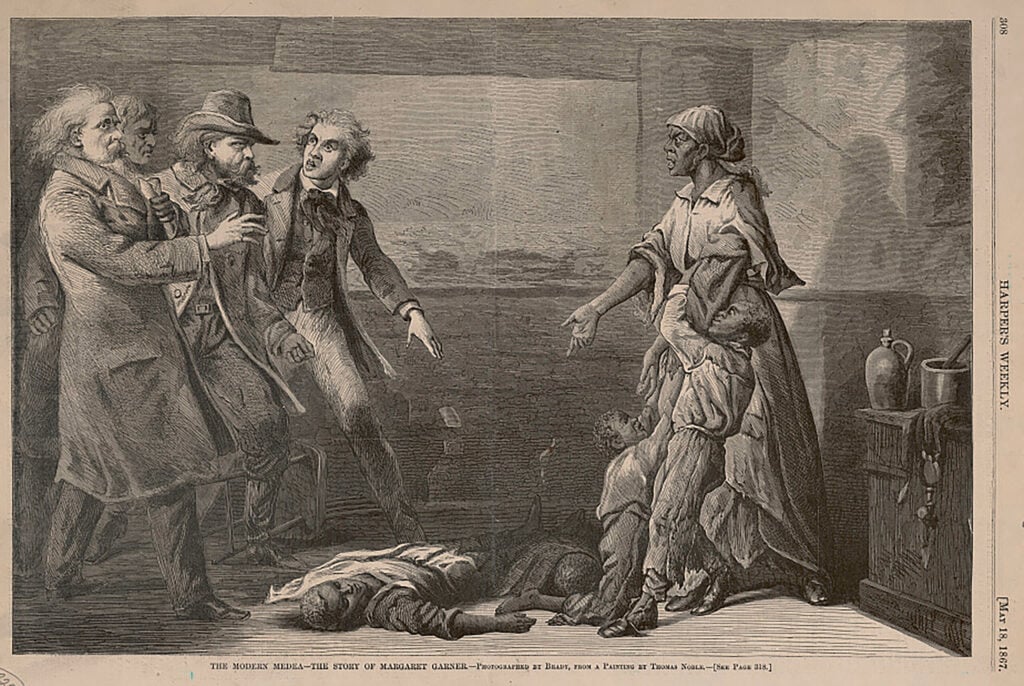
In late January 1856, the family of Margaret Garner and her husband Robert (enslaved by a neighboring plantation) crossed the frozen Ohio River into Cincinnati, Ohio. They fled to the home of relatives in Cincinnati’s West End. However, they were soon discovered by slave catchers and U.S. marshals, who surrounded and broke into the house. Margaret Garner, in an act some say was unforeseen, took the life of her youngest daughter, Mary, rather than see her return to slavery. The “Louisville Daily Courier” described how the child’s “throat was cut from ear to ear, and the blood was spouting out profusely …” (“Horrible Affair. Arrest of 8 Fugitive Slaves. Desperate Resistance. A Child Slain by Its Mother,” “Louisville Daily Courier,” January 30, 1856, p. 2).
Margaret Garner proceeded to bring additional physical harm to the other children before she was captured by the marshals. What made Garner wish to harm or kill her children? Why did the Garners want to escape from slavery? What arguments were used to defend and attack their actions? Questions like this filled the minds of many people throughout the nation. Were the Garners martyrs for freedom as abolitionists believed or violent runaways as proslavery advocates countered?
These events raised complicated questions that the court would have to confront. The fugitive slave trials surrounding the Garner family began just a few days after their arrests. The major defense arguments focused on the fact that many members of the Garner family had been in Cincinnati and the state of Ohio a number of times with their owner’s knowledge. Mary Garner, the mother-in-law of Margaret, gave an affidavit stating she had visited Cincinnati several times to attend the Methodist Church in the company of her enslavers. In addition, several witnesses cited that they had seen Robert Garner in Cincinnati during the previous Christmas season (“The Defense. Affidavits of the Fugitives. Intense Excitement,” “Cincinnati Daily Enquirer,” January 31, 1856, p. 3; “The Fugitive Slave Case: Before United States Commissioner Hon. John L. Pendery,” “Cincinnati Daily Enquirer,” February 3, 1856, p. 3).

The defense argued that the many times the Garners were in Cincinnati — with their enslavers’ knowledge — would automatically make them free. On the other hand, the prosecution argued that the affidavits made by the Garners could not be trusted due to their status as enslaved people. The argument was whether enslaved people’s status as enslaved traveled with them when they entered free states. The defense pushed this argument in hopes that Ohio law would support it, despite the federal Fugitive Slave Act of 1850 denying the Garners’ freedom.
Beyond legal arguments, the defense also leaned on moral and emotional appeals. While imprisoned, Margaret Garner was interviewed by abolitionist Lucy Stone Blackwell. Garner offered her reasons for killing her child, which Blackwell echoed in a bold speech at the trial. Blackwell detailed the brutality of slavery, especially to African-American women. She pointed to “the faded faces of the negro children” which told “too plainly to what degradation female slaves submit.” The “faded faces” were those of Garner’s enslaved children, who were perhaps the result of sexual abuse towards Margaret Garner by her enslaver, Archibald Gaines. Robert Garner was typically sent away to work for extended periods of time. When he returned to the Boone County plantation, he discovered that Margaret was pregnant (“Lucy Stone Blackwell and the Fugitive Slaves,” “Louisville Daily Courier,” February 15, 1856, p. 4).
Other sources likewise referred to Garner’s children as “mulatto,” meaning that they had a mix of Black and White ancestry. For the defense and the abolitionist community at large, these details were necessary to depict Margaret’s actions not as senseless violence but as a motherly, desperate attempt to prevent her child from experiencing the same kind of abuse she had received (Taylor, p. 39).
Despite these defenses, the court ruled against the Garners. The commissioner overseeing the case cited a Supreme Court ruling that even if slaveowners took enslaved people with them into free states, it was not or could not be considered the slaveowner releasing them.
Yet another possibility remained for abolitionists to try to free Garner. If she were charged for the murder of her child on Ohio soil, a sympathetic jury might find her not guilty. And even if she were sentenced, some believed imprisonment was a better alternative than enslavement. The Attorney General of Ohio order the extradition of Garner to Ohio, but she and the rest of her family had already been sold further south (Julius Yanuck, “The Garner Fugitive Slave Case.” “The Mississippi Valley Historical Review,” vol. 40, no. 1 (1953): pp. 47–66).

The final fate of the Garners was quite unfortunate. An 1870 “Cincinnati Chronicle” interview of Robert Garner revealed that the Garners were sold to Archibald Gaines’ brother in Arkansas and later to a different enslaver in Mississippi. While being transported via steamboat, a crash occurred that resulted in daughter Cilla Garner’s death by drowning. The sons, Tommy and Sammy, remained enslaved in Mississippi, and their fate is still unknown to this day. Robert died in 1871 and was supposedly buried in Cincinnati.
The Garner’s story, marked by loss, separation, and unknowns, reflects the brutal realities that enslaved families faced. They are a reminder of the families who were torn apart and lives forever altered by a system of bondage and violence (“The Margaret Garner Story,” African Americans of the Kentucky Borderlands, Boone County Public Library, https://omekas.bcplhistory.org/s/borderlands/page/GarnerStory).
The Margaret Garner case reveals the deep legal and moral struggles over slavery in the Ohio River Valley in the years before the Civil War. In this Borderland, the Fugitive Slave Act became a tool for enforcing bondage while abolitionists worked to oppose it. The Garners’ attempted escape, the death of Mary, and the courtroom arguments show contradictions in a system where human beings were seen as property that denied their humanity. Although the ruling returned the family to enslavement, the trial drew national attention and showed the brutal realities that enslaved people, especially women like Margaret, faced. The Garner case demonstrated how the conflict over law and humanity played out in the Borderland.
Dylan Mahorney is a graduate student in Northern Kentucky University’s Public History Program. He received his bachelor’s degree in history, with minors in military history and honors, from Northern Kentucky University. The author’s favorite subjects of history are the American Civil War, World War II, and the Cold War.
Paul A. Tenkotte, PhD is editor of the “Our Rich History” weekly series and Professor of History at Northern Kentucky University (NKU). He also serves as Director of the ORVILLE Project (Ohio River Valley Innovation Library and Learning Engagement). He can be contacted at tenkottep@nku.edu.