












For nearly a century, the hard hat had one fairly straightforward job: take the hit so your head doesn’t have to. Before OSHA standards, formal PPE programs, and toolbox talks became part of the jobsite routine, worker safety often came down to common sense, experience, and a little luck — and luck has never been much of a safety program.
The modern hard hat traces back to the early 1900s, when E.D. Bullard, a California mining equipment supplier, developed what became known as the “Hard Boiled Hat.” Inspired by the helmets used during World War I, Bullard’s version was made from steamed canvas, glue, and black paint. Compared to today’s equipment, it was about as high-tech as a lunch box, but for workers facing falling debris and serious head injuries with little protection, it was a major step forward.
It has protected workers from falling wrenches, lumber, debris, and all the other surprises a jobsite likes to throw at people before lunch. But now we’re seeing products like Guardhat and Knowit’s connected helmet that do a lot more than just sit there and look OSHA-compliant.
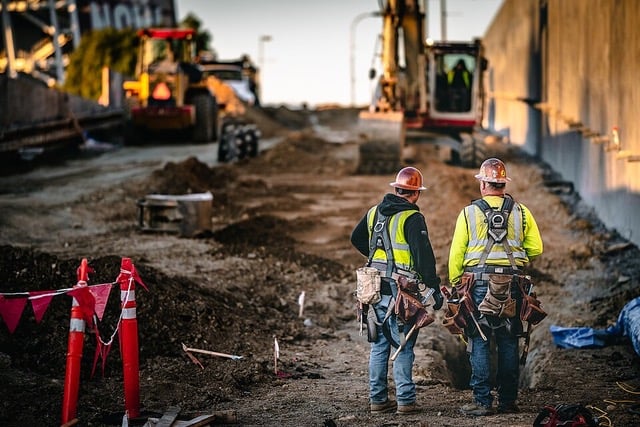
Some of these smart wearable hard hats will have a QR code that can be scanned and will pull up all their training records for the person wearing the hard hat. They can also detect falls, register impacts, monitor body temperature, and alert a worker when they get too close to a crane, excavator, or other piece of heavy equipment — which is helpful, because arguing with an excavator is not usually a winning strategy.
As a safety and risk management guy, I can appreciate the appeal. On paper, this sounds like a big step forward and in construction, where serious injuries and fatalities are still far too common, anything that helps keep people upright, alert, and out from under heavy equipment deserves a serious look. But before a company starts handing out smart hard hats like party favors at the safety meeting, there are a few questions worth asking: “what do we gain, what do we give up, and are we prepared to manage both?”
There is a strong argument in favor of this kind of wearable technology, and the safety argument is the easiest one to make. If a sensor detects a fall and notifies a supervisor within seconds, that can make a major difference in response time. Heat-stress monitoring may identify a worker who is getting into trouble before it turns into a medical emergency. Proximity alerts around heavy equipment can also provide another layer of protection on a busy, noisy jobsite where supervision alone is not always enough.
There may also be a financial argument. Builders risk and casualty markets are starting to take a closer look at contractors who can document real-time risk controls. For example, in my line of work working for an insurance broker we have already seen this with water leak-detection sensors, where some programs have offered lower deductibles or premium consideration because the controls are measurable.
Measurable results for an underwriter pricing out your future premiums, such information should warrant a credit, which is essentially a bet against future losses. So, they need evidence, not intentions, before they’ll price that bet lower. Premiums are built on expected loss frequency and severity and an underwrite can’t adjust the math based on “be bought some hard hats.”
They need quantifiable shift (e.g ., drop in recordable accidents, lower experience mod, fewer claims per man-hour) that moves the loss projections. Requiring measurable results filters out programs that look good on paper from ones that change the loss curve; otherwise, every insured could ask for a discount for owning safety equipment, regardless of whether it’s actually used or effective.
A contractor needs to show adoption data, incident trends, and how the wearable technology tie into an actual reduction in claims frequency or severity, not just proof of purchase.
There is also a benefit of documentation, especially when something goes wrong. Sensor data may help confirm what happened, when it happened, and where it happened. That can improve OSHA recordkeeping accuracy and may help move a workers’ compensation claim toward resolution instead of turning it into a drawn-out dispute.
That said, none of this comes without a cost. The first issue is trust. Workers are going to have questions when a company starts tracking location, movement, impacts, and body temperature, even if the stated purpose is safety. Most employees do not get excited when their hard hat suddenly starts acting like a Fitbit with a subpoena risk. If they feel like they are being watched instead of protected, the rollout can go sideways quickly. That is especially true if the company introduces the technology without clearly explaining why it is being used, what data is being collected, and how that information will be handled.
 Keven Moore works in risk management services. He has a bachelor’s degree from the University of Kentucky, a master’s from Eastern Kentucky University and 25-plus years of experience in the safety and insurance profession. He is also an expert witness. He lives in Lexington with his family and works out of both Lexington and Northern Kentucky. Keven can be reached at kmoore@higusa.com
The second issue is legal exposure. Contractors need to understand that data can cut both ways. The same information that proves that a company responded quickly to an incident may also show that the company knew about a hazard and failed to correct it. If a device records repeated near misses at the same ladder, trench, access point, or blind corner before an injury occurs, that record may become evidence in a claim or OSHA investigation. Depending on the facts, it may not help the employer.
There is also the practical side of it: equipment costs, software fees, training, connectivity issues on jobsites, and the ongoing question of who gets access to the data and how long the company keeps it. None of these problems are necessarily deal breakers, but they are real, and they get bigger as more employees and jobsites are added.
Contractors cannot let the technology create a false sense of security. A smart hard hat may detect a fall, but it does not prevent the fall from happening. It does not replace ladder safety, fall protection training, equipment spotters, good supervision, or basic hazard correction. Technology should support a safety program, not become the safety program.
So where does that leave contractors? My advice is simple: do not buy the technology first and then try to build the policy after the fact. That is a little like buying a bulldozer and then deciding to read the operator’s manual after it rolls through the construction trailer. Start with a written data governance policy. Spell out what will be collected, why it is being collected, who can access it, how long it will be kept, and how it will and will not be used. Legal counsel should review that policy before the first device goes on a worker’s head — not after the first incident, when everyone suddenly develops a deep interest in the fine print.
Contractors should also talk with their insurance broker before renewal. Underwriters cannot give credit for controls they do not know about. A few devices on one job site will not carry the same weight as a documented, consistent program across the company. If the contractor is going to spend the money, the investment should show up in the total cost of risk discussion, not just as another line item in the safety budget.
If AI does not take your job in the near future, it may still become the overly helpful coworker who follows you around the job site reminding you to hydrate, tie off, watch your step, and stop treating heavy equipment like it has a sense of humor. Think of it as a digital safety manager riding shotgun in your hard hat that is part coach, part hall monitor, and part annoying seatbelt chime that happens to be right more often than you want to admit.
Smart hard hats are a real advancement, but they are not a magic fix. They can provide valuable information, improve response time, and support better risk management, but they still are not going to replace common sense, good supervision, or a solid safety program. Think of them like backup cameras on a pickup truck: helpful, smart, and occasionally lifesaving, but if you back into the dumpster while staring at your phone, the camera was not the problem.
Be safe my friends.