

















By Stephen Enzweiler
Special to NKyTribune
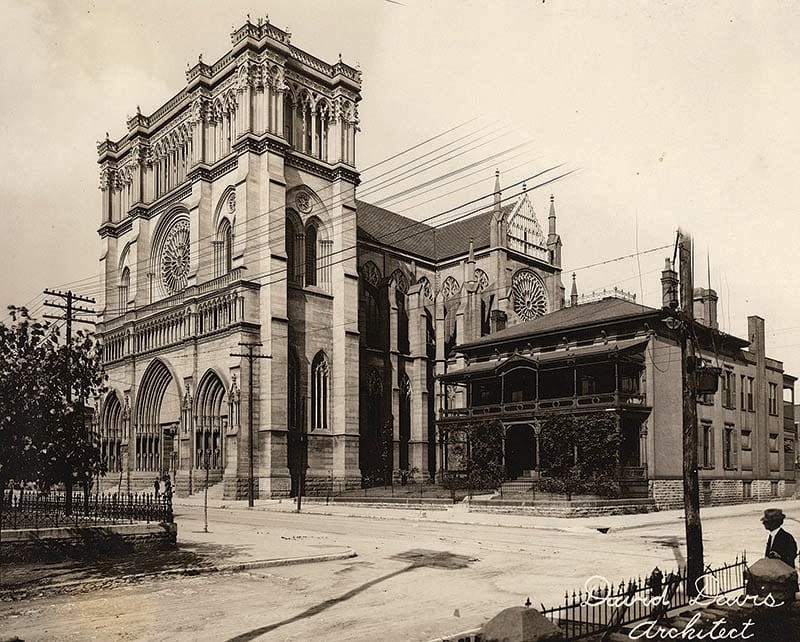
On a warm, cloudless June morning, a father and son stood together on the sidewalk on Madison Avenue gazing up at the imposing façade of the Cathedral Basilica. As they stood there, they admired the statues of the saints, pondered the tympana reliefs above the portals, and marveled at the architectural accomplishment of the recently restored limestone. Just then, they were surprised by an old man dressed in tattered clothes and wrap-around sunglasses who approached them with the lively greeting, “Hi kids! Have you been inside?”
The father and son said they had. With an almost childlike enthusiasm, the old man began to describe his many experiences of visiting the Cathedral Basilica, expressing a distinct sense of the awe and wonder he found there.
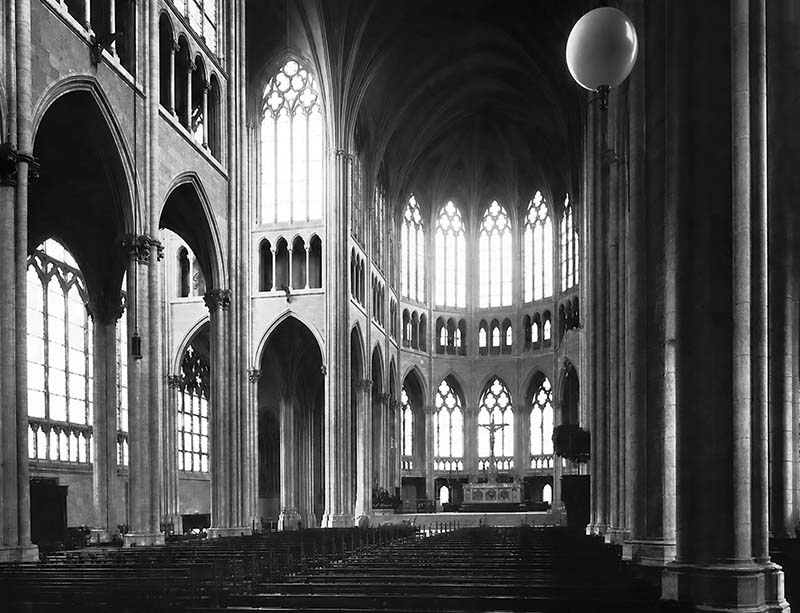
“You got to go inside and experience it,” he went on to say, his voice growing increasingly emotional. “Go inside and sit in the last pew for a while and just look around at everything,” he said. “Then, get up and go sit in the front pew for a while and look around. It’s…amazing!”
As he continued to tell his story, it quickly became apparent to the father and son that the old man wasn’t simply describing the things he saw. Rather, his words seemed to take on the tone of a testimonial of how his encounter with the Cathedral had caused a change in him somehow. He said he often liked to go in and just sit. Nothing more. He also made the point of how “very grateful” he was that the Cathedral was there, because he said it was a place where he knew he could always go to find peace and hope. Then he turned to continue on his way down the street. The father and son thanked him for stopping to talk. He turned around and smiled. “No,” he said. “Thank you for taking the time to talk with me.”
For anyone who spends any time hanging around the Cathedral Basilica of the Assumption in Covington, this kind of encounter isn’t uncommon. At any hour of the day, people can be seen pausing in front of the façade or lingering in the parking lot, milling about in groups or by themselves, looking up at the limestone edifice towering over them, pointing to it, talking about it, snapping photos of it, or just standing in its shadow trying to take it all in. Tens of thousands travel to Covington each year to see it. They come on tours, in groups large and small, as individuals and families, young and old, and from a wide variety of faiths. They come from places with far-away names … from France, Germany, Poland and Japan, from small towns and great cities across the United States, and from people’s homes just around the corner. But to think such attention is a modern phenomenon would be to forget how much excitement it generated and the attention that was paid to it even before it was built more than 125 years ago.
The old St. Mary’s Cathedral on East Eighth Street, built in 1853 when the Diocese was established, had for decades been suffering from the effects of overuse, age and environmental decline without any effective means of rescue. Accounts of its condition frequently appeared in the local papers, with one newspaper describing it as being one of the “least impressive” buildings in the city. Everyone knew a new cathedral was needed, and by early 1894, the nearly 600 Catholic families served by the old cathedral hinged their hopes on the new house of worship planned for the corner of Twelfth Street and Madison Avenue. Once the plans were made public and its details revealed, the newspapers quickly understood the scale of the undertaking and seized on the excitement it generated.
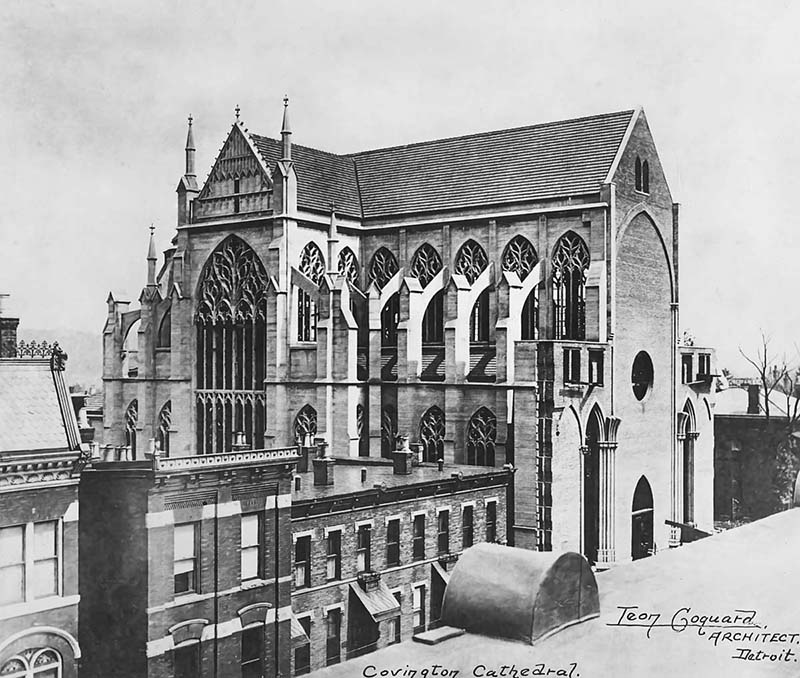
“The building will be an ornament to Covington,” the “Cincinnati Enquirer” predicted, “in fact, (it) would be to a city of 10 times its size! Even uneducated eyes can at a glance perceive the manifold beauties of architectural skill and ability combined in the construction of the edifice.” But while Bishop Maes laid no claims to it being as superb and grand as the cathedrals that graced England and the continent of Europe, he was convinced it would become the “finest temple of purely gothic architecture in America.” His architect, Leon Coquard, in a paper written in 1917, declared that St. Mary’s Cathedral “was designed with the idea in mind that it should stand for centuries as a monument symbolical of the strength and purity of the Catholic faith.”
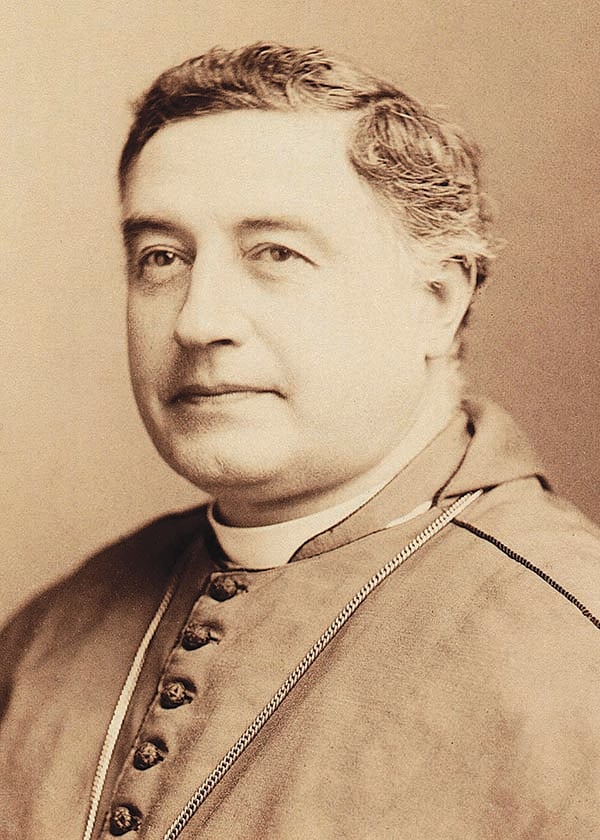
On Sunday, September 8, 1895, Bishop Camillus Paul Maes, the third Bishop of Covington, placed the cornerstone to the new Cathedral, still under construction. In his remarks that day, he told the more than 3,000 in attendance:
“The building of a church is a great act of religion. Of all the works performed by man, there is none greater – it is at once an act of mercy, of charity and devotion. Consider what cheering prospects this day opens to our view, and how intimately connected with the good of man – of yourselves, your children, nay unborn generations, is the building we have undertaken. We are here assembled to raise a temple to the honor of the Supreme Being, in which the voice of Religion will be heard, teaching us the Science of Salvation – introducing us to objects divine and immortal – elevating our thoughts above this earth to an Eternal future, and showing us how to attain the end of our creation.”
For six more years, the difficult work continued at the corner of Twelfth and Madison while the people of Covington watched in studied fascination as the vision of this new creation gradually took shape. Then on a cold January day in 1901, the people of Covington at last looked out their windows and saw their finished cathedral as it towered above the rest of the city. Soaring walls of stone and glass were surrounded by a web of flying buttresses and crowned by snarling gargoyles, mythical beasts and monsters.
Suddenly, people who had never known anything of the Old World now found it in their midst. It was as if a great cathedral from the medieval era had traveled through time and was somehow planted in their city. The new St. Mary’s Cathedral was so magnificent to the people of the day, it put Covington on the map as a destination, and it forever changed the lives of the people who lived there.
Even before the façade was added in 1910, artists and architects were streaming into Covington “from all parts of the nation,” one paper reported, “to see Covington’s famous Cathedral and to go away full of praise for the artistic triumph gained by Kentucky’s second city.” In 1914, the “Kentucky Post” added that the city suddenly found it “had risen high in the architectural annals of America by possessing the perfect Gothic edifice.”
It’s important to point out that Bishop Maes’ vision had never been to imitate or recreate what could already be found in Europe, but to bring into existence something new for his people, something that would give them a deeper and more profound spiritual encounter as well as a new art and architectural aesthetic for the city and the culture. In the end, he chose to build in the High Gothic style of 13th century France, not because he had any particular attachment to it, but because he knew that the splendor of the Gothic cathedral leads one invariably to the via pulchritudinis, the way of beauty – that enigmatic blend of art and religion that leads man on the privileged path by which he may approach the mystery of God.
“Centered within the cathedral are all the spiritual means which Jesus Christ places within His church for men’s salvation,” Bishop Maes wrote in his 1910 Jubilee message to the people of Covington. “Enter it freely, seek the Corpus Christi chapel, where the quiet and mysterious light shed around you will enable you to enter it yourself, realize God’s presence and help you on your weary way to see God’s will and lead a Christian life.”
For more than 125 years, the Catholics of the Diocese, the people of Covington, and throngs of visitors from around the world have been coming here to see the Cathedral Basilica. And they continue to come, seeking that spiritual encounter Bishop Maes always hoped they would find. It is a legacy that is still enduring well into the second century of its life, and it promises to endure for centuries to come. All of this because of a saintly Bishop who poured out 30 years of his life to give the people “this holy temple, that the soul, wearied with the things of earth, will come and commune with her God.”
The enduring legacy of the Cathedral Basilica is that it belongs to everyone and has always belonged to everyone, even to old men in tattered clothes and wrap-around sunglasses.
For more information on Covington’s cathedral, see:
• Our Rich History: A new cathedral was his dearest wish, but would his people ever see it?
• Our Rich History: The Bishop and the architect — and a vision for the future of Covington
• Our Rich History: Bishop Camillus Paul Maes meets unforeseen obstacles during Cathedral construction
• Our Rich History: Out of struggle and hardship, Covington’s new Cathedral is born
Stephen Enzweiler is the Cathedral Historian and Archivist of the Cathedral Basilica of the Assumption.
Paul A. Tenkotte, PhD is editor of the “Our Rich History” weekly series and Professor of History at Northern Kentucky University (NKU). To browse more than ten years of past columns, click here. Tenkotte also serves as Director of the ORVILLE Project (Ohio River Valley Innovation Library and Learning Engagement). For more information see orvillelearning.org. He can be contacted at tenkottep@nku.edu.