












By Paul A. Tenkotte, PhD
Special to NKyTribune
In the years following World War II, millions of Americans and businesses relocated to the suburbs. Members of the Greatest Generation (born between 1901 and 1927), later joined by the Silent Generation (born between 1928 and 1945), played a major role in the nation’s rapid modernization. Having endured both the Great Depression and World War II, they were determined to create better opportunities for their children. The promise of suburban living, complete with manicured lawns, backyard patios, barbecue grills, and garages for the family automobile, made the suburbs an attractive destination.
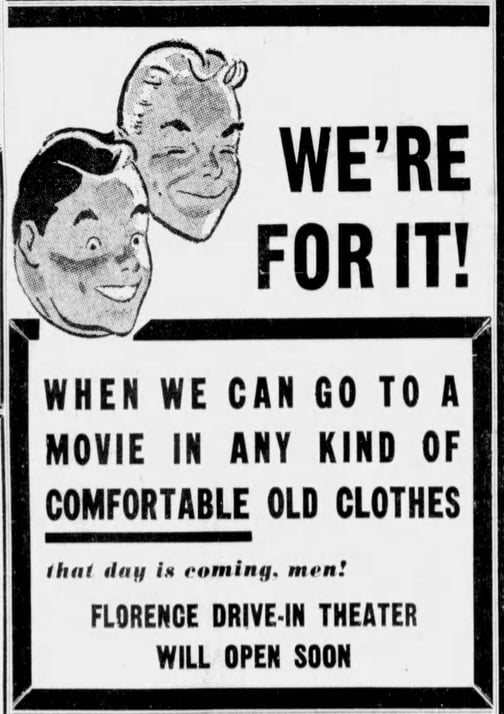
Automobiles provided a new sense of independence, giving people the freedom to travel where they wanted, when they wanted, without relying on someone else’s schedule. Shopping centers with ample free parking flourished, drive-in restaurants gained popularity, and new drive-in movie theaters appeared throughout Northern Kentucky.
Although television became increasingly popular in the postwar years, many people continued to enjoy movies in downtown theaters. Theater attendance remained a social occasion, shaped by the customs and expectations of the era. Smoking was prohibited in theaters due to fire safety regulations, and patrons were generally expected to dress neatly, reflecting the more formal standards of the time.
“You can bring the entire family … and nobody has to dress up!” declared the opening line of a “Kentucky Post” article announcing the arrival of Northern Kentucky’s first drive-in theater. The article emphasized this casual, family-friendly atmosphere as a major selling point when the Florence Drive-In Theater opened in May 1947. Situated along U.S. Routes 25 and 42, the theater featured a large outdoor screen and parking for 800 vehicles. The project was developed by local business leaders through the Richard P. Ernst Realty Company, headed by President William R. Macklin. The company also operated three prominent downtown Covington theaters: the Liberty, Madison, and Broadway (“Drive-In Theater to Open This Week,” “Kentucky Post,” May 21, 1947, p. 1)
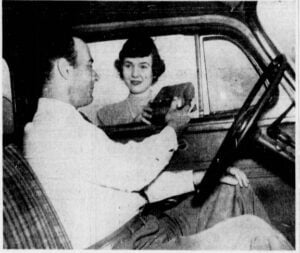
Tom E. Hill, general manager of the Florence Drive-In, highlighted several features designed to appeal to families. As he explained, “Children may watch the show or go to sleep on the back seat. And if they cry, no one will be disturbed in the other cars.” To further accommodate parents with young children, the theater even provided a free bottle-warming service for infants. Hill also emphasized the convenience and flexibility of the drive-in experience, noting that motorists could leave at any time without disrupting others and that late arrivals could enter after the show had begun. Unlike traditional theaters, patrons were free to come and go as they pleased, ensuring that neither the movie nor fellow guests would be disturbed.
Visitors who preferred not to watch the movie from their automobiles could take advantage of the Florence Drive-In’s “very comfortable reclining chairs and benches.” As an outdoor venue, the theater also allowed patrons to smoke while enjoying the show from their cars. To satisfy hungry moviegoers, the refreshment stand offered a variety of treats, including hot dogs, coffee, soft drinks, buttered popcorn, candy bars, cigars, and cigarettes.
Northern Kentucky’s second drive-in movie theater was Dixie Gardens, located on Dixie Highway in Lookout Heights, Kentucky (now Fort Wright). Slightly smaller than the Florence Drive-In, it accommodated up to 700 vehicles. The theater was developed by the locally based Dixie Gardens Outdoor Theater Corporation, led by veteran theater owner Willis Vance, whose career in the industry began in 1925 with Covington’s Strang Theatre. The property’s size was later reduced when Interstate 71-75 was constructed through the rear portion of the site.
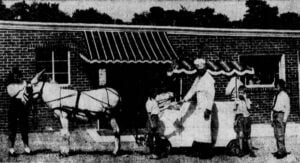
In August 1969, the Ernst Realty Company, which had long maintained a policy of exhibiting family-friendly films, sold the Dixie Gardens Drive-In to National Amusement of Louisville, Kentucky. The change in ownership soon raised concerns about community standards. The drive-in’s screen was plainly visible not only to motorists traveling on the nearby expressway but also to residents of a Fort Wright subdivision located across Interstate 71-75. In December 1970, Kenton County Commonwealth Attorney John J. O’Hara objected to three films being shown at Dixie Gardens, including two that carried an “X” rating and one rated “R.” Introduced by the Motion Picture Association (MPA) in 1968, the rating system restricted “X”-rated films to adult audiences, while “R”-rated films required viewers under the age of 17 to be accompanied by an adult (“Prosecutor Declares War on ‘X’ Films at Drive-in,” “Kentucky Post,” December 23, 1970. p. 1).
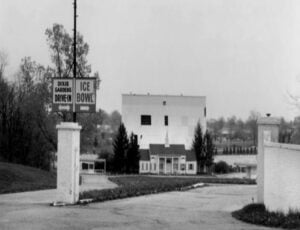
O’Hara’s legal challenge was not based on allegations of obscenity but rather on the claim that the films constituted a public nuisance because the drive-in’s screen was visible to minors. By Christmas 1970, the “Kentucky Post” reported that O’Hara and the new owners had reached a compromise. Dixie Gardens was permitted to complete the scheduled run of the three films, provided that certain scenes were removed. As part of the agreement, the theater’s owners also pledged not to exhibit X-rated films in the future.
Growing up in a Catholic suburban family during the 1960s, movie outings were relatively uncommon. Many of the downtown and neighborhood theaters were already beginning to decline, their aging facilities showing signs of wear and neglect. Drive-in theaters offered a different experience, typically screening two or three features each evening and usually opening with a family-friendly film geared toward younger audiences. It was not unusual for families in our neighborhood to dress their children in pajamas before heading to the drive-in. By the time the second feature began, many of the youngsters were already asleep in the back seat.
My parents were selective about the movies we saw. My mother especially favored films with wholesome themes, and even more so those with a Catholic connection, such as “The Singing Nun,” “Where Angels Go, Trouble Follows,” and “The Sound of Music.” I can still remember my father loading the family into the car for evenings at the drive-in. Over the years, we visited several of the area’s outdoor theaters, including the Dixie Gardens, Florence, Riverview, and Pike 27 drive-ins.
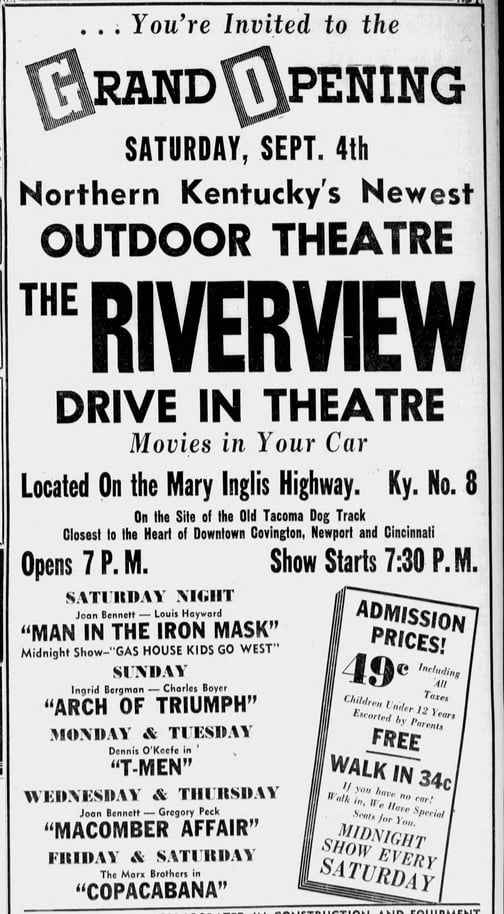
I do not recall which film we watched at the Riverview Drive-In Theater, located on Route 8 (Mary Ingles Highway) in Dayton, Kentucky. Situated along the Ohio River on the site of a former beach and amusement park called Tacoma, the Riverview was Northern Kentucky’s third drive-in theater, opening in 1948. What I remember most from a family visit there in the 1960s is not the movie itself, but the setting: a summer evening illuminated by flashes of lightning from a distant storm and accompanied by the gentle chirping of crickets in the background.
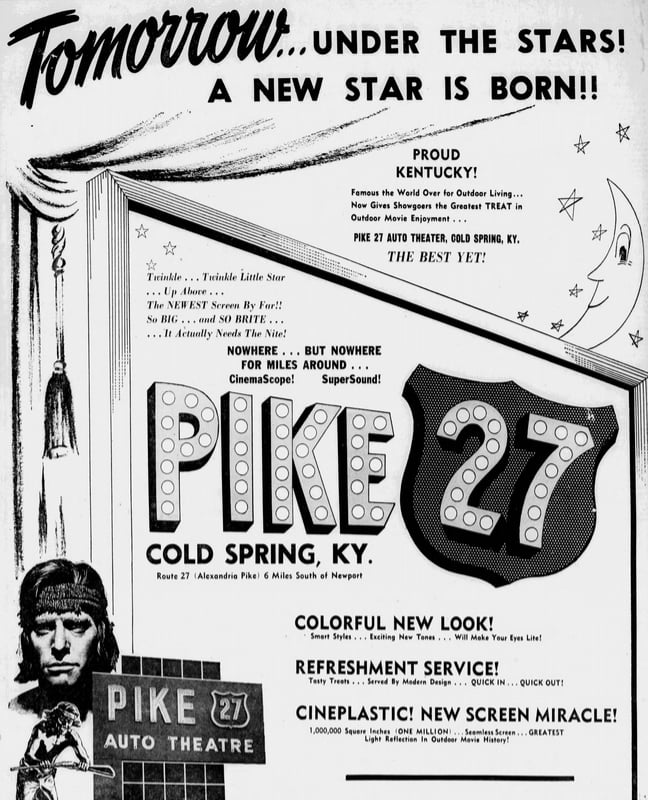
The fourth and final drive-in theater in Northern Kentucky was the Pike 27, located on U.S. Route 27 (Alexandria Pike) in Cold Spring next to the Plantation Club. It opened in the summer of 1954 and was developed by the M. & M. Theater Company as the largest drive-in theater in the Northern Kentucky suburbs of Cincinnati. The venue featured the latest projection and sound technology, including the newly introduced CinemaScope system. Launched by 20th Century Fox in 1953, CinemaScope was designed to lure audiences away from their television sets and back into movie theaters by offering an immersive ultra-wide-screen viewing experience. Paramount Studios followed in 1954 with an even higher-resolution widescreen film format called VistaVision.
By the mid-to-late 1960s, the heyday of the drive-in movie theater was beginning to fade. Television had become the dominant form of home entertainment, offering many of the same conveniences that had once made drive-ins so appealing. Families could now enjoy a wide range of programming from the comfort of their own homes, without even leaving the couch. With the three major networks, ABC, CBS, and NBC, joined by a growing number of independent and public television stations, viewers had more choices than ever before. At the same time, movie studios gradually eased their restrictions on television broadcasts of feature films. A major milestone came in 1961 when NBC launched “Saturday Night at the Movies,” bringing recent Hollywood films to a nationwide television audience and further challenging the popularity of drive-in theaters.
By the 1980s, the rise of cable television, Betamax and VHS technology, and neighborhood video rental stores accelerated the decline of movie theaters across the nation. As more families chose to watch films at home, attendance at drive-ins and traditional theaters continued to fall. Northern Kentucky’s drive-ins gradually disappeared: Riverview closed in 1982, Florence and Dixie Gardens followed in 1988, and Pike 27 screened its final movies in 1992. Although the automobile remained central to American culture, family entertainment had largely returned to the home, where, ironically, it had been before the advent of motion pictures.
Paul A. Tenkotte, PhD is editor of the “Our Rich History” weekly series and Professor of History at Northern Kentucky University (NKU). To browse more than ten years of past columns, click here. Tenkotte also serves as Director of the ORVILLE Project (Ohio River Valley Innovation Library and Learning Engagement). For more information see orvillelearning.org. He can be contacted at tenkottep@nku.edu.