










By Andy Furman
NKyTribune staff writer
Inflation. In Northern Kentucky. Bah, humbug.
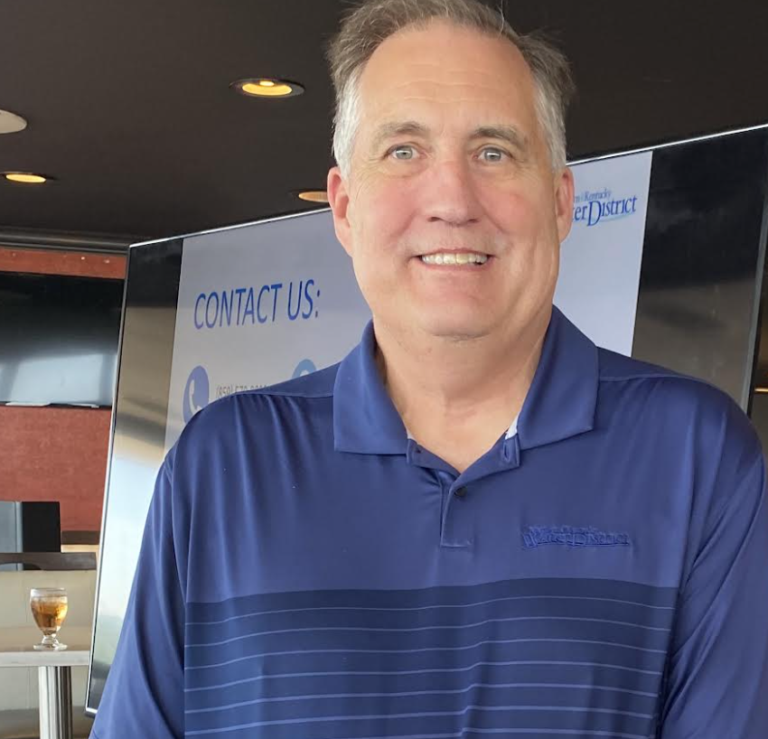
Richard Harrison, Vice-President of Engineering and Distribution at the Northern
Kentucky Water District has the numbers to, well, make you feel pretty good.
At least about your water bill.
He asked the Covington Rotary Club at their weekly luncheon how many gallons of
NKWD water do you get for one quarter.
The answer, he told the group, “36 gallons.”
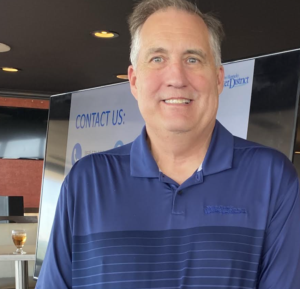
The daily and monthly price of water for the average customer is still a good buy when compared to other utilities, he explained.
“The daily cost is approximately $1.48 a day; about 200 gallons, based on estimated usage of 4,000 gallons per month,” he said. “It’s less than a soft drink, a bottled water, or even a cup of coffee.”
Harrison is closing in on 40 years in the water business, working for the Water District. He has a Bachelor of Science degree in Civil Engineering from the University of Kentucky and is a licensed professional engineer in the Commonwealth.
The group he manages is responsible for the asset management, project design and
implementation of water main distribution, including water main maintenance and
operations, and facility improvements.
In fact, engineering has been in Harrison’s genes.
“I started out with a Transportation Scholarship, and after three-and a half years I moved to the Kenton County Water District,” he told the Northern Kentucky Tribune. And his brother worked as a Highway Department Engineer, and pops did the same. In fact, his dad did some work for Procter and Gamble in New Castle, England, and young Richard attended fourth and fifth grade across the pond.
The strategic vision plan for the NKY Water District is plain and simple, according to HarrisonL To provide for a better community through safe, sustainable drinking water. And the mission – to meet and exceed regulatory standards and community expectations by efficiently providing safe, reliable, and affordable water.
The Northern Kentucky Water District is chartered under Chapter 74 of Kentucky
Revised statutes. “And,” added Harrison, “it is the largest water district in Kentucky; third largest water provider in Kentucky.”
• Louisville Water: Serves approximately 1,000,000
• Kentucky American Water (Lexington): Serves approximately 500,000
• Northern Kentucky Water District: Services approximately 300,000
The NKWD has a 231 square mile service area, 88,000 active accounts approzimately 182 employees and a $68.5 million operating revenue, according to
Harrison’s figures.
Water treatment plants are located in Fort Thomas, Memorial Parkway and Taylor Mill.
And the treatment process, according to Harrison, is aa three phase process:
Phase 1
• Ohio River Intake
• Pre-Treatment
• Raw Water Storage
Phase 2
• Rapid Mixing
• Sedimentation
• Filtration
Phase 3
• Activated Carbon
• UV Disinfection
• Final Disinfection
The finished water goers to customers.
“This time of year,” says Harrison, “there usually is a musty smell in water. Not in Northern Kentucky thanks to the carbon.”
Yet, there are challenges, especially when 10.08 billion gallons of NKWD water was produced last year.
The 1,330 miles of water main is affected by aging infrastructure, unfunded mandates and emerging contaminant, he noted.
“Aging infrastructure and main breaks are our biggest challenge,” Harrison said, “and new regulations are a close second.”
Harrison makes the water main breaks a somewhat happier experience for his staff. We‘ll have a contest for a photo of the best break,” he said. “We’ll take the winning photo to Sam’s for a cake molded just like the winning photo.”
That’s the easy part. When you have over 127,000 pipe segments and over 380 miles 50 years or older, main breaks – especially in winter – are quite frequent.
As for Emerging Contaminants, the list of emerging ones is ongoing and growing,
Harrison noted.
“It can now measure parts per trillion as compared to operates per billion,” he said.
Drinking water, he noted, including bottled water, may reasonably be expected to
contain at least mensural amounts of some of these compounds. Their presence does not necessarily indicate that water poses a health risk.
In April 2023, NKWD conducted testing and all 29 PFAS – a group of man-made
chemicals used in commercial products – included in the test, including GenX, were below detectable levels.
So, have a cold glass of water.