












By Al Cross
Special to NKyTribune
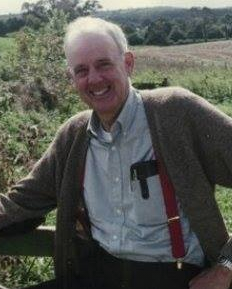
Wendell Berry, who fostered international movements for local food and sustainable agriculture from his Henry County farm, died peacefully there on Monday, August 31, at the age of 92.
Berry was a poet, novelist and essayist, but preferred to be called merely a writer, and even more so a farmer, said his daughter Mary Berry, who carries on his legacy at a New Castle center dedicated to “small farmers, land-conserving communities and healthy regional economies.”
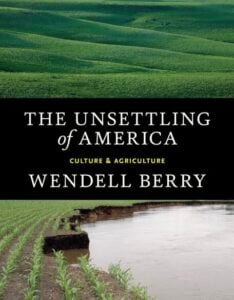
Berry’s seminal work was his 1977 book, The Unsettling of America: Culture and Agriculture, which was highly critical of industrialized agriculture and federal farm policy, which he said was devastating soil, water and rural communities.
“The true measure of agriculture is not the sophistication of its equipment the size of its income or even the statistics of its productivity but the good health of the land,” he wrote. “We now have more people using the land (that is, living from it), and fewer thinking about it than ever before. We are eating thoughtlessly, as no other entire society ever has been able to do.”
Berry’s pithiest quote was “Eating is an agricultural act,” which held drive the local-food and small-farm movements. In the early 1990s, the number of farms in the United States, which had been declining for decades, plateaued – and actually rose in some years as the century turned. In 2009, the new U.S. administration embraced agricultural sustainability, and President Obama presented Berry with the National Humanities Medal in 2011.
But in that year and every year since, the number of U.S. farms has declined while the average farm size has increased. Still, at a time when only 2 percent of the U.S. population is engaged in agriculture, and most Americans have little contact with nature, Berry’s work reminds many of the value of conserving soil and water for future generations.

Berry said he was building on the work of other agricultural thinkers and his father, John M. Berry Sr., who helped create the now-repealed federal tobacco program and the farmers’ cooperative that helped administer it, and brother John Berry Jr., who succeeded their father at the co-op after being majority leader of the state Senate.
Berry was a Kentuckian by birth and by choice. After earning English degrees from UK, he was a creative-writing fellow at Stanford University, taught at New York University and lived in Greenwich Village. But he and his wife Tanya came back to Kentucky, where he taught at UK, and then to live and work on a 60-acre subsistence farm along the Kentucky River, abandoning what he called “the headlong pilgrimage after money and comfort and prestige.”
Mary Berry said, “He loved the life he led. He was deeply devoted to my mother, and thought she was the one who made it possible by coming to Henry County and making a home here.” His son Pryor, who goes by “Den,” also farms, as do Berry and her husband Steve Smith. “What Daddy showed us is that it’s possible to do good work, to enjoy a life, to be endlessly fascinated with one particular place,” even just 60 acres,” she said. “Daddy was fascinated by it until the day that he died.”
Berry wrote 52 books, including 12 novels set in a place called Port William, modeled after Port Royal, where he had P.O. Box 1, and other Henry County communities. The Memory of Old Jack (1974) is a monologue by a dying 92-year-old man recalling the signal events in his life and town; Jayber Crow (2000) is the story of a young man who aimed to become a minister but would up as the town barber and soothes his regrets of unrequited love with the stories of his customers.
In What are People For?, Berry said human purpose is tied to moral responsibility, including stewardship of community and the environment. His writings often had religious overtones, and he remained a follower of Christ, in whom he had professed faith as a youth, but he was not a fan of organized religion. The editor-in-chief of Christianity Today, Russell Moore, said when Berry died, “No writer in my lifetime has more shaped my life and thought.”
Berry’s dislike of things modern – he refused to buy a computer and wrote in longhand – led some critics to call him a crank, but his daughter said, “We ought not be judged cranky or curmudgeonly because we say ‘This isn’t good.’ He was accused of wanting to go back. He said ‘I’m not trying to do something impossible.’”
Delivering the Thomas Jefferson Lecture in the Humanities in 2012, Berry acknowledged he was fighting a rearguard action: “The two great aims of industrialism, replacement of people by technology and concentration of wealth into the hands of a small plutocracy, seem close to fulfillment. At the same time the failures of industrialism have become too great and too dangerous to deny. Corporate industrialism itself has exposed the falsehood that it ever was inevitable or that it ever has given precedence to the common good.”
Berry had a role in steering Kentucky’s agricultural future in 2000, when Gov. Paul Patton was planning how to spend the money the state would get from the national settlement with cigarette manufacturers. After Berry and his brother actively participated in a planning session in Shelbyville, the Governor’s Office of Agricultural Policy invited him to a statewide “summit,” recalled John-Mark Hack, the director of the office at the time.
“He brought a moral conscience to the conversation about the long-term future of Kentucky that no one else was able to bring,” Hack said in an interview. Part of that was a strong objection to using any of the money to develop biotechnology, a suggestion of Lee Todd, UK president at the time.
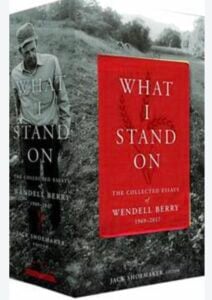
However, the meeting gave Berry and new Agriculture Dean Scott Smith a chance to meet, and that grew into a friendship – and Berry’s attendance at the college’s 2005 symposium on the future of Kentucky agriculture in the wake of a 10-year grower buyout that ended the tobacco program. Other speakers included other nationally known advocates of local food systems and sustainable agriculture.
Berry helped steer the college toward more service to small farmers. “Many of the faculty, staff and students in the ag college working on challenges of conservation, sustainable ag, local food systems and rural economic development have been influenced and sometimes inspired by Wendell Berry’s words, as I have been over the last three decades,” said Smith, who was dean when the college’s name was changed in 2013 to the College of Agriculture, Food and Environment. “He had a very, very significant influence.”
But Berry broke with UK as a whole in 2009, telling the university that he was dropping his plan to leave his papers there because the athletic program had accepted $7 million from the coal industry for a basketball-team dormitory named Wildcat Coal Lodge.
In 2020 he successfully sued UK to keep it from removing a historical mural, done by his wife’s aunt, that depicted the subjugation of Black farm workers in a way that some students said honored slavery: bent over working a crop, probably tobacco. That’s history, Berry argued: “It’s on their backs that the whole of society was built” in the state.
A descendant of enslavers on both sides of his family, Berry acknowledged years earlier that “the crisis of racial awareness [was] fated to be the continuing crisis of my life. . . . The reflexes of racism … are embedded in my mind as deeply at least as the language I speak.” He wrote The Hidden Wound about race in America.
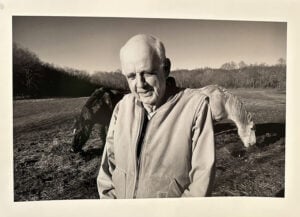
In his later years, Berry returned to the activism of his younger days, when he fought a proposed dam in the Red River Gorge and protested the Vietnam War. He was the star of a weekend occupation of the Kentucky governor’s office to protest mountaintop-removal strip mining of coal in 2011.
While Berry’s views were generally liberal, he was enough of an old-school conservative that in 2012 he received the Russell Kirk Paideia Prize, named for the author of The Conservative Mind and awarded by the CiRCE Institute, which promotes Christian classical education, for “cultivating virtue and wisdom.” When a writer for the conservative magazine National Review interviewed him on the occasion, he was self-reflective: “It’s been an extraordinarily rich life.”
When Berry died, he received praise from both sides of the political spectrum. Democratic Gov. Andy Beshear wrote, “His writing reminded us to live simply and to love our neighbors.” Berry’s congressman, Republican Thomas Massie, posted this: “He protested the Vietnam War, factory farming, and mountaintop removal. He was loved by many of us for his writings on honest sustainable farming and conservation of the land.”
The Kentucky Natural Lands Trust said of Berry, “He reminded us all regularly through his writings we are a part of the broader community of life and that ‘The earth is what we all have in common’.”
Mary Berry said her father’s funeral and burial will be private, but “at a later date” The Berry Center will hold a memorial service and celebrate the 50th anniversary of The Unsettling of America.
Al Cross was founding director of the Institute for Rural Journalism at the University of Kentucky, where he is a professor emeritus (retired) of journalism. This story was originally written for the Henry County Local.