












By Paul A. Tenkotte, PhD
Special to NKyTribune
Dr. Gladys L. Rouse of Boone County, shattered many barriers in the traditionally male-dominated field of medicine. She became the county’s first female physician, paving the way for future generations of women in healthcare. She also achieved the remarkable feat of earning her medical degree after giving birth to a child, an accomplishment that was highly uncommon in the early 20th Century.
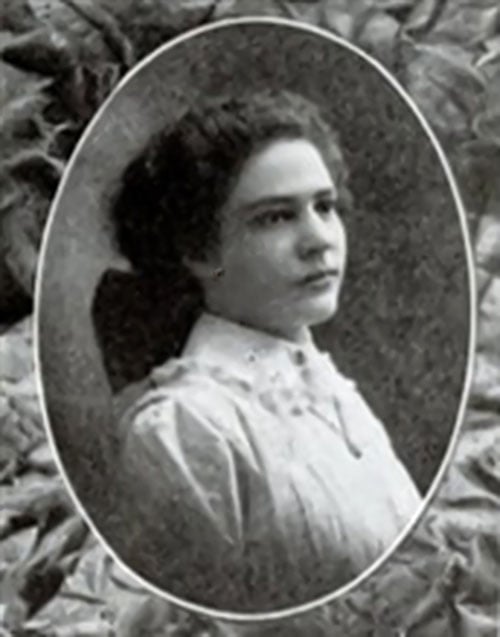
During World War II, when many local physicians were serving in the military, Dr. Rouse expanded her practice to treat adult male patients. At a time when women physicians were typically limited to caring for women and children, her service demonstrated both her skill and her determination to transcend the era’s gender expectations.
Gladys Rouse was born on March 28, 1892, in Boone County, to Silas J. Rouse and Emma V. Meyer Rouse. She attended elementary school in Boone County and later graduated from Covington High School, then Northern Kentucky’s premier secondary school. Rouse went on to earn an undergraduate degree from the University of Cincinnati. After completing her studies, she spent a year teaching school in St. Petersburg, Florida, before returning to Kentucky to marry her third cousin once removed, Robert Bernard Rouse (1891–1974).
The Rouse family were early migrants to Boone County, part of the Germanna Colony settlers from Virginia. They were among the founders of Hopeful Lutheran Church in Florence. Gladys Rouse’s great-great grandfather was Jacob Rouse (1757–1833), the younger brother of her husband Robert’s great-great-great grandfather, Samuel Rouse (1752–1834). Both Jacob and Samuel Rouse were veterans of the American Revolutionary War. They settled in Boone County in the early 1800s.
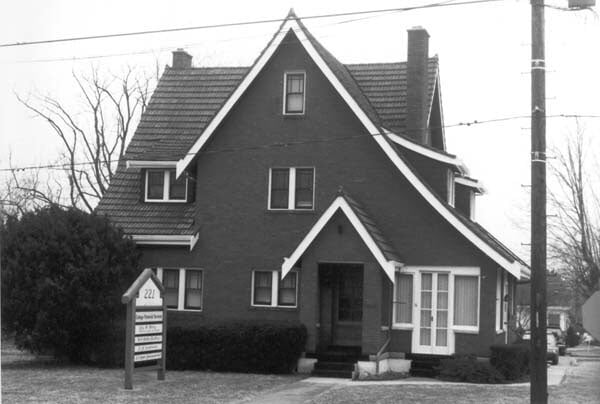
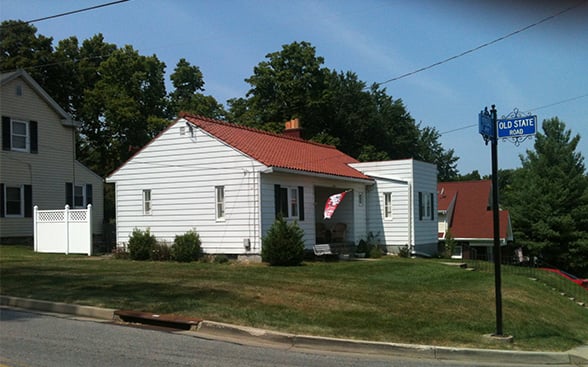
In February 1917, Gladys gave birth to the couple’s only child, Robert “Bobbie” Meyer Rouse (1917–1971). She entered the Cincinnati College of Medicine, earning her medical degree in 1923. Dr. Rouse set up her medical practice in Boone County in 1924. Her home and office, at 221 Main Street in Florence, was built in the 1920s and was added to the National Register of Historic Places in 2005.
Throughout her career, Dr. Rouse was deeply engaged in civic and public health initiatives. She participated in vaccination and immunization programs for schoolchildren, Diabetes Detection Week, and served as Boone County supervisor for the Sabin oral polio vaccine campaign. She also served as a director of the Boone County Chapter of the American Cancer Society. In addition, Dr. Rouse held medical staff appointments at both St. Elizabeth Hospital in Covington and The Christ Hospital in Cincinnati.
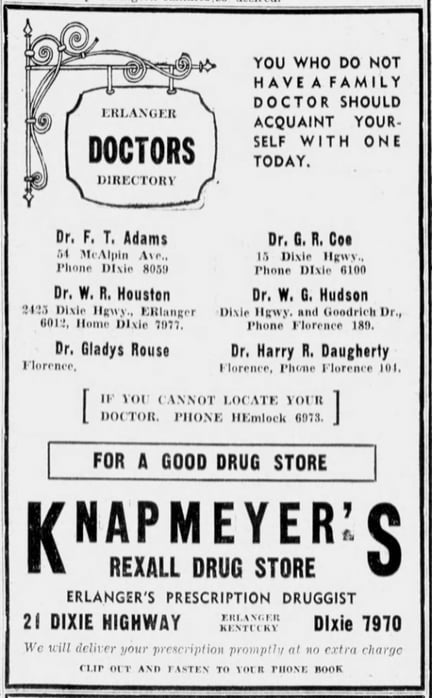
From 1924 until her retirement in 1964, Rouse was a general practitioner, principally serving women and children. She delivered many babies in the county, some of whom attended the community’s celebration of her career at Boone County High School in November 1966.
Patients frequently expressed appreciation for Dr. Gladys Rouse’s dedication and commitment to her work. One former patient, Janis Broering, recalled that Dr. Rouse cared for her mother during her pregnancy in 1947. Although Janis was born before Dr. Rouse arrived at St. Elizabeth Hospital in Covington and was delivered by an intern, Dr. Rouse later declined payment for her services and instead suggested that Janis’s father compensate the intern, who received $10. Broering also noted that Dr. Rouse had delivered her brother in 1944 (Janis Broering, email to Paul A. Tenkotte, July 29, 2026).
Janis also recalled that Dr. Rouse “made many house calls to our home. I remember her bringing in her black doctoring satchel. All I remember that was in it was a stethoscope, but I’m sure it contained a treasure of medicine and medical devices.”
Broering continued, “I have a few memories of her office. One was that she had a large, taxidermic sail fish hanging in her waiting room. It always frightened me. One evening, my brother fell off a horse, and my Dad knew he would need a tetanus shot. We went immediately to her home, and she let us in, even though it was not during office hours, and she got the shot ready. But we had to put in some effort to get my brother ready. He took off running out her office. I also remember an incident when I fell in some gravel and injured my knee. Again, we went to her home and she let us in, not during office hours, and she managed to take the gravel out of the wound. I still have a scar from that injury.”
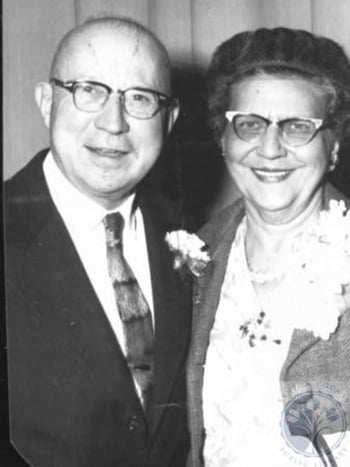
On December 17, 1970, Dr. Gladys Rouse died at St. Elizabeth Hospital in Covington, from complications of a heart condition. The editorial page of the “Kentucky Post” articulated her impact: “She was physician, friend, wife and mother. And in none of these areas of tremendous concern was Dr. Gladys L. Rouse lacking.”
Dr. Rouse began her practice when Boone County was still a rural area. Forty years later, when she retired, it was becoming a fast-growing suburban community. Medicine had likewise changed. House calls to patients’ homes were diminishing quickly. Combined office-home doctor’s facilities were also disappearing. Yet, the memories remained of her medical prowess as well as those other skills that country doctors had offered in abundance—”advice, counsel or just the warmth of an understanding presence.” Those skills, the “Kentucky Post” editors proclaimed, “she practiced until the day a tired heart gave out” (“Dr. Gladys Rouse,” “Kentucky Post,” December 22, 1970, p. 8).
For further information on country doctors, see Our Rich History: By the 1940s, the country doctor was becoming a relic of the past.
Paul A. Tenkotte, PhD is Editor of the “Our Rich History” weekly series and Professor of History at Northern Kentucky University (NKU). To browse past columns, click here. Tenkotte also serves as Director of the ORVILLE Project (Ohio River Valley Innovation Library and Learning Engagement). For more information see orvillelearning.org. He can be contacted at tenkottep@nku.edu.